By Karalee Greer  | WBN News - Vancouver | September 9, 2026
Subscription to WBN and being a Contributor is
Free

For decades, one of the most difficult parts of cleaning our oceans has been the garbage we can't see.

Plastic, tires, fishing gear and other debris can sink below the surface and settle on the seafloor, where removing it is difficult, expensive and sometimes dangerous for human divers.

Now a European research project is showing that robots may be able to help.

SeaClear2.0 is developing a team of intelligent robotic vessels that can search for, identify and retrieve marine litter from beneath the water.

And unlike many futuristic environmental ideas, this technology is already being tested in real waterways.

A Team Of Robots Working Together

SeaClear2.0 isn't simply one underwater robot.

It's an entire robotic cleanup team.

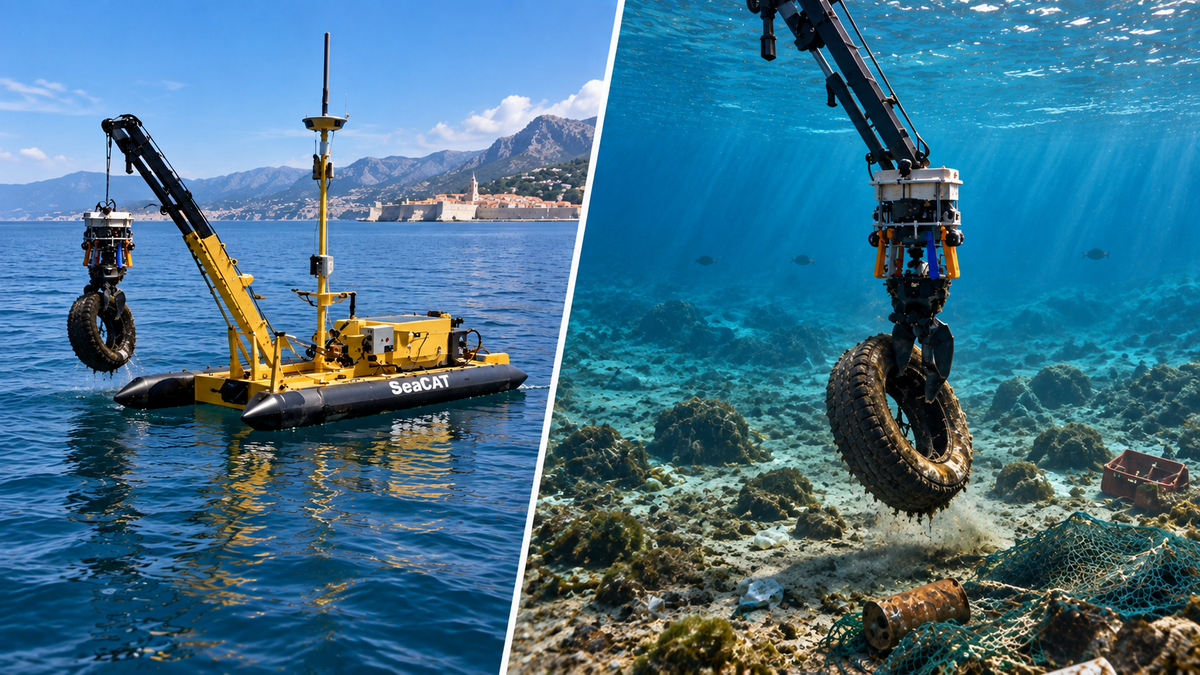
An uncrewed surface vessel called SeaCAT serves as the central hub. A compact underwater vehicle called Mini TORTUGA maps the seafloor and searches for debris.

Once litter has been identified, another robot equipped with a Smart Grapple can retrieve objects from below.

Above the water, a tethered aerial drone called SeaHawk helps locate areas where litter has accumulated. Small surface drones called SeaBees can work together with a net to collect floating garbage.

Another vessel, SeaDragon, helps transfer collected waste.

Artificial intelligence helps the system identify and classify litter and coordinate the different machines.

It Has Already Picked Up A Tire

One of the project's important demonstrations took place at the Port of Hamburg in Germany in May 2025.

The robots successfully detected a large tire on the bottom of the port, grabbed it, lifted it and transported it to shore automatically, according to the European Commission.

Since then, the project has continued testing the technology under very different underwater conditions.

Trials and demonstrations have taken place in locations including Marseille, Larnaca, Venice and Dubrovnik.

That's important because underwater visibility can vary enormously. A system that performs well in clear Mediterranean water also needs to cope with murky ports and harbours if the technology is eventually going to be useful around the world.

Reaching Places That Are Difficult To Clean

The scale of underwater garbage is enormous, although estimates vary.

Fraunhofer researchers cite estimates of 26 million to 66 million tonnes of waste in the world's oceans, with more than 90 per cent believed to lie on the ocean floor.

Traditional underwater cleanup has depended heavily on human divers, making the work difficult and costly.

SeaClear2.0 is being designed to operate as deep as 100 metres and retrieve individual pieces of debris weighing up to 250 kilograms.

The larger SeaCAT vessel can carry up to 500 kilograms and has a maximum operating endurance of 10 days under specified conditions.

That could eventually allow robotic systems to tackle debris that is particularly difficult for conventional cleanup teams to reach.

Artificial Intelligence Goes Underwater

Finding garbage underwater is more complicated than simply pointing a camera at the seabed.

Water can be dark or cloudy. Currents move objects and robots. Natural objects can resemble human-made debris.

Researchers are therefore combining robotics with artificial intelligence.

A peer-reviewed 2026 paper involving the SeaClear research team describes the use of deep-learning computer vision to identify underwater litter, along with navigation and control technologies that allow multiple robotic vehicles to work together.

The researchers have tested the system in real underwater environments.

Cleaning Up Without Damaging The Environment

Removing garbage from the ocean floor presents another challenge.

Not everything that looks like garbage should necessarily be pulled out immediately.

An object that has been underwater for years may have become part of a marine habitat.

SeaClear2.0 says potential effects on the seafloor and marine wildlife are evaluated before litter is collected. The project also looks at what can be done with recovered material, including sorting, recycling and repurposing it where possible.

That makes the project about more than building a robotic garbage collector.

Researchers are trying to develop a complete system for identifying, evaluating, collecting and dealing with marine litter.

Humans Are Still Part Of The Picture

Despite the project's use of the word autonomous, humans haven't disappeared from the process.

The European Commission's 2026 assessment notes that operations still require a qualified operator on site who can command the operation and intervene in an emergency.

That distinction is important.

SeaClear2.0 isn't yet a fleet of robots independently roaming the world's oceans picking up garbage.

It is developing and demonstrating technology that could eventually make marine cleanup safer, more efficient and less dependent on sending divers underwater.

From The Mediterranean To Other Oceans

SeaClear2.0 is primarily a European initiative and has a particular focus on the Mediterranean.

But researchers are designing the technology with wider use in mind.

The project has expanded testing and related work to additional regions, while technology developed through the program has also attracted commercial interest outside Europe. The European Commission reports that project partner Subsea Tech secured a contract to supply a Japanese marine survey company with an uncrewed surface vessel based on the SeaClear2.0 system.

SeaClear2.0 itself is a roughly €9.1-million project, including almost €8 million in European Union funding. It began in January 2023 and is scheduled to run through the end of 2026.

Could Technology Like This Eventually Help Canada?

For a coastal city like Vancouver, the project is particularly interesting.

British Columbians live beside an enormous marine environment where protecting shorelines, harbours and wildlife is part of everyday life.

SeaClear2.0 is not currently a Vancouver cleanup program, and there is no indication that these particular robots are headed for our waters.

But the technology demonstrates what may become possible.

Robotic systems capable of identifying and retrieving underwater debris could someday provide another tool for ports, municipalities and environmental organizations dealing with marine pollution.

The important word is could.

SeaClear2.0 is still a research and demonstration project, and questions about cost, reliability, environmental impact and large-scale deployment remain.

Why It Matters

Environmental news can sometimes leave us feeling that the problems are simply too large to solve.

SeaClear2.0 offers a more hopeful story.

Scientists, engineers, governments and communities are taking technologies originally developed for other purposes — robotics, drones, artificial intelligence and computer vision — and applying them to one of the world's most stubborn environmental problems.

The robots won't solve ocean pollution by themselves.

Preventing garbage from entering our oceans in the first place remains essential.

But if we can combine prevention with better ways of removing the waste already there, technology may give us another reason to be optimistic about the future of our oceans.

And sometimes, a little good news is exactly what we need.

Sources

  • CNN
  • European Commission
  • SeaClear2.0
  • Fraunhofer Center for Maritime Logistics and Services
  • Delft University of Technology
  • Engineering Applications of Artificial Intelligence

By Karalee Greer  | WBN News - Vancouver
LinkedIn:
 https://www.linkedin.com/in/karalee/
Subscription to WBN and being a Contributor is Free

Tags: #Marine Pollution #Artificial Intelligence #AI Robotics #Environmental Innovation #Plastic Pollution #Climate and Environment #WBN News #Karalee Greer

Share this article
The link has been copied!