
On This Week | September 21–27, 2026: Moments That Shaped Our World
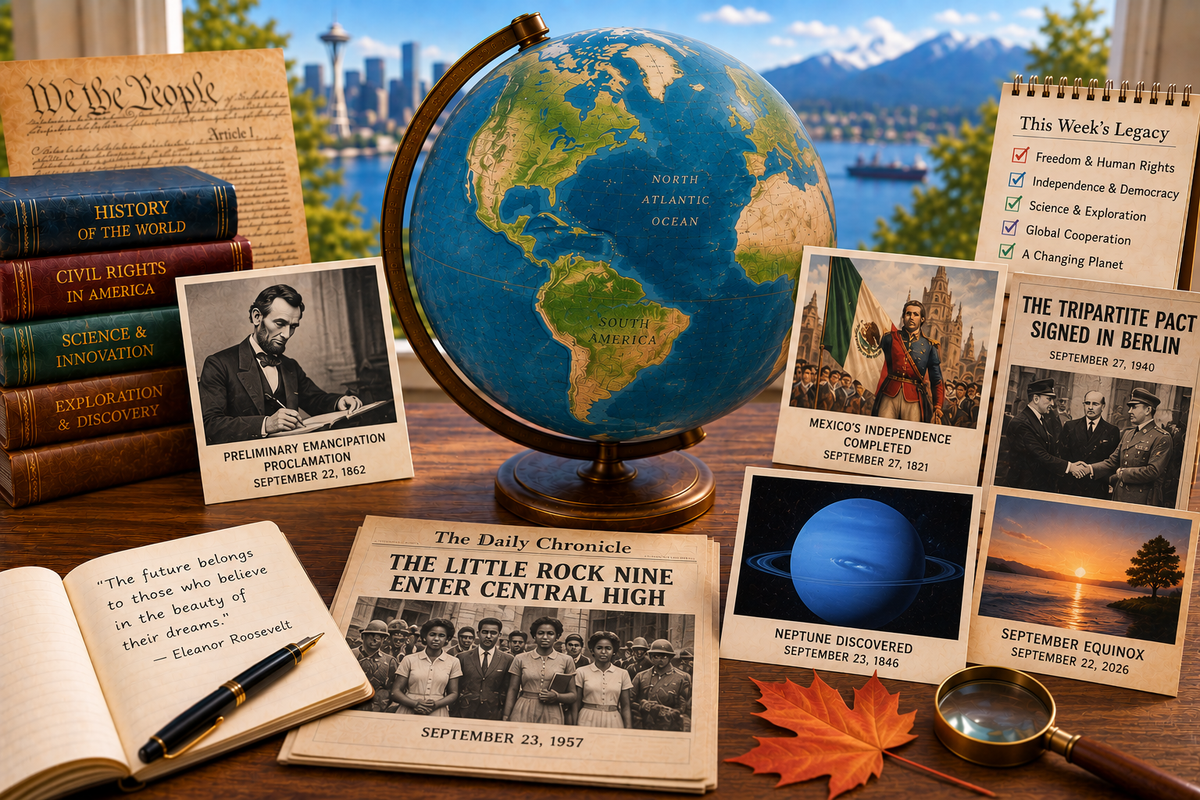
From emancipation and the Little Rock Nine to Mexican independence, Neptune and the equinox, September 21–27 changed our world.




From emancipation and the Little Rock Nine to Mexican independence, Neptune and the equinox, September 21–27 changed our world.
By Karalee Greer | WBN News - Vancouver | Sept 21-27, 2026
Subscription to WBN and being a Contributor is Free
Editor’s Note: “On This Week” features the strongest verified historical events connected to each calendar week. Historical significance takes priority over including every region equally.
Some weeks in history are linked by a common idea. September 21 to 27 is a week of freedom—and the struggle required to achieve and protect it.
Abraham Lincoln announced that enslaved people in states still rebelling against the United States would be declared free. Nine Black teenagers confronted segregation in Little Rock and entered their high school under federal military protection. Mexico completed the long struggle that ended Spanish colonial rule.
Elsewhere, alliances were formed that helped widen a world war, while astronomers achieved something extraordinary: they discovered a planet not simply by looking for it, but by first predicting mathematically where it ought to be.
And as autumn begins in the Northern Hemisphere, new scientific measurements from both poles offer another reminder of how much our planet continues to change.
On September 21, 1981, Belize became an independent nation, ending more than a century of British colonial rule.
Formerly known as British Honduras, Belize had moved gradually toward self-government before independence. The new nation remained a member of the Commonwealth.
Independence did not resolve every issue surrounding the country's sovereignty. A longstanding territorial dispute with neighbouring Guatemala continued after 1981 and remains part of the countries' relationship today.
Yet September 21 marked the point at which Belize assumed responsibility for its own government and international affairs, and it remains the country's Independence Day.
On September 22, 1862, President Abraham Lincoln issued the Preliminary Emancipation Proclamation.
Lincoln announced that on January 1, 1863, enslaved people in states or parts of states that remained in rebellion against the United States would be declared free.
The proclamation did not immediately free every enslaved person in the country. It applied specifically to areas still in rebellion and therefore excluded slaveholding border states that remained in the Union and certain other areas.
Its importance was nevertheless enormous.
The Civil War had initially been fought by the Union primarily to preserve the United States. The proclamation increasingly placed the destruction of slavery at the centre of the Union war effort.
One hundred days later, Lincoln issued the final Emancipation Proclamation.
On September 23, 1957, nine Black students entered Central High School in Little Rock, Arkansas, as the United States confronted one of the most visible tests of school desegregation.
A hostile crowd gathered outside the school and became increasingly violent. Police ultimately removed the students for their safety.
The confrontation forced President Dwight D. Eisenhower to intervene.
On September 24, Eisenhower ordered members of the U.S. Army's 101st Airborne Division into Little Rock and federalized the Arkansas National Guard. The following morning, September 25, federal troops escorted the Little Rock Nine through the doors of Central High for their first full day of classes.
The nine students were Minnijean Brown, Terrence Roberts, Elizabeth Eckford, Ernest Green, Thelma Mothershed, Melba Pattillo, Gloria Ray, Jefferson Thomas and Carlotta Walls.
Their courage turned a local school into a national test of whether constitutional rights and federal court decisions would actually be enforced.
Last week's article marked September 16, 1810, when Miguel Hidalgo's call for rebellion began Mexico's independence struggle.
This week brings the other end of that story.
On September 27, 1821, the Army of the Three Guarantees entered Mexico City, effectively completing Mexico's long struggle for independence from Spain.
The achievement followed more than a decade of war and political upheaval. Agustín de Iturbide and insurgent leader Vicente Guerrero had formed an alliance earlier in 1821 around the Plan of Iguala.
The following day, Mexico's Declaration of Independence was signed.
Together, September 16 and September 27 represent two ends of an extraordinary eleven-year struggle: the call for independence and its eventual achievement.
On September 27, 1940, Germany, Italy and Japan signed the Tripartite Pact in Berlin.
Germany and Italy recognized Japan's leadership in establishing a new order in East Asia, while Japan recognized German and Italian leadership in Europe. The three governments also agreed to assist one another politically, economically and militarily under specified circumstances.
The agreement formally connected the three countries that became known as the principal Axis powers.
Its importance extended beyond Europe. The U.S. State Department's historical account notes that the agreement helped link the conflicts already unfolding in Europe and Asia.
Little more than a year later, after Japan attacked Pearl Harbor and Germany and Italy declared war on the United States, those regional conflicts had become part of a truly global war.
The discovery of Neptune is one of the most remarkable detective stories in the history of science.
Astronomers had noticed that Uranus did not move exactly as expected. Its unusual orbit suggested that the gravity of another, more distant planet might be affecting it.
French mathematician Urbain Le Verrier and British mathematician John Couch Adams independently calculated where that unknown planet might be.
On the night of September 23–24, 1846, astronomer Johann Gottfried Galle used a telescope at the Berlin Observatory to search near the location predicted by Le Verrier.
There it was.
Neptune was found only about one degree from its mathematically predicted position.
The discovery was extraordinary because scientists had essentially found a world through mathematics before confirming it through a telescope.
More than a century later, Voyager 2 transformed our understanding of Neptune during its 1989 flyby, discovering additional moons and confirming the existence of the planet's dark rings.
Another technological turning point arrived on September 26, 1960, when John F. Kennedy and Richard Nixon participated in the first televised U.S. presidential debate.
Television had already transformed entertainment and news. Now it was beginning to transform how voters encountered political candidates.
Approximately 90 percent of American homes had televisions by 1960, and the four Kennedy-Nixon debates drew enormous audiences.
The debate demonstrated that political communication was no longer simply about speeches, newspapers and radio. Appearance, presentation and performance on television had become part of modern campaigning.
Televised presidential debates subsequently became an established part of U.S. election campaigns beginning again in 1976.
This week's seasonal turning point occurred on September 22 at 5:05 p.m. Pacific time, when Earth reached the September equinox.
At that instant, the centre of the Sun crossed Earth's equatorial plane. Neither hemisphere was tilted more strongly toward the Sun, producing nearly equal periods of daylight and darkness around the world.
For Vancouver and the rest of the Northern Hemisphere, it marked the astronomical beginning of autumn. South of the equator, spring began.
But this year's change of seasons coincided with important new measurements from Earth's polar regions.
Scientists at the National Snow and Ice Data Center reported this week that Arctic sea ice likely reached its annual minimum on September 12 at 4.60 million square kilometres. That tied 2008, 2010 and 2025 for the 10th-lowest minimum in the nearly 48-year satellite record.
One statistic puts the longer trend into perspective: the last 20 years are the 20 lowest Arctic sea-ice extents recorded during the satellite era.
At the opposite end of the planet, Antarctic sea ice most likely reached its annual maximum on September 14 at 17.59 million square kilometres. If confirmed, it would be the third-lowest Antarctic maximum in the satellite record. Scientists caution that Antarctic ice can fluctuate around its seasonal peak, so that figure remains preliminary.
The equinox has been observed by human civilizations for thousands of years. Today, satellites allow us to observe something our ancestors could not: how Earth's frozen regions change from season to season and decade to decade.
It is a fitting connection between ancient skywatching and modern planetary science.
Series Note: “On This Week” explores significant global events, discoveries, turning points, and cultural milestones connected to each calendar week throughout the year
By Karalee Greer | WBN News - Vancouver
LinkedIn: https://www.linkedin.com/in/karalee/
Subscription to WBN and being a Contributor is Free
Tags: #WBN News #On This Week #World History #Karalee Greer #Interesting Facts #Global Events