By Karalee Greer  | WBN News - Vancouver | October 19 - 25, 2026
Subscription to WBN and being a Contributor is
Free

Editor's Note: “On This Week” features the strongest verified historical events connected to each calendar week. Historical significance takes priority over including every region equally.

From a stock market crash that shook the world to the founding of the United Nations, October 19–25 marks turning points in international relations, economics, and scientific discovery.

This week also remembers the Cuban Missile Crisis, a decisive naval battle in the Pacific, and the first photograph of Earth taken from space—an achievement celebrating its 80th anniversary in 2026.

History Around The World

The Americas

October 19, 1987 — Black Monday Shakes Global Markets

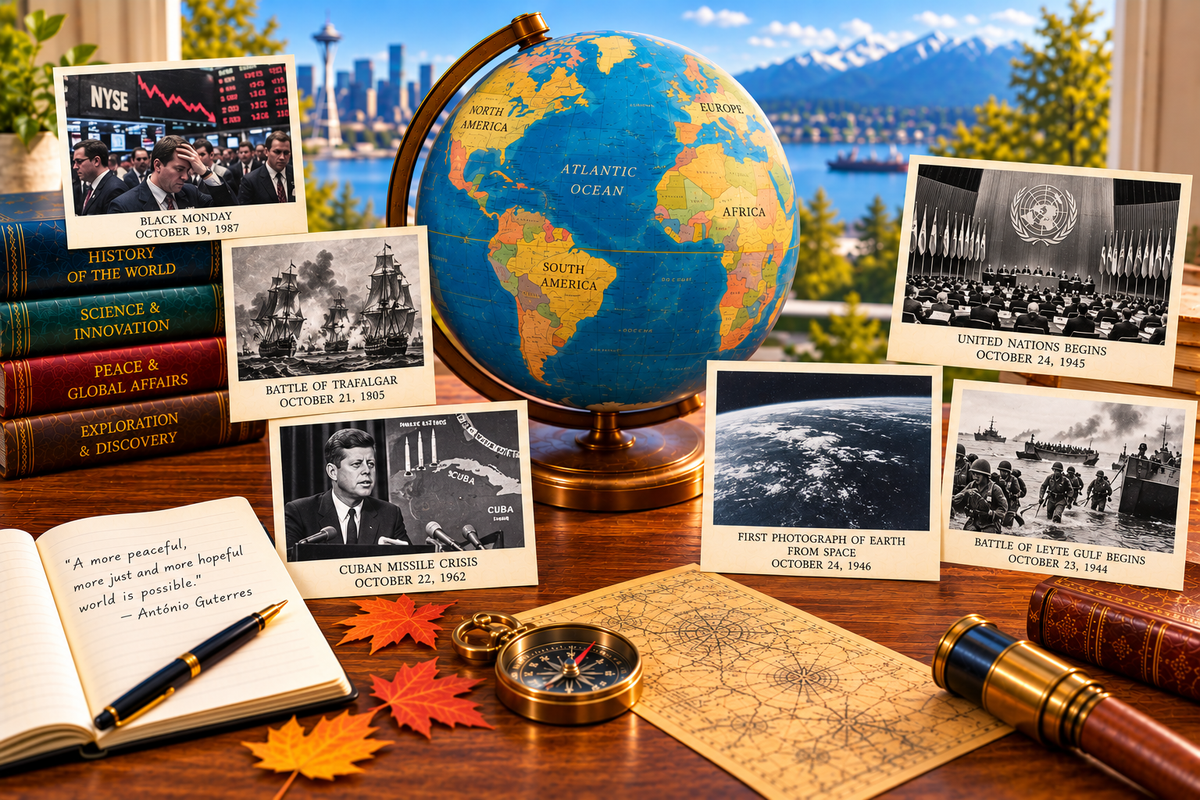
On October 19, 1987, stock markets around the world plunged, with the Dow Jones Industrial Average falling 22.6% in a single day.

Known as Black Monday, the crash exposed vulnerabilities in computerized trading and financial markets. It led to reforms, including trading halts designed to limit panic-driven market declines.

October 22, 1962 — The Cuban Missile Crisis Reaches The Public

On October 22, 1962, President John F. Kennedy announced that Soviet nuclear missiles had been discovered in Cuba, bringing the world dangerously close to nuclear confrontation.

Kennedy ordered a naval quarantine of Cuba while the United States and Soviet Union entered tense negotiations. The crisis ended days later through diplomatic agreements and remains one of the Cold War's most dangerous moments.

Europe

October 21, 1805 — The Battle Of Trafalgar

On October 21, 1805, the British Royal Navy defeated a combined French and Spanish fleet off the coast of Spain.

Admiral Horatio Nelson was mortally wounded during the battle, but the victory strengthened British naval dominance during the Napoleonic Wars and influenced the balance of power in Europe for decades.

Africa

October 19, 1986 — Mozambique's President Dies In A Plane Crash

On October 19, 1986, Mozambican President Samora Machel died when his aircraft crashed near the South African border.

Machel had led Mozambique since independence from Portugal in 1975. His death occurred amid regional tensions and conflict, and questions surrounding the crash continued for decades.

Asia & The Pacific

October 23, 1944 — The Battle Of Leyte Gulf Begins

On October 23, 1944, American and Allied naval forces engaged Japan in the Battle of Leyte Gulf, one of the largest naval battles in history.

The four-day battle severely weakened Japan's navy and helped secure the Allied return to the Philippines during the Second World War.

October 25, 1971 — China Takes Its Seat At The United Nations

On October 25, 1971, the UN General Assembly voted to recognize the People's Republic of China as China's representative at the United Nations, replacing the representatives of the Republic of China.

The decision transformed China's role in international diplomacy and remains central to debates about representation and Taiwan's international status.

Global Turning Points

October 24, 1945 — The United Nations Officially Begins

On October 24, 1945, the United Nations Charter came into force, formally establishing the United Nations following the devastation of the Second World War.

Created to promote peace, international cooperation, and human rights, the UN became a central institution in global diplomacy. October 24 is now celebrated annually as United Nations Day.

Science & Technology Watch

October 24, 1946 — The First Photograph Of Earth From Space

On October 24, 1946, a camera aboard a V-2 rocket captured the first photograph of Earth from space, approximately 105 kilometres above New Mexico.

The grainy black-and-white image marked the beginning of a new way of observing our planet, laying foundations for satellite photography, weather forecasting, and environmental monitoring.

October 24, 2026, marks the 80th anniversary of this achievement.

Weather & Nature Watch

October 21–22, 2026 — The Orionid Meteor Shower Peaks

The Orionid meteor shower reaches its peak this week, as Earth passes through debris left behind by Halley's Comet.

Under ideal dark skies, the shower can produce approximately 10–20 meteors per hour. However, bright moonlight will obscure some fainter meteors in 2026.

For the best chance of viewing, observers should look during the hours before dawn, preferably when the Moon is low or has set.

October 19–25 — Watching The Pacific's Changing Weather

Autumn brings increasing attention to Pacific storm systems and their potential effects on British Columbia.

Meteorologists monitor ocean temperatures, atmospheric pressure, and moisture patterns to assess developing storms and rainfall risks.

Modern satellite observations make this forecasting possible on a scale unimaginable when the first photograph of Earth was taken from space in 1946.

Series Note: “On This Week” explores significant global events, discoveries, turning points, and cultural milestones connected to each calendar week throughout the year

By Karalee Greer  | WBN News - Vancouver
LinkedIn:
 https://www.linkedin.com/in/karalee/
Subscription to WBN and being a Contributor is Free

Tags: #WBN News #On This Week #World History #Karalee Greer #Interesting Facts #Global Events

Sources

  • Federal Reserve History — Stock Market Crash of 1987
  • John F. Kennedy Presidential Library — Cuban Missile Crisis
  • Royal Museums Greenwich — Battle of Trafalgar
  • Encyclopaedia Britannica — Samora Machel
  • U.S. Naval History and Heritage Command — Battle of Leyte Gulf
  • United Nations — General Assembly Resolution 2758
  • United Nations — History of the United Nations
  • NASA — 90 Years of Our Changing Views of Earth
  • NASA — Orionids Meteor Shower
  • American Meteor Society — 2026 Meteor Shower Calendar
Share this article
The link has been copied!