
On This Week | September 14–20, 2026: Moments That Shaped Our World
From independence and voting rights to civil rights, ozone protection and Space Shuttle Enterprise, September 14–20 changed our world.




From independence and voting rights to civil rights, ozone protection and Space Shuttle Enterprise, September 14–20 changed our world.
By Karalee Greer | WBN News - Vancouver | August 24-30, 2026
Subscription to WBN and being a Contributor is Free
Editor’s Note: “On This Week” features the strongest verified historical events connected to each calendar week. Historical significance takes priority over including every region equally.
The week of September 14 to 20 brings together moments when people challenged political systems, expanded democratic rights, confronted racial hatred, protected the planet—and imagined entirely new ways of reaching beyond it.
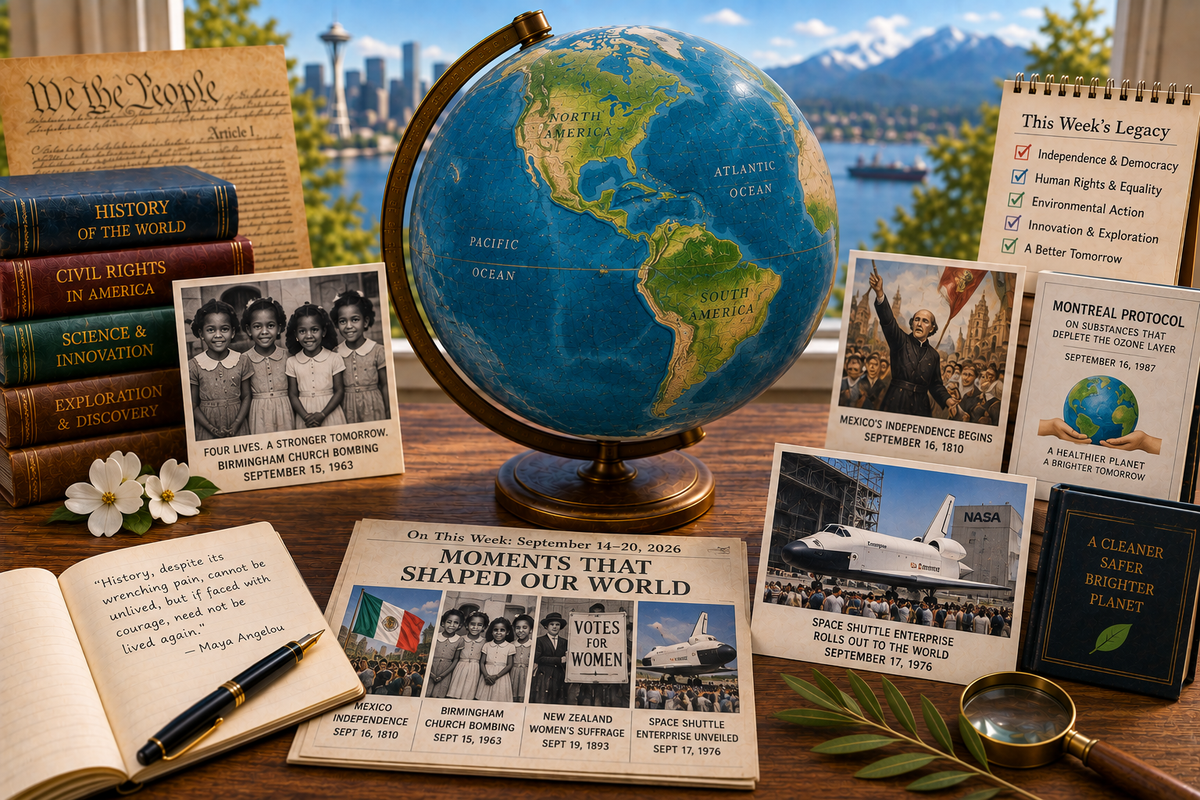
Mexico's struggle for independence began. Chile established its first national governing junta. New Zealand became the first self-governing country in the world to give women the right to vote in parliamentary elections. In Birmingham, Alabama, the murder of four young girls became one of the most painful turning points of the American civil rights era.
This week also gave the world an unusually hopeful environmental story. Nations gathered in Montreal and agreed to cooperate against a threat to Earth's protective ozone layer.
And 50 years ago this week, NASA rolled an extraordinary new spacecraft out of a California hangar: Space Shuttle Enterprise.
On the morning of September 14, 1814, after a 25-hour British bombardment of Fort McHenry in Baltimore, American soldiers raised a huge 15-star, 15-stripe flag above the fort.
From a ship in Baltimore Harbor, lawyer Francis Scott Key saw the flag and realized that the fort had survived the attack.
The sight inspired him to write the poem that became “The Star-Spangled Banner.” The song did not officially become the United States national anthem until 1931.
The original flag itself survives. Made by Baltimore flagmaker Mary Pickersgill and several assistants, including African American indentured servant Grace Wisher, it is preserved by the Smithsonian's National Museum of American History.
On Sunday morning, September 15, 1963, members of the Ku Klux Klan bombed Birmingham's 16th Street Baptist Church, an important gathering place for Alabama's Black community and the civil rights movement.
Four girls were killed: Addie Mae Collins, Denise McNair, Carole Robertson and Cynthia Wesley. Seventeen other people were injured.
The attack shocked the United States and the world.
Birmingham had experienced years of racist bombings and violence, but the murder of children generated particular outrage. The tragedy helped galvanize public support for the civil rights movement and contributed to the political momentum surrounding the Civil Rights Act of 1964.
More than six decades later, remembering their names keeps the human cost of the struggle against segregation at the centre of the history.
In the early hours of September 16, 1810, Catholic priest Miguel Hidalgo y Costilla summoned people in the town of Dolores and called for resistance to Spanish colonial rule.
The event became known as the Grito de Dolores, or Cry of Dolores, and is remembered as the beginning of Mexico's struggle for independence.
Independence was not achieved immediately. Years of warfare followed, and Mexico would not complete its separation from Spain until 1821.
Yet September 16—not the date on which independence was finally secured—became Mexico's Independence Day.
On September 17, 1787, delegates gathered in Philadelphia signed the United States Constitution.
Thirty-nine delegates ultimately signed the document. Three delegates present—George Mason, Elbridge Gerry and Edmund Randolph—refused, in part because of concerns including the absence of a bill of rights.
The Constitution created a new federal system with legislative, executive and judicial branches and replaced the much weaker framework of the Articles of Confederation.
It did not resolve many of the country's deepest contradictions, particularly slavery and the exclusion of large portions of the population from political participation. Nor did signing make the Constitution law immediately: nine states still had to ratify it.
Nevertheless, the document established the governmental framework under which the United States continues to operate.
On September 18, 1810, an open meeting in Santiago established Chile's First Government Junta.
The immediate circumstances were complicated. Napoleon's occupation of Spain had displaced King Ferdinand VII, creating a crisis of legitimate authority throughout Spain's American territories.
Chile's new junta initially declared loyalty to Ferdinand rather than outright independence. But the creation of a locally governed political authority became the opening of the process that ultimately led to Chilean independence.
That is why September 18 remains at the heart of Chile's annual national celebrations.
On September 19, 1893, Governor Lord Glasgow signed a new Electoral Act into law.
With that signature, New Zealand became the first self-governing country in the world in which women had the right to vote in parliamentary elections.
The achievement followed years of campaigning by suffrage organizations and leaders including Kate Sheppard. Petitions gathered in 1893 carried signatures representing nearly one-quarter of New Zealand's adult female population.
Women went to the polls in the general election later that year.
At a time when women remained excluded from national elections across most democracies, New Zealand's decision became an important international milestone in the expansion of political rights.
On September 16, 1987, nations adopted the Montreal Protocol on Substances that Deplete the Ozone Layer.
Scientists had discovered that chemicals including chlorofluorocarbons—better known as CFCs—were damaging the stratospheric ozone layer that helps protect life on Earth from harmful ultraviolet radiation.
Representatives gathered in Montreal from September 14 through 16 to negotiate an international response.
The agreement committed countries to control and eventually phase out major ozone-depleting substances.
What happened afterward makes this anniversary particularly important.
The Montreal Protocol became one of the world's strongest examples of countries responding collectively to scientific evidence about a global environmental threat. The ozone layer is now on a long-term path toward recovery.
It is a rare environmental story in which humanity identified a planetary-scale problem, negotiated international action—and changed course.
This week marks a particularly special anniversary.
Fifty years ago, on September 17, 1976, NASA publicly unveiled its first space shuttle orbiter, Enterprise.
The spacecraft rolled from Rockwell International's facility in Palmdale, California, before hundreds of invited guests and members of the media.
But Enterprise had an unusual story before it even appeared.
NASA originally intended to call the spacecraft Constitution. Then Star Trek fans mounted a letter-writing campaign asking that it instead be named Enterprise, after the fictional starship.
Nearly 100,000 fans wrote to the White House, according to NASA's 50th-anniversary account. President Gerald Ford supported the change. Star Trek creator Gene Roddenberry and members of the television cast attended the rollout.
Enterprise was never designed to travel into orbit. Instead, it became the test vehicle that helped engineers determine whether the shuttle could fly through Earth's atmosphere and land like an aircraft.
During the following year, Enterprise was carried aloft aboard a modified Boeing 747 and eventually released for a series of unpowered approach-and-landing tests. Those experiments helped pave the way for the operational shuttle fleet.
There is a wonderful coincidence in the date.
Enterprise made its debut on September 17—Constitution Day—during America's bicentennial year, while the spacecraft itself had originally been intended to carry the name Constitution.
Fifty years later, Enterprise remains an intriguing bridge between imagination and engineering: a fictional spacecraft inspired its name, while the real spacecraft helped prepare humanity for a new era of reusable spaceflight.
As September progresses, one of the most important global climate stories remains the rapid strengthening of El Niño.
The World Meteorological Organization's September update says El Niño is now firmly established and is expected to intensify into a very strong event in the coming months. Forecast centres show exceptionally strong agreement that El Niño will persist through February 2027.
El Niño begins with unusually warm surface waters across the tropical Pacific, but its effects extend far beyond that ocean.
Changes in the interaction between the ocean and atmosphere can shift rainfall and temperature patterns around the world, increasing the risk of drought in some regions while contributing to heavy rainfall and flooding in others.
This year's event is also developing in a world whose background temperatures have already been raised by human-caused climate change.
That combination matters.
El Niño itself is a natural recurring phenomenon. It does not cause climate change. But when a powerful El Niño adds additional heat to an already warmer climate system, the potential for extreme heat and disruptive weather can increase. WMO specifically warns of heightened risks of floods, drought and extreme heat as the event strengthens.
There is an interesting connection to another anniversary in this week's article.
The Montreal Protocol demonstrated that atmospheric problems that seem enormous are not necessarily beyond humanity's ability to address. Scientists identified the danger to the ozone layer, governments acted internationally, industries adapted—and the trajectory changed.
The climate challenge is vastly larger and more complicated, but the underlying lesson remains valuable: scientific knowledge can identify a global threat; what happens next depends on the choices societies make with that knowledge.
Series Note: “On This Week” explores significant global events, discoveries, turning points, and cultural milestones connected to each calendar week throughout the year
By Karalee Greer | WBN News - Vancouver
LinkedIn: https://www.linkedin.com/in/karalee/
Subscription to WBN and being a Contributor is Free
Tags: #WBN News #On This Week #World History #Karalee Greer #Interesting Facts #Global Events