
On This Week | September 28–October 4, 2026: Moments That Shaped Our World
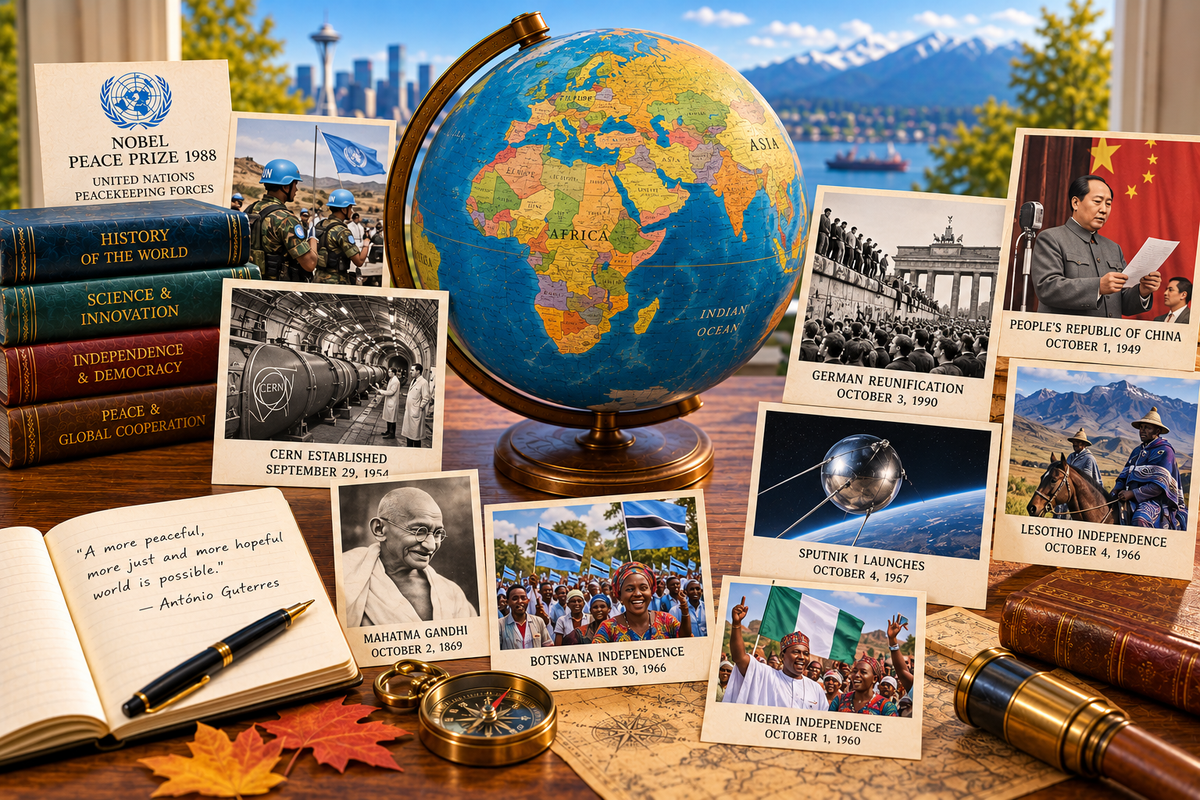
From German reunification and African independence to Gandhi, CERN and Sputnik, September 28–October 4 reveals moments that transformed our world.





From German reunification and African independence to Gandhi, CERN and Sputnik, September 28–October 4 reveals moments that transformed our world.
By Karalee Greer | WBN News - Vancouver | Sept 28 - Oct 4, 2026
Subscription to WBN and being a Contributor is Free
Editor’s Note: “On This Week” features the strongest verified historical events connected to each calendar week. Historical significance takes priority over including every region equally.
The seven days bridging September and October have witnessed some extraordinary turning points in world history.
Germany became one nation again after decades of Cold War division. China established a new government that would fundamentally reshape global politics. African nations celebrated independence from colonial rule, while an international organization devoted to scientific research began a journey that would eventually transform our understanding of the universe.
And on October 4, 1957, a small metal sphere launched into orbit changed humanity’s relationship with space forever.
This week reminds us that history is not simply about the rise and fall of governments. It is also about cooperation, scientific discovery, national identity, and the decisions that influence generations.
On September 29, 1988, the Norwegian Nobel Committee announced that the Nobel Peace Prize would be awarded to United Nations Peacekeeping Forces.
The decision recognized the contributions of international peacekeepers working to reduce tensions in regions affected by conflict.
Since the first UN peacekeeping operation in 1948, military personnel and civilian specialists from numerous countries had served in difficult and sometimes dangerous environments. Their responsibilities included monitoring ceasefires, helping maintain stability, and creating conditions in which diplomatic negotiations could proceed.
The award acknowledged an important reality: peacekeeping does not necessarily resolve the political disagreements underlying a conflict, but it can provide the stability needed for negotiations.
For Canada, with its long history of involvement in United Nations peacekeeping, the recognition carried particular significance.
The award remains an important reminder that maintaining peace can require sustained international commitment long after fighting has stopped.
On September 29, 1954, the convention establishing the European Organization for Nuclear Research, better known as CERN, officially entered into force.
The organization emerged from a remarkable idea following the devastation of the Second World War: European countries could rebuild scientific strength by working together rather than competing independently.
CERN was established near Geneva, Switzerland, with the goal of conducting fundamental research into the nature of matter and the universe.
Its founding represented more than the creation of another scientific institution. It demonstrated how countries that had recently been divided by war could cooperate in pursuit of shared knowledge.
Over subsequent decades, CERN developed into one of the world’s most important centres for particle physics.
Its researchers would eventually contribute to major discoveries about fundamental particles and the forces governing the universe.
CERN would also become the birthplace of the World Wide Web, developed by Tim Berners-Lee in 1989 to help scientists share information.
What began as a European scientific partnership ultimately influenced how people around the world communicate, conduct research, and exchange information.
On October 3, 1990, East and West Germany officially reunited, ending more than four decades of division following the Second World War.
After Germany’s defeat in 1945, the country had been divided into occupation zones that eventually developed into two separate states.
West Germany became a democratic republic aligned with Western Europe and the United States. East Germany became a socialist state closely aligned with the Soviet Union.
Berlin itself became one of the Cold War’s most recognizable symbols of division, particularly after construction of the Berlin Wall in 1961.
But political change accelerated across Eastern Europe during the late 1980s. The Berlin Wall opened on November 9, 1989, following mounting public pressure and growing demands for freedom of movement. Less than a year later, the two German states formally became one.
At midnight on October 3, 1990, reunification took effect and Germany’s division officially ended. Hundreds of thousands gathered in Berlin to celebrate.
Reunification was a defining moment in the peaceful transformation of Europe at the end of the Cold War. It also brought enormous economic, political, and social challenges as two very different systems began the long process of integration.
October 3 remains Germany’s national holiday, German Unity Day.
On October 1, 1949, Mao Zedong proclaimed the establishment of the People’s Republic of China in Beijing.
The announcement followed years of civil war between the Chinese Communist Party and the Nationalist government. The Communist victory brought most of mainland China under a new political system, while the Nationalist government retreated to Taiwan.
The establishment of the People’s Republic marked one of the most consequential political transformations of the 20th century.
China’s new government introduced sweeping changes to land ownership, economic organization, education, and political institutions. The country’s relationship with the Soviet Union, the United States, and other nations also became a major factor in Cold War diplomacy.
Over subsequent decades, China experienced profound political and economic changes. Beginning in the late 1970s, economic reforms helped transform the country into a major manufacturing and trading power. Today, China plays a central role in global commerce, technology, international diplomacy, and geopolitical competition.
The events of October 1, 1949, therefore continue to influence the political and economic relationships shaping the modern world.
On October 2, 1869, Mohandas Karamchand Gandhi was born in Porbandar, India. Gandhi would become one of the most influential figures in the struggle against British colonial rule.
His approach to political resistance emphasized nonviolence, civil disobedience, and the power of ordinary people to challenge injustice. India achieved independence in 1947, but Gandhi’s broader legacy remains closely associated with the belief that organized nonviolent resistance can bring political change.
Among his most famous campaigns was the 1930 Salt March, which protested British control over salt production and taxation.
Gandhi’s philosophy influenced civil rights and independence movements far beyond India. Leaders including Martin Luther King Jr. and Nelson Mandela drew inspiration from his ideas, although their movements developed within different political circumstances.
Recognizing his international influence, the United Nations designated October 2 as the International Day of Non-Violence.
The observance encourages education, tolerance, peaceful conflict resolution, and respect for human dignity.
On September 30, 1966, Botswana became an independent republic, ending British colonial administration of the territory previously known as Bechuanaland. At independence, Botswana faced significant economic challenges, including limited infrastructure and a largely rural population.
Sir Seretse Khama became the country’s first president.
The discovery and development of diamond resources subsequently transformed the country’s economy. Botswana became widely recognized for its comparatively stable democratic institutions and sustained periods of economic growth, although inequality and economic dependence on diamonds remain important challenges.
Its experience has frequently been studied as an example of how governance, natural resources, and economic policy can influence national development.
September 30, 2026, marked Botswana’s 60th anniversary of independence.
The anniversary celebrates six decades of national sovereignty while providing an opportunity to reflect on the country’s achievements and future challenges.
On October 1, 1960, Nigeria gained independence from Britain, becoming a sovereign nation. The new country brought together numerous ethnic, linguistic, and religious communities within a federal political system.
Sir Abubakar Tafawa Balewa served as Nigeria’s first prime minister.
Independence was a major milestone in the wave of African decolonization that transformed the continent during the 1950s and 1960s.
Nigeria subsequently experienced periods of military government, civil conflict, and democratic transition.
The country also became a major oil producer and an increasingly influential participant in African and international affairs.
Today, Nigeria is Africa’s most populous country and plays a significant role in regional politics, culture, commerce, and entertainment. Its film industry, Nollywood, and internationally successful music industry have helped bring Nigerian cultural expression to audiences around the world.
October 1 remains Nigeria’s Independence Day and an important occasion for reflecting on national identity and the country’s future.
On October 4, 1966, Lesotho became an independent kingdom, ending British colonial rule over the territory previously known as Basutoland.
The mountainous country is geographically unusual because it is completely surrounded by South Africa.
Its modern political identity developed from the kingdom established under King Moshoeshoe I during the 19th century. Lesotho retained its monarchy after independence, with King Moshoeshoe II becoming the country’s monarch at independence.
The country subsequently experienced periods of political instability and constitutional change while maintaining its distinct national identity.
Lesotho’s mountainous geography, cultural traditions, and relationship with neighbouring South Africa continue to shape its economy and society.
October 4, 2026, marked the country’s 60th anniversary of independence.
Together, Botswana and Lesotho provide two important examples of the African independence movements that transformed the continent during the 1960s.
One of the most extraordinary technological milestones in human history occurred on October 4, 1957.
That day, the Soviet Union successfully launched Sputnik 1, the world’s first artificial satellite, into orbit around Earth.
The spacecraft was remarkably simple by modern standards. It was a polished metal sphere approximately 58 centimetres in diameter, weighing about 84 kilograms. Four external antennas transmitted radio signals that could be detected by receivers on Earth.
Sputnik completed an orbit in roughly 96 minutes. Its significance was enormous. For the first time, humanity had successfully placed an artificial satellite into Earth orbit.
The launch demonstrated the Soviet Union’s growing technological capabilities and shocked many Americans.
It also intensified competition between the United States and Soviet Union, accelerating what became known as the Space Race.
The United States responded by expanding its own scientific and technological programs. In 1958, the U.S. government established NASA, which officially began operations on October 1 of that year. Within little more than a decade, the competition would help propel humans to the Moon.
Sputnik’s legacy extends far beyond the Cold War.
Today, satellites support navigation, weather forecasting, telecommunications, environmental monitoring, disaster response, and scientific research.
Every time someone checks a satellite weather image or uses GPS navigation, they are benefiting from technologies whose development accelerated during the early Space Age.
A small metal sphere launched in 1957 helped create the technological foundations of our connected world.
There is another interesting coincidence in this week’s history.
CERN was established on September 29, 1954. CERN advanced international cooperation in fundamental physics.
Sputnik 1 was launched on October 4, 1957. Sputnik demonstrated that humanity could operate beyond Earth’s atmosphere.
NASA began operations on October 1, 1958. NASA helped develop the scientific and engineering capabilities required for human space exploration.
Within just four years, three developments helped establish institutions and technologies that would transform modern science. Together, these milestones illustrate how quickly scientific ambition expanded during the middle of the 20th century.
As September gave way to October 2026, scientists continued monitoring El Niño conditions in the tropical Pacific Ocean.
El Niño develops when sea-surface temperatures become unusually warm across the central and eastern equatorial Pacific. These changes influence atmospheric circulation and can alter weather patterns thousands of kilometres away. Depending on the region, El Niño can contribute to drought, heavy rainfall, unusual temperatures, and changes in tropical cyclone activity.
Scientists caution that El Niño does not automatically determine the severity of weather in any particular location. Individual weather events depend on numerous interacting factors.
For communities, governments, farmers, and emergency planners, seasonal forecasts can nevertheless provide valuable information for preparing for possible flooding, drought, heat, and other weather-related risks.
Another important environmental development emerged from satellite observations of Arctic and Antarctic sea ice.
In September, the National Snow and Ice Data Center reported that Arctic sea ice likely reached its annual minimum on September 12, covering approximately 4.60 million square kilometres. That tied several previous years for the tenth-lowest minimum in the nearly 48-year satellite record.
More significantly, the centre reported that the 20 lowest Arctic sea-ice minimum extents have all occurred during the past 20 years.
At the opposite end of the planet, Antarctic sea ice appeared to have reached its annual maximum on September 14 at approximately 17.59 million square kilometres. If confirmed, that would represent the third-lowest Antarctic maximum in the satellite record.
Scientists emphasized that the Antarctic figure remained preliminary because sea ice can fluctuate around its seasonal maximum.
These measurements provide another example of the value of satellite technology. Before the Space Age, scientists had far fewer opportunities to observe changes across the planet’s remote polar regions.
Today, satellites provide consistent measurements that help researchers understand long-term environmental trends.
The connection to this week’s Sputnik anniversary is especially meaningful. In 1957, the launch of a single satellite demonstrated that humanity could reach orbit. Nearly seven decades later, satellites have become essential tools for understanding Earth’s atmosphere, oceans, ice, and climate.
The technology that once symbolized international competition now plays a vital role in international scientific cooperation.
Series Note: “On This Week” explores significant global events, discoveries, turning points, and cultural milestones connected to each calendar week throughout the year
By Karalee Greer | WBN News - Vancouver
LinkedIn: https://www.linkedin.com/in/karalee/
Subscription to WBN and being a Contributor is Free
Tags: #WBN News #On This Week #World History #Karalee Greer #Interesting Facts #Global Events