By Karalee Greer | WBN News - Vancouver | May 31-June 6, 2026
Subscription to WBN and being a Contributor is Free
History is often remembered through moments that shift the direction of nations, science, exploration, culture, and everyday life. The week of May 31 to June 6 includes military turning points, groundbreaking discoveries, political milestones, and achievements in exploration that continue to shape the modern world.
North America
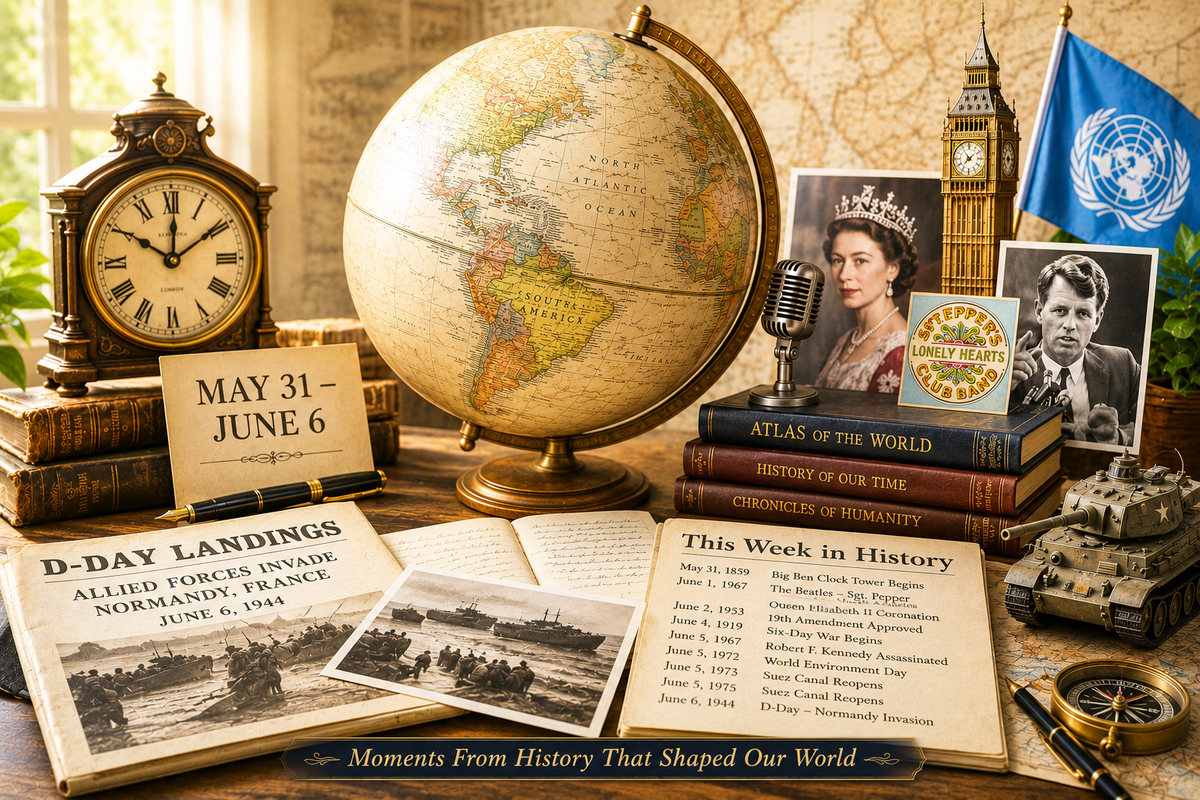
On June 1, 1967, The Beatles released Sgt. Pepper’s Lonely Hearts Club Band in North America, an album widely considered one of the most influential recordings in modern music history.
On June 4, 1919, the United States Congress approved the 19th Amendment to the Constitution, advancing women’s voting rights and marking a major step in American democratic history.
On June 5, 1968, U.S. Senator Robert F. Kennedy was assassinated in Los Angeles during his presidential campaign, a tragedy that deeply affected the United States during a period of social and political upheaval.
On June 6, 1944, Allied forces launched the D-Day invasion of Normandy during the Second World War. The operation became one of the largest amphibious military invasions in history and marked a major turning point in the liberation of Europe.
Europe
On May 31, 1859, the clock tower housing what is commonly known as Big Ben began keeping time in London, becoming one of the world’s most recognizable landmarks.
On June 2, 1953, Queen Elizabeth II was formally crowned at Westminster Abbey in London during a globally broadcast coronation that symbolized a new era for postwar Britain.
On June 5, 1989, the world witnessed the iconic “Tank Man” moment in Beijing following the Tiananmen Square protests, an image that became one of the most recognized symbols of civil resistance in modern history.
On June 6, 1944, Europe became the focal point of one of history’s defining military operations as Allied troops landed on the beaches of Normandy in occupied France.
Asia
On June 1, 2001, the Nepalese royal massacre shocked the world after members of Nepal’s royal family were killed inside the Narayanhiti Royal Palace in Kathmandu, triggering major political instability in the region.
On June 5, 1967, the Six-Day War began in the Middle East, dramatically reshaping political relationships and territorial boundaries across the region.
On June 5, 1972, the United Nations established World Environment Day during the Stockholm Conference on the Human Environment. Many Asian nations now participate annually through environmental campaigns, sustainability initiatives, and climate awareness programs.
Africa
On May 31, 1961, South Africa officially became a republic and formally withdrew from the British Commonwealth during the apartheid era, marking a major political turning point in the country’s history.
On June 5, 1972, the United Nations established World Environment Day during the Stockholm Conference on the Human Environment. Countries across Africa now participate annually in activities focused on conservation, wildlife protection, desertification, water security, and climate resilience.
South America
On June 5, 1975, the Suez Canal reopened after being closed for eight years following the 1967 Arab-Israeli War, helping restore major global shipping routes connecting Europe, Africa, and South America.
On June 5, 1972, the United Nations established World Environment Day during the Stockholm Conference on the Human Environment. Environmental organizations and governments across South America now participate annually in initiatives focused on rainforest protection, biodiversity, and sustainable development.
Science and Technology Watch
The week of May 31 to June 6 reflects major achievements in communication, transportation, environmental awareness, and global broadcasting. The coronation of Queen Elizabeth II became one of the first major international television events viewed by millions worldwide.
This week also highlights the growing global importance of environmental science through World Environment Day and continuing international discussions around sustainability and climate resilience.
Weather and Nature Watch
Early June often marks the transition into major summer weather patterns across the Northern Hemisphere. Severe thunderstorms, heat events, and early wildfire conditions are commonly monitored throughout North America during this period.
Across parts of Asia, June signals intensifying monsoon activity, while many European regions experience the beginning of peak summer tourism and warming temperatures.
Series Note: “On This Week” explores significant global events, discoveries, turning points, and cultural milestones connected to each calendar week throughout the year.
By Karalee Greer | WBN News - Vancouver
LinkedIn: https://www.linkedin.com/in/karalee/ Subscription to WBN and being a Contributor is Free
Tags: #WBN News Vancouver #On This Week #World History #Global Events #Karalee Greer #Interesting Facts