By Karalee Greer | WBN News - Vancouver | July 27-August 2, 2026
Subscription to WBN and being a Contributor is Free
Editor's Note: The "On This Week" series features the most historically significant verified events connected to each calendar week. Some weeks naturally contain more major events in certain regions, so this edition prioritizes historical importance rather than forcing geographic balance.
History is shaped by defining moments that expand human knowledge, transform societies, and inspire future generations. The week of July 27 to August 2 has witnessed events that changed borders, advanced civil rights, transformed health care, opened the space age, and altered the course of international relations. It also reminds us of the devastating consequences of war and natural disasters, alongside milestones that expanded freedom and opportunity.
History Around The World
The Americas
On July 28, 1868, the Fourteenth Amendment was officially declared ratified and became part of the United States Constitution. It established national citizenship for people born or naturalized in the country and prohibited states from denying anyone due process or equal protection under the law. Its principles would become central to generations of civil rights decisions.
On July 29, 1958, President Dwight D. Eisenhower signed the National Aeronautics and Space Act, creating the National Aeronautics and Space Administration (NASA). The new civilian agency would lead America's space exploration efforts, eventually sending astronauts to the Moon and launching missions throughout the solar system.
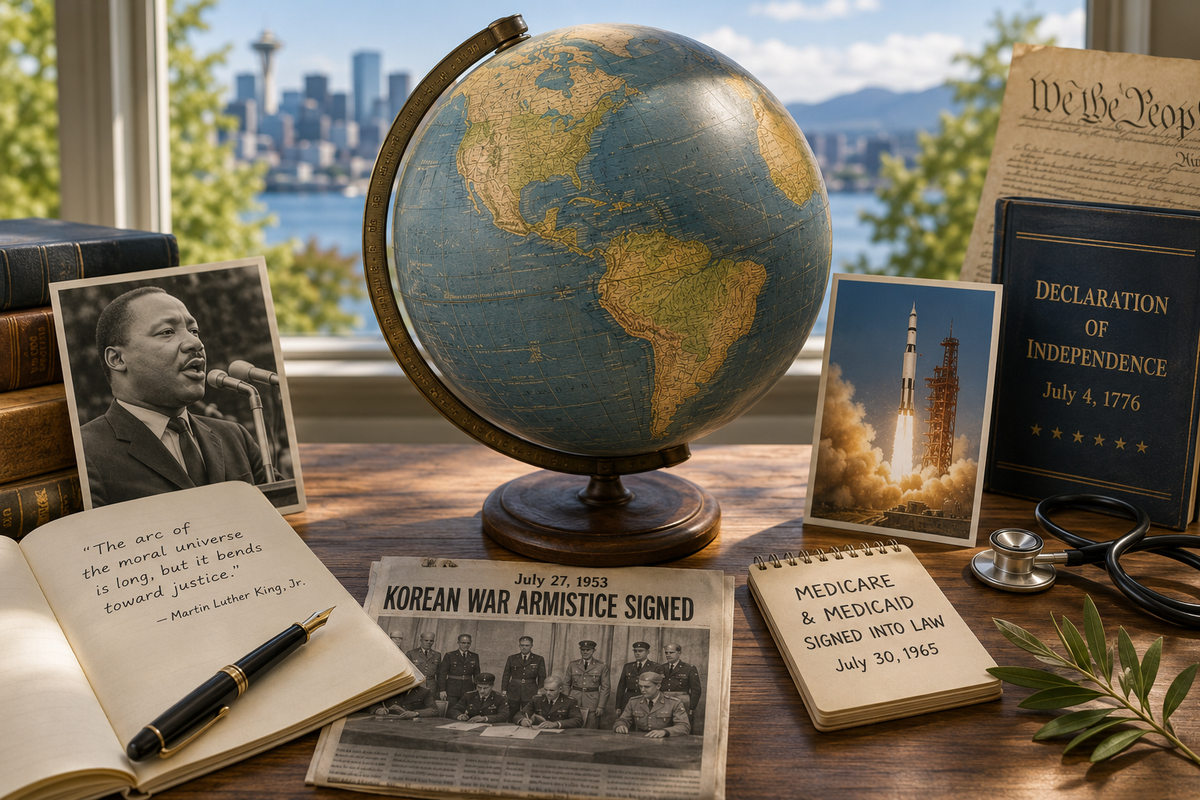
On July 30, 1965, President Lyndon B. Johnson signed legislation creating Medicare and Medicaid. Together, these programs dramatically expanded access to health care for older adults, people with disabilities, and millions of lower-income Americans, becoming enduring pillars of the U.S. health-care system.
On August 1, 1834, the Slavery Abolition Act came into force across much of the British Empire. Approximately 750,000 enslaved people in the British West Indies legally gained their freedom, although many were initially placed into an apprenticeship system before achieving full emancipation in 1838. Antigua and Bermuda granted immediate freedom.
On August 2, 1776, most members of the Continental Congress signed the engrossed copy of the United States Declaration of Independence. While the Declaration was adopted on July 4, the formal signing by most delegates occurred nearly a month later, marking one of history's defining declarations of self-government.
Europe
On July 28, 1914, Austria-Hungary declared war on Serbia following the assassination of Archduke Franz Ferdinand. The declaration triggered the alliance system that rapidly expanded into the First World War, reshaping global politics throughout the twentieth century.
On August 1, 1944, the Warsaw Uprising began as the Polish resistance sought to liberate Warsaw from German occupation before Soviet forces arrived. Lasting 63 days, it became one of the largest and most courageous resistance efforts of the Second World War.
Asia
On July 27, 1953, the Korean Armistice Agreement was signed at Panmunjom, ending three years of active fighting in the Korean War. Although the agreement established the Demilitarized Zone (DMZ), no formal peace treaty was signed, and the Korean Peninsula technically remains under an armistice.
On July 28, 1976, a devastating magnitude 7.8 earthquake struck Tangshan, China, during the early morning hours. Officially claiming approximately 240,000 lives, it remains one of the deadliest earthquakes in recorded history and transformed China's approach to earthquake preparedness and emergency response.
Middle East
On August 2, 1990, Iraqi forces invaded Kuwait, triggering international condemnation, United Nations sanctions, and ultimately the Gulf War. The conflict reshaped geopolitical relations throughout the Middle East and remains one of the defining international crises of the late twentieth century.
Science & Technology Watch
The creation of NASA on July 29, 1958, marked the beginning of one of humanity's greatest scientific and engineering journeys.
Since its founding, NASA has led missions that landed humans on the Moon, explored every planet in the solar system, launched revolutionary space telescopes, studied Earth's changing climate, and partnered internationally aboard the International Space Station.
The agency's work continues to demonstrate how long-term investment in science and innovation produces discoveries that improve everyday life through advances in communications, navigation, weather forecasting, medicine, materials science, and environmental monitoring.
Weather & Nature Watch
Scientists continue to closely monitor a strengthening El Niño in the tropical Pacific Ocean as unusually warm ocean waters expand across the equatorial Pacific.
According to the World Meteorological Organization, El Niño conditions are expected to persist through much of 2026, influencing rainfall, temperatures, tropical cyclone activity, and marine ecosystems across many parts of the globe. Combined with exceptionally warm global ocean temperatures, these conditions may contribute to increased risks of drought, flooding, heatwaves, coral bleaching, and wildfire activity in different regions.
Although El Niño does not directly cause every extreme weather event, it remains one of Earth's most influential naturally occurring climate patterns and is closely watched by meteorologists and climate scientists worldwide.
Series Note: "On This Week" explores significant global events, discoveries, turning points, and cultural milestones connected to each calendar week throughout the year.
By Karalee Greer | WBN News - Vancouver
LinkedIn: https://www.linkedin.com/in/karalee/
Subscription to WBN and being a Contributor is Free
Tags: #WBN News - Vancouver #On This Week #World History #Karalee Greer #Interesting Facts #Global Events