
On This Week | August 31–September 6, 2026: Moments That Shaped Our World
From the outbreak and end of WWII to civil rights, Solidarity and Voyager 1, August 31–September 6 traces a remarkable week in history.



From the outbreak and end of WWII to civil rights, Solidarity and Voyager 1, August 31–September 6 traces a remarkable week in history.
By Karalee Greer | WBN News - Vancouver | August 31 - September 6, 2026
Subscription to WBN and being a Contributor is Free
Editor’s Note: “On This Week” features the strongest verified historical events connected to each calendar week. Historical significance takes priority over including every region equally.
The week bridging August and September contains moments when the direction of history changed dramatically.
Workers in Poland won the right to organize independently, helping create a movement that would eventually challenge communist rule. Nazi Germany invaded Poland and plunged Europe into the Second World War. Six years and a day later, Japan formally surrendered, bringing that global conflict to its official conclusion.
Elsewhere, a treaty confirmed the independence of the United States, Black students confronted segregation in Little Rock, and NASA launched a spacecraft that—nearly half a century later—is still communicating with Earth from interstellar space.
Together, these events tell a story about war and peace, freedom and resistance, and humanity's extraordinary ability to push beyond previously imagined limits.
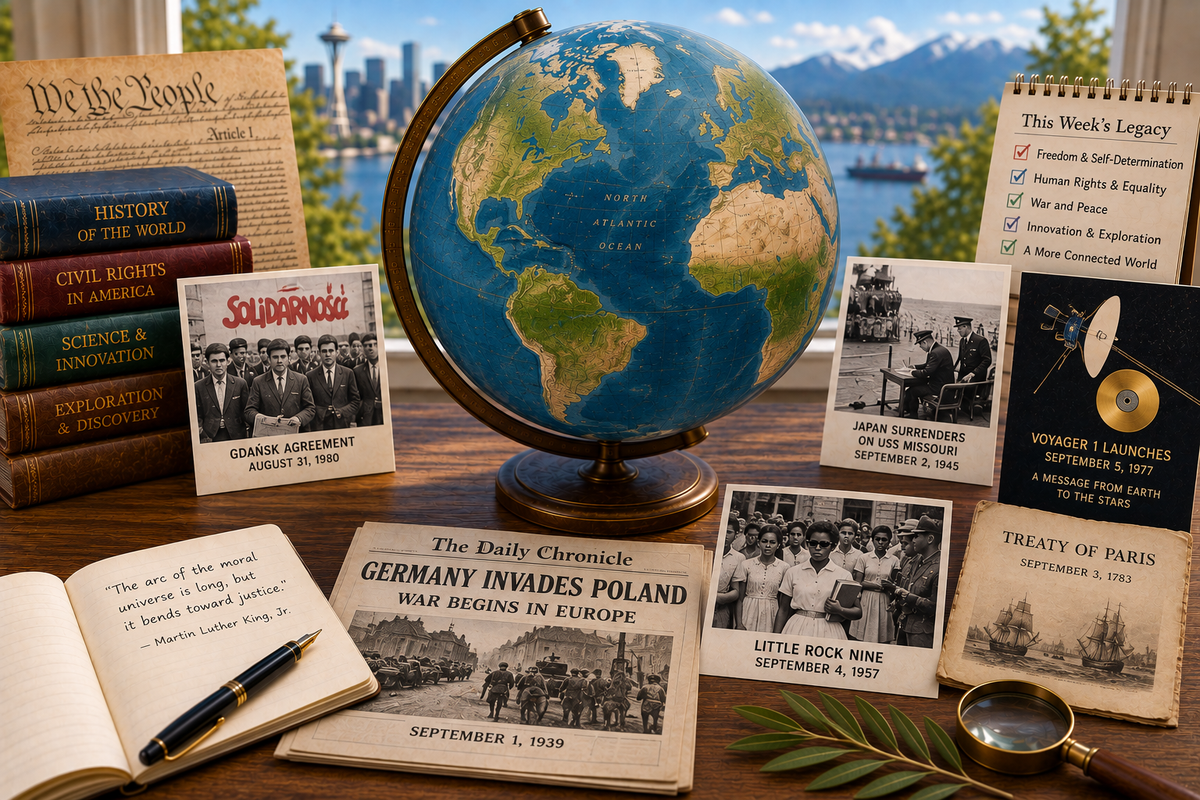
On September 3, 1783, representatives of Great Britain and the United States signed the Treaty of Paris, formally ending the American Revolutionary War.
Britain recognized the United States as an independent nation, while the treaty established boundaries and addressed issues including debts, property and fishing rights.
The conflict had extended far beyond Britain and its former colonies. France, Spain and the Netherlands had also become involved, making the struggle part of a much wider international war.
For the new United States, the treaty represented something fundamentally different from the Declaration of Independence seven years earlier: its independence was now formally recognized by its former colonial ruler.
On September 4, 1957, Black students attempting to integrate Central High School in Little Rock, Arkansas, were prevented from entering by the Arkansas National Guard.
Governor Orval Faubus had ordered the Guard to the school despite a federal court order requiring desegregation.
Fifteen-year-old Elizabeth Eckford arrived separately from the other students and found herself surrounded by an angry white crowd. Photographs of the teenager confronting hostility outside the school became enduring images of the American civil rights movement.
The crisis was far from over. Later that month, President Dwight D. Eisenhower federalized the Arkansas National Guard and sent federal troops to enforce the students' right to attend Central High.
Little Rock became an important test of whether the federal government would enforce the Supreme Court's ruling against segregated public education.
On August 31, 1980, striking workers at the Gdańsk Shipyard and representatives of Poland's communist government signed an extraordinary agreement.
Among its most important provisions was government acceptance of independent, self-governing trade unions.
The strikes had been driven by economic grievances but developed into something much larger. Under the leadership of electrician Lech Wałęsa, workers demanded greater freedom to organize and express themselves.
The agreement helped give rise to Solidarity, or Solidarność, which became the first independent trade union in a Soviet-bloc country and grew into a vast social movement.
The communist government later imposed martial law and attempted to suppress Solidarity, but the movement survived. By the end of the decade, it would play a central role in Poland's democratic transition and the wider collapse of communist rule across Eastern Europe.
At dawn on September 1, 1939, Nazi Germany launched an unprovoked invasion of Poland.
German forces attacked with more than 2,000 tanks supported by hundreds of aircraft, rapidly breaking through Polish defences. Britain and France declared war on Germany two days later.
The Second World War in Europe had begun.
Later that month, Soviet forces invaded Poland from the east under arrangements connected to the secret provisions of the German-Soviet pact signed in August.
The war that followed would engulf much of the planet, kill tens of millions of people, produce the Holocaust, redraw borders, destroy empires and fundamentally transform international politics.
Almost exactly six years after Germany invaded Poland, representatives of Japan boarded the USS Missouri in Tokyo Bay on September 2, 1945.
There they signed the formal Instrument of Surrender.
Japan had announced its acceptance of Allied surrender terms in August, but the September 2 ceremony made the surrender official. Japanese Foreign Minister Mamoru Shigemitsu signed on behalf of the emperor and government, followed by General Yoshijirō Umezu for the Japanese armed forces.
Representatives of the Allied powers then signed the document.
The ceremony formally brought the Second World War to an end—six years and one day after Germany's invasion of Poland began the European conflict.
Placed together in the calendar, September 1, 1939 and September 2, 1945 form a striking historical bookend to the most destructive war in human history.
On the same day that Japan formally surrendered, another major historical transformation was unfolding in Hanoi.
On September 2, 1945, Ho Chi Minh proclaimed the independence of the Democratic Republic of Vietnam, declaring an end to French colonial rule.
But independence did not bring peace.
France attempted to restore colonial control, leading to the First Indochina War. The subsequent division of Vietnam and escalating Cold War involvement eventually led to the much larger Vietnam War.
The declaration therefore marked both the beginning of independent Vietnamese statehood and the opening of a prolonged struggle over the country's political future.
On September 1, 1969, a group of young Libyan military officers overthrew King Idris I while the monarch was outside the country.
Among the officers was 27-year-old Muammar Gaddafi, who quickly emerged as the dominant figure in the new government.
The coup abolished the monarchy and proclaimed the Libyan Arab Republic.
Gaddafi would dominate Libya for more than four decades, pursuing an unconventional political system, nationalizing important industries and playing a controversial role in regional and international affairs.
His rule ended during the Libyan uprising and civil war of 2011, but the political consequences of the 1969 revolution continue to influence Libya today.
On September 5, 1977, NASA launched Voyager 1 from Cape Canaveral, Florida.
Its original mission was ambitious enough: explore Jupiter and Saturn.
Voyager 1 ultimately accomplished far more.
The spacecraft returned thousands of images and observations that transformed scientists' understanding of the outer solar system. At Jupiter it helped reveal a thin planetary ring and discovered two moons; at Saturn it studied the planet, its rings and its extraordinary moon Titan.
Then Voyager simply kept going.
In 1998 it became the most distant human-made object, and in 2012 it crossed the heliopause and entered interstellar space.
Remarkably, Voyager 1 remains an active mission in 2026, nearly 49 years after launch.
Its longevity is an extraordinary engineering achievement—but Voyager carries something even more evocative.
Attached to the spacecraft is the Golden Record, containing sounds and images selected to portray the diversity of life and culture on Earth. Should another civilization ever encounter Voyager, the record serves as a tiny introduction to the world that sent it.
A spacecraft designed in the 1970s has therefore become both a scientific instrument and a message from humanity travelling through interstellar space.
The world's climate story has changed significantly as September begins.
The World Meteorological Organization now says El Niño is firmly established and expected to strengthen further, with an exceptionally high likelihood that it will persist through the coming Northern Hemisphere winter. Its September seasonal outlook projects further development toward stronger El Niño conditions through September, October and November.
Its effects are emerging alongside striking weather extremes around the world.
Typhoon Saudel brought severe rainfall to eastern China this week. More than 2,500 teachers and students became trapped at a school compound in Wenzhou after extreme rainfall caused flash flooding, while authorities warned of additional flood risks.
Across the Atlantic, Tropical Storm Edouard came ashore near the Texas-Louisiana border on September 1, bringing heavy rain, winds and flash-flood concerns.
Europe has just emerged from an extraordinary summer as well. Provisional data show the United Kingdom experienced its hottest summer on record in 2026, accompanied by drought and unusually severe wildfire conditions. In Spain, official data attributed 2,149 excess deaths during August to heat.
And as spring begins in the Southern Hemisphere, the pattern is appearing there too. Sydney experienced temperatures approaching 13°C above normal this weekend, prompting extreme fire-danger warnings and a total fire ban across the Greater Sydney region.
No single storm, fire or heatwave can tell the entire climate story. But together with a strengthening El Niño and exceptionally warm oceans, this week's events show how interconnected atmospheric and ocean conditions can influence communities thousands of kilometres apart.
Series Note: “On This Week” explores significant global events, discoveries, turning points, and cultural milestones connected to each calendar week throughout the year
By Karalee Greer | WBN News - Vancouver
LinkedIn: https://www.linkedin.com/in/karalee/
Subscription to WBN and being a Contributor is Free
Tags: #WBN News #On This Week #World History #Karalee Greer #Interesting Facts #Global Events