By George Moen | WBN News Subscribe For Free Click Here: Here | June 19, 2026
A social media exchange about creativity, employment, and artificial intelligence highlights growing concerns among artists and creative professionals. The discussion may be an early signal of a broader debate about how technology will reshape creative work in the coming decade.

A recent social media post captured a sentiment that is becoming increasingly common as artificial intelligence spreads across creative industries.
The commenter wrote:
"I'm not a business girl. I'm a creative person. I am so sick of this. I spent 4 years in college, spending more time with the actors and artists on my campus. I didn't jive with business economics people as much. I got the degree. But that's it. I am unemployable in corporate."
The comment struck a nerve because it reflects concerns many creative professionals are quietly wrestling with. As artificial intelligence becomes more capable, questions about the future of creative work are moving from industry conferences and boardrooms into everyday conversations.
In response, I offer a different perspective.
I don't see AI as the enemy of creativity.
The pen didn't destroy writing. The typewriter didn't destroy writers. Word processors didn't destroy authors. Digital cameras didn't destroy photographers. Computer animation didn't destroy storytelling. The internet didn't destroy publishing.
Every major technological shift changed how creative work was produced, distributed, and monetized. Some jobs disappeared. New opportunities emerged. Yet creativity itself survived. In many cases, it expanded.
The value was never in the pen, the keyboard, the camera, the software, or the technology itself. The value has always been in the human imagination behind the tool.
What makes a great writer is not the keyboard. What makes a great photographer is not the camera. What makes a great artist is not the brush. The difference has always been the person using the tool—their ideas, perspective, experiences, emotions, and ultimately the story they have to tell.
That exchange raises what may be one of the most important questions of the AI era.
The real debate isn't whether AI can create content. The real question is whether AI will empower human creativity or replace it.
The Signal Behind The Conversation
This discussion is about far more than technology. It reflects growing concerns about identity, employment, economic security, and the future value of human-created work.
For many creative professionals, creativity is not simply a career. It is part of who they are. As AI-generated content becomes more common, difficult questions are emerging. Will employers need fewer writers? Will businesses hire fewer designers? Will musicians compete against algorithms? Will audiences continue to value human-created work?
These concerns are understandable. Every major technological disruption creates uncertainty before its long-term impact becomes clear. The rise of artificial intelligence is no exception.
History Suggests Creativity Adapts
History offers a useful perspective. Creative industries have experienced major technological disruption before. The transition from typewriters to word processors, from film to digital photography, from traditional animation to computer animation, and from physical media to digital distribution fundamentally changed creative workflows.
Yet creativity did not disappear. The tools evolved, and creators evolved with them.
Digital photography did not eliminate photographers. Computer animation did not eliminate storytellers. The internet did not eliminate writers. In many cases, technology lowered barriers to entry and gave creators access to larger audiences than ever before.
The lesson from history is not that change is painless. It is that creativity has repeatedly proven more resilient than the technologies that reshape it.
Business Impact
For business leaders, the AI debate extends far beyond creative industries. Organizations are rapidly adopting AI tools to improve productivity, accelerate research, streamline workflows, and reduce repetitive work.
The question facing executives is no longer whether AI will be adopted. The question is how to combine AI efficiency with human creativity.
Businesses still compete on ideas, brand, trust, and emotional connection with customers. While AI may improve efficiency, these remain fundamentally human advantages that technology alone cannot replicate.
The organizations that succeed may be those that use AI to increase productivity while preserving the unique perspectives, creativity, and judgment that only people can provide.
By The Numbers
Several trends are becoming increasingly clear.
AI adoption continues to accelerate across marketing, media, publishing, design, software development, and education. Millions of knowledge workers are experimenting with AI-assisted workflows, while creative professionals are increasingly using AI for research, brainstorming, editing, and production support.
At the same time, independent creators now have access to capabilities that once required large teams and significant budgets. The pace of change suggests AI will become a standard business tool across most industries.
How AI May Empower Creators
The conversation often focuses on what AI can do. A more useful question may be: what can creators do with AI?
Writers can use AI to organize research and overcome creative blocks. Designers can rapidly test concepts before refining final work. Filmmakers can accelerate production planning. Entrepreneurs can create content, launch products, and reach audiences more efficiently. Authors can spend less time on repetitive tasks and more time developing ideas.
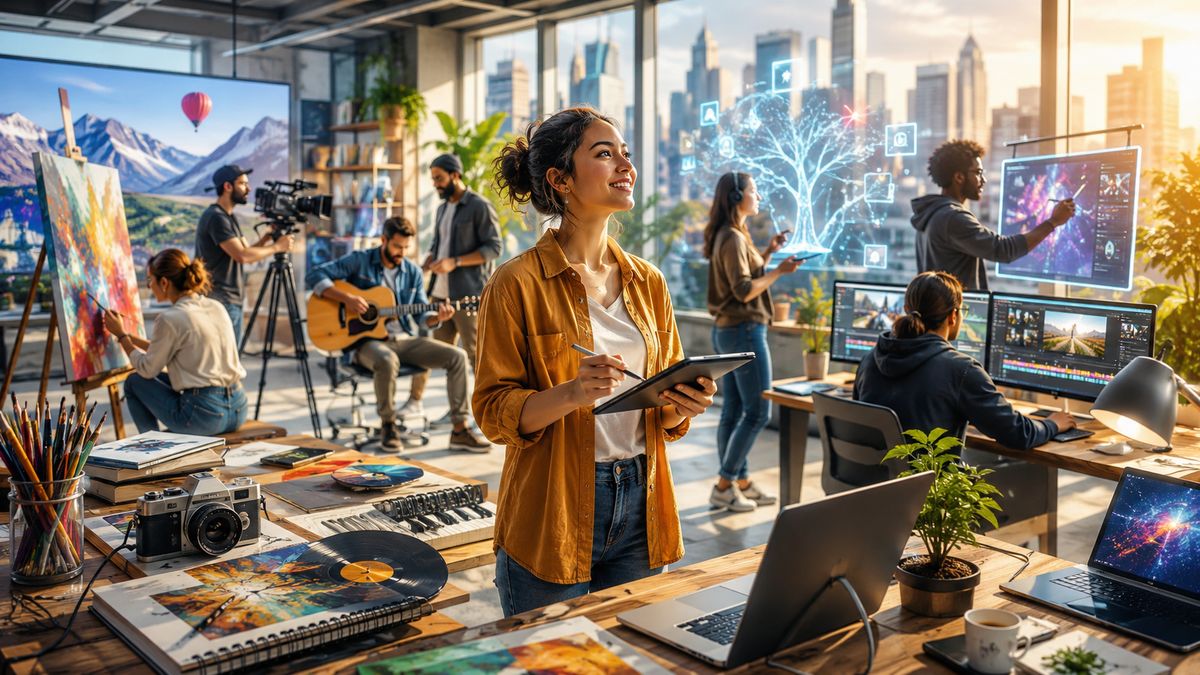
The creators who thrive over the next decade may not be the ones who reject AI. Nor will they be the ones who rely entirely upon it. They may be the individuals who learn how to combine human creativity with AI-assisted productivity.
AI can generate words and images, but it cannot live a human life. It cannot experience joy, loss, love, failure, hope, ambition, or curiosity. Those experiences continue to shape the stories, perspectives, and emotional connections that audiences value.
Why It Matters
The social media exchange represents an important signal. It demonstrates that the AI debate is no longer primarily about technology. It is increasingly about people.
Many professionals are trying to understand how their skills, careers, and identities fit into a rapidly changing economy. While the technology itself receives most of the attention, the larger story may be how individuals adapt to it.
History suggests that creativity itself is remarkably resilient. New tools tend to change the process rather than eliminate the creator. The larger signal may be that we are entering a period where human imagination becomes even more valuable as routine tasks become increasingly automated.
Those who learn to leverage technology while preserving authentic human insight may gain significant advantages in the years ahead.
Looking Ahead
Artificial intelligence will continue to evolve, creative tools will continue to improve, and distribution systems will continue to change. What is unlikely to change is the human desire for stories, meaning, emotion, curiosity, perspective, and connection.
Those qualities remain at the center of creative work. Technology may transform how creativity is expressed, but it does not eliminate the need for creative people.
The future may not belong to AI alone.
It may belong to the creators who learn how to work alongside it.
George Moen
WBN News – Real-Time Intelligence For Business
Subscribe: Here
Contact: gmoen@wbnn.news
LinkedIn: Here
Tags: #Artificial Intelligence #Future Of Work #Creative Economy #Digital Transformation #Innovation #Technology Trends #Business Strategy #Content Creation #Human Creativity #WBN Signals