By Karalee Greer  | WBN News - Vancouver | August 3-9, 2026
Subscription to WBN and being a Contributor is
Free

Editor’s Note: “On This Week” features the strongest verified historical events connected to each calendar week. Not every region produces an equally significant milestone during every seven-day period, so this edition emphasizes historical importance rather than forced geographic balance.

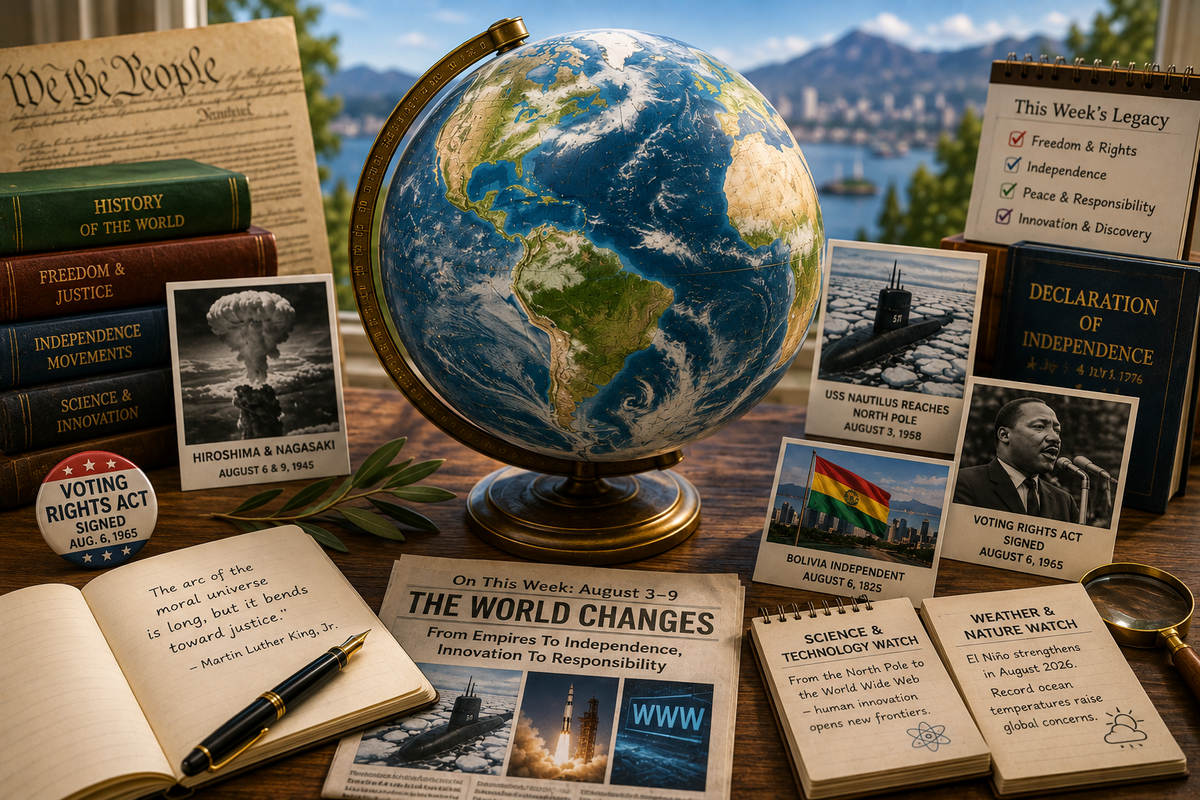
The week of August 3 to August 9 carries a striking theme of transformation. Empires ended, nations emerged, democratic rights expanded, and technologies opened new pathways beneath the Arctic ice and across the digital world. Yet this week also includes two of the most devastating moments in human history: the atomic bombings of Hiroshima and Nagasaki. Together, these events reveal both humanity’s extraordinary capacity for progress and the profound consequences of how knowledge and power are used.

History Around The World

The Americas

On August 6, 1825, representatives meeting in Chuquisaca declared the independence of Upper Peru from Spanish rule, establishing the country that would become Bolivia. Named in honour of independence leader Simón Bolívar, the new republic emerged after years of warfare across Spanish South America and became part of the continent’s broader movement toward self-government.

On August 6, 1965, U.S. President Lyndon B. Johnson signed the Voting Rights Act into law. The landmark legislation outlawed discriminatory voting practices, including literacy tests, and gave the federal government greater authority to protect access to the ballot in jurisdictions with histories of racial discrimination. Its passage became one of the defining achievements of the American civil rights movement.

Europe

On August 3, 1914, Germany declared war on France as the crisis following the assassination of Archduke Franz Ferdinand expanded into a continental conflict. German forces entered Belgium the following day, prompting Britain to declare war on Germany and transforming a regional confrontation into the First World War.

On August 6, 1806, Emperor Francis II relinquished the title of Holy Roman Emperor, formally bringing the Holy Roman Empire to an end. The political structure had shaped Central Europe for centuries, but pressure from Napoleon and the reorganization of German territories made its continuation impossible.

Asia

From August 6 to August 9, 1945, the United States dropped atomic bombs on the Japanese cities of Hiroshima and Nagasaki. Hiroshima was bombed on August 6, followed by Nagasaki three days later. Tens of thousands of people, most of them civilians, died immediately, and many more suffered from severe injuries and radiation-related illness.

The bombings contributed to Japan’s decision to surrender and the end of the Second World War, while also opening the nuclear age. Historians continue to debate their military necessity, ethical implications, and relationship to Japan’s surrender. Hiroshima and Nagasaki remain enduring symbols of the human cost of nuclear warfare and the global responsibility to prevent such destruction from happening again.

On August 9, 1965, Singapore separated from Malaysia and became an independent and sovereign republic. Independence arrived amid considerable political and economic uncertainty, but Singapore would subsequently develop into a major centre of global trade, finance, transportation, and technology.

Africa

On August 7, 1960, Côte d’Ivoire gained full independence from France. Félix Houphouët-Boigny became the country’s first president as Côte d’Ivoire joined the wave of African nations achieving sovereignty during the landmark decolonization year often called the “Year of Africa.”

Global Turning Points

On August 3, 1958, the nuclear-powered submarine USS Nautilus became the first vessel to reach the geographic North Pole, travelling beneath the Arctic ice. The achievement demonstrated the extended range made possible by nuclear propulsion and opened a new era in undersea navigation, Arctic exploration, and military strategy.

On August 6, 1991, British computer scientist Tim Berners-Lee publicly introduced the World Wide Web project through an online newsgroup message. Developed at CERN as a way for researchers to share information, the Web eventually transformed communication, education, journalism, business, entertainment, and everyday life around the world.

Science & Technology Watch

Two events from this week illustrate very different ways technology can reshape the world.

The voyage of USS Nautilus beneath the North Pole showed how nuclear propulsion could allow a submarine to travel great distances without surfacing. Its journey provided new possibilities for polar navigation and scientific exploration, while also changing military strategy during the Cold War.

The public introduction of the World Wide Web in 1991 created an entirely different kind of frontier. Tim Berners-Lee envisioned a universal system through which information stored on different computers could be connected and accessed through hyperlinks. What began as a scientific information-sharing project grew into the digital foundation of modern communication and commerce.

Weather & Nature Watch

August 2026 is unfolding during a rapidly strengthening El Niño in the tropical Pacific. The World Meteorological Organization reports that El Niño conditions are already underway and are expected to intensify, increasing the likelihood of drought in some regions, heavier rainfall in others, and greater risks of heatwaves over both land and sea.

Global ocean temperatures are also exceptionally high. Copernicus reported that sea-surface temperatures across the extra-polar oceans reached record levels for June, while marine heatwaves continued in several regions. These prolonged periods of unusually warm ocean water can disrupt fisheries, damage coral reefs, alter marine ecosystems, and intensify heat over nearby land.

El Niño does not cause every individual weather event, and its effects differ by season and location. However, its rapid development alongside elevated global ocean temperatures is being closely monitored because of the potential consequences for agriculture, water security, wildfire conditions, tropical storms, and coastal communities.

Series Note: “On This Week” explores significant global events, discoveries, turning points, and cultural milestones connected to each calendar week throughout the year

By Karalee Greer  | WBN News - Vancouver
LinkedIn:
 https://www.linkedin.com/in/karalee/
Subscription to WBN and being a Contributor is Free

Tags: #WBN News - Vancouver #On This Week #World History #Karalee Greer #Interesting Facts #Global Events

Share this article
The link has been copied!