The “Diplomat’s Notebook” No. 1

Nicholas Jeffery | WBN News – Global | February 11, 2026 Subscribe to WBN News

Some people come to Hungary to understand it. Others marry into it.

I did the latter — which, as any student of Central and Eastern Europe will confirm, is the more permanent form of accreditation.

My wife is a Budapest-born architect and urban planner whose connection to the city is more identity than residence. She has always felt deeply Hungarian through every political period. Yet lately, the news can feel so overwhelming and biased that she invariably turns it off — a bellwether of the times we live in.

This is the third time our family has lived here. The children attend a state school, speak with alarming fluency in Hungarian, English, and German, and correct my Hungarian pronunciation with the confidence of citizens correcting a visiting diplomat. Our lives oscillate internationally, but Budapest remains the fixed coordinate — home, the point to which everything returns, whether pandemics, market conditions, or relatives at Christmas.

Professionally, I have spent three and a half decades navigating corporate restructurings, telecom transformations, distressed assets, M&A negotiations, and investment strategy across Europe and beyond. This included restructuring PSINet Europe, leading Uniserve Communications — a public company in Canada — from distressed to market darling, and serving at the European Bank for Reconstruction and Development (EBRD) as Head of Strategy and Investment Planning for the Telecoms, Media and Technology Group. During that time, I have watched systems — political and corporate — perform and behave under geopolitical, financial, and latterly conflict pressure.

But the focus of these observations is Hungary — home. A country that, from my perspective, is permanently under commentary and rarely under deep examination. Living inside it, rather than observing it from conference panels in Brussels or Washington, produces a different perspective — one I would like to share and explore together.

This musing is therefore not an academic paper nor a diplomatic communiqué.

It is my personal letter from Budapest, as Hungary moves toward and beyond the 2026 general election.


There are countries that loudly announce their place in the world.

And there are countries that also loudly insist the world has misunderstood them.

Hungary has always belonged to both categories — especially in the current political climate.

From the banks of the Danube, geopolitics is not practiced so much as performed: a choreography of sovereignty, suspicion, and self-confidence executed globally while the rest of Europe argues about independent media, family funds, and institutional norms. Having paid taxes here long enough to earn opinions — and holding a passport that opens more doors than it closes — I offer these observations in the spirit of civic affection, mild exasperation, and that ancient Hungarian conversational tradition: saying one thing while meaning three.

SPONSORED

AMP video: Looking to Reduce Your Credit Card Fees? Click here


A Passport, a Superpower, and the Curious Case of Relative Decline

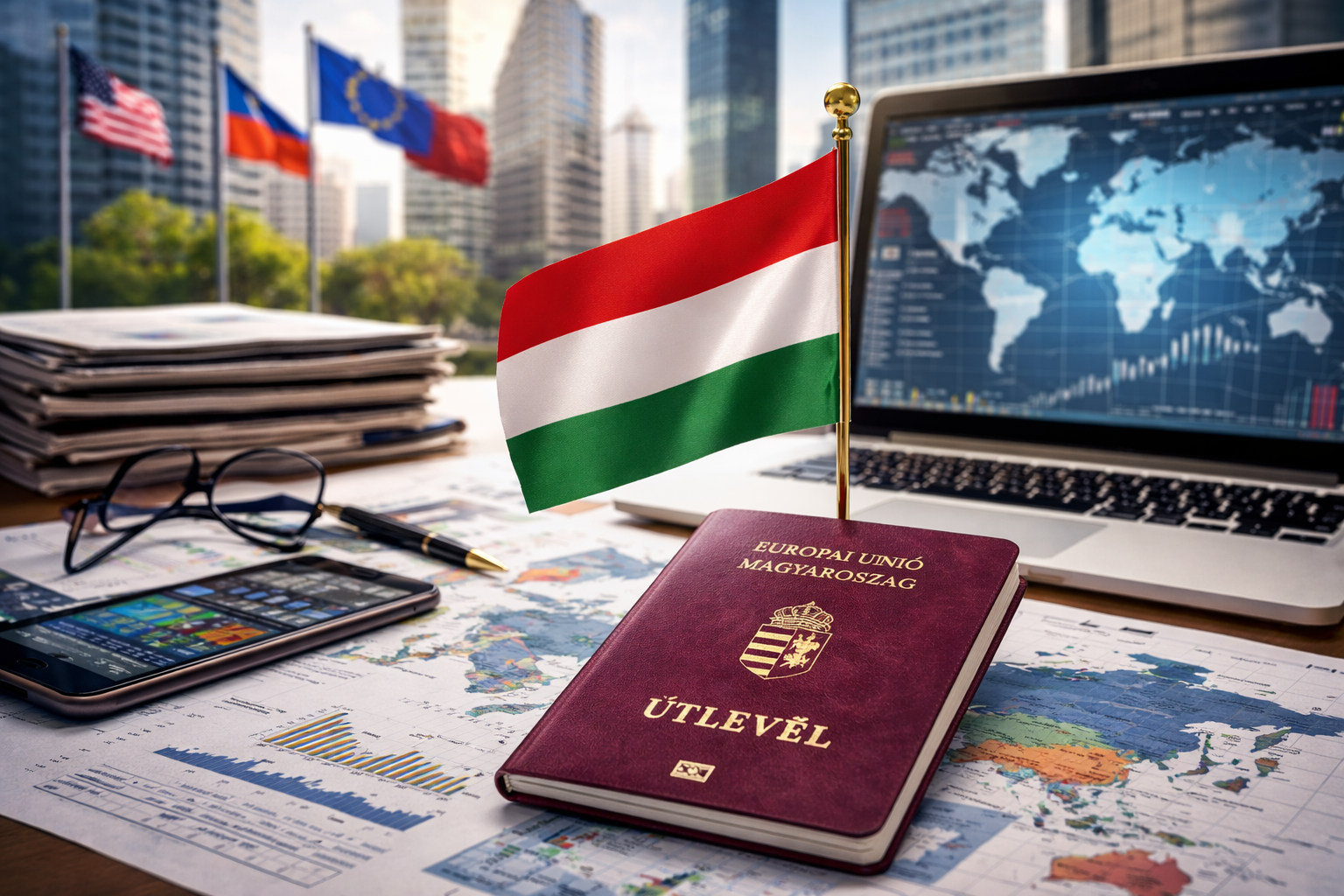
The Hungarian passport — a small burgundy booklet, modestly crested and frequently underestimated at airport check-ins — now ranks comfortably among the world’s most useful travel documents. It grants access to most of the planet with minimal questioning. I once assumed my British passport held that distinction. It is striking that Hungary now ranks so highly — which begs the question: why?

This places Hungary in an interesting category. Its global relationships with major geopolitical actors are often misunderstood, while Hungarian political rhetoric and alliance strategy are debated — and frequently maligned — abroad.

Hungary is regularly described as a democracy in retreat. Yet its citizens travel, trade, work, and invest internationally with remarkable ease and confidence. Meanwhile, several larger democracies increasingly find themselves explaining both their policies and occasionally their internal stability to border officials — and to history.

One country is accused of backsliding.

Another livestreams it.

From Budapest, the global order appears less a rules-based system and more a diplomatic pick-and-mix. Brussels lectures. Washington moralises. Moscow glowers. Beijing waits patiently. Hungary hedges — economically agile, rhetorically defiant, culturally insistent on being interpreted in its own language.


As the 2026 election approaches, the public mood is neither revolutionary nor complacent.

It is pragmatic, experienced, and faintly worried — but not amused.

Polarisation between the capital, Budapest, and the regional districts splits generations and families in a manner reminiscent of Brexit. One front-bench politician recently stated on television: “I am with you, not with the capital.”

More on State versus Capital — and the Renaissance paradigm playing out again — in the next Danube Dispatches.

Hungarians have lived through Ottomans, Habsburgs, Germans, Soviets, markets, and consultants. They are difficult to alarm. The debate here is rarely framed as democracy versus authoritarianism. It is framed as control versus independence — and quietly, whether anyone else is demonstrably managing things better.

The current opposition party’s name, Tisza, carries historical weight. The river is Hungary’s second artery, but the political reference is to Kálmán Tisza, the 19th-century prime minister who oversaw rapid modernisation while balancing powerful neighbours — a recurring Hungarian profession. Infrastructure, education, and much of Budapest’s grandeur date to that era. Hungarian politics does not repeat history so much as quote it with new actors.

Meanwhile, daily life continues normally. Children go to school. Cafés remain full.

My sons and I remain British citizens with Hungarian residency — a modern European compromise.

In the coming weeks, the temperature will rise — rhetorically first. Poster campaigns, publicly funded and positioned as informational memoranda, already dominate the skyline, espousing the virtues of the ruling party and the issues surrounding Brussels and Kyiv. Political heat will follow. Economic consequences will not lag far behind.

Hungary rarely moves dramatically.

But it almost always moves deliberately.

By Ambassador Dr. Nicholas Jeffery
Nicholas Jeffery LinkedIn: http://linkedin.com/in/nicholas-jeffery

Subscribe to WBN News

Tags: #Nicholas Jeffery #Danube Dispatches #Diplomat’s Notebook #Hungary 2026 #Budapest #Central Europe #Geopolitics

Share this article
The link has been copied!