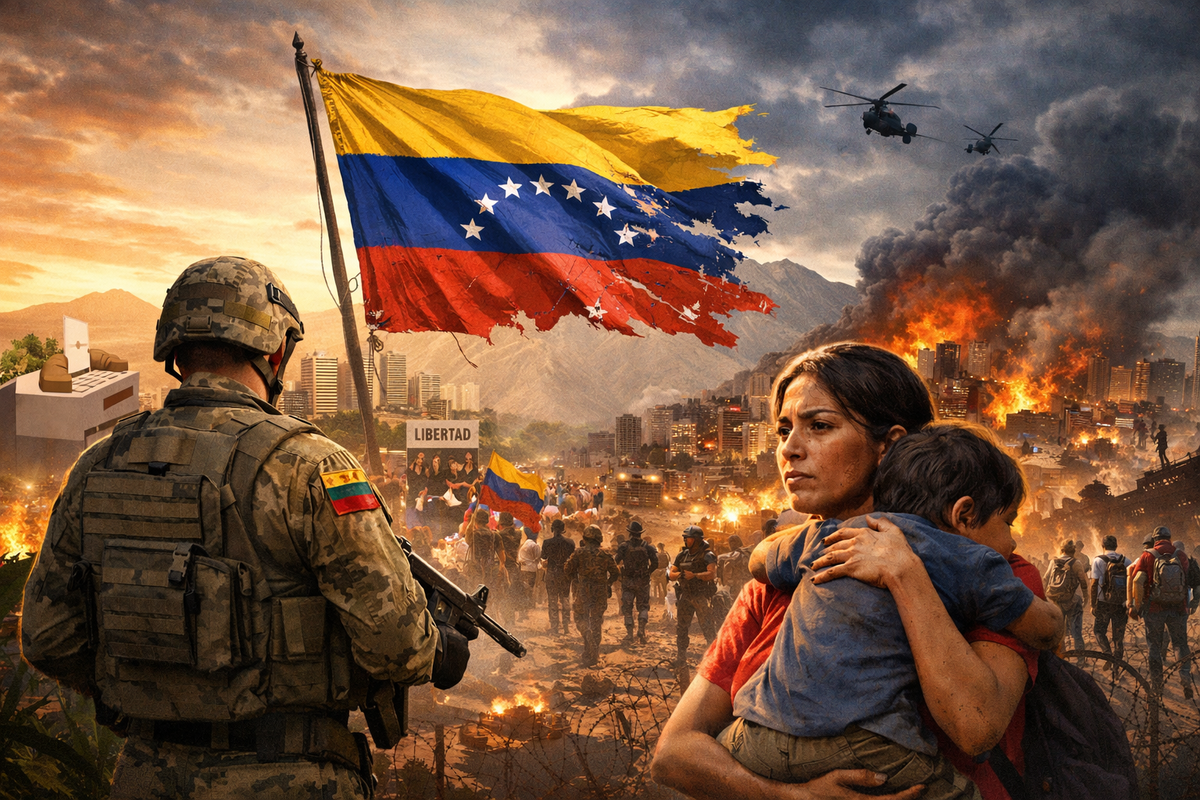
Venezuela's Five Futures: Recovery or Ruin?
Five scenarios for Venezuela's future: democratic transition, U.S. occupation, civil conflict, regime continuity, or negotiated settlement. What happens next?


Part 3: Scenarios, Families, and the Question of Agency
By Elke Porter | WBN News Global | January 3, 2026
Subscription to WBN and being a Writer is FREE!
Following the U.S. military strikes on Venezuela and the capture of President Nicolás Maduro on January 3, 2026, the world asks: what happens next?
The international response is divided—China and Russia condemn the action as a sovereignty violation, while some U.S. allies praise it. Oil markets fluctuate, neighbors prepare for potential refugees, and investors pull back. But the real question is Venezuela's future: Will the nation, plagued by fear, corruption, and barbed-wire enclaves, finally rebuild? Or will Maduro's removal lead to chaos, violence, or foreign control?
Five political scenarios could unfold, each affecting Venezuela's 28 million citizens and millions of refugees.
A negotiated shift involves opposition leaders, international mediators, and cooperative regime elements. The U.S. facilitates free elections within 6-18 months. Key challenges: amnesty vs. justice, reforming security forces, and diversifying the economy beyond oil. Sanctions ease gradually; GDP recovery begins in years, full rebuild in decades. Probability: Moderate to low—requires broad buy-in and luck.
The U.S. installs an interim government, secures oil infrastructure, and controls resources—echoing Iraq or historical interventions. Oil production restarts quickly under American firms, but risks insurgency, proxy conflicts with China/Russia, and high costs. Probability: Moderate—plausible under transactional U.S. policy, but constrained by public opinion and casualties.
Maduro's removal triggers violence among military factions, militias, cartels, and guerrillas—similar to Libya or Syria. Oil collapses, refugees surge to 10-12 million, spillover destabilizes neighbors. Humanitarian crisis overwhelms aid. Probability: Moderate to high without planned transition—armed groups and desperation fuel conflict.
Reports prove exaggerated, or Maduro's allies maintain power via a successor. The system persists, justifying repression as anti-imperialism. Economy continues declining; refugees hit 10 million. Probability: Low given confirmed capture, but authoritarian resilience is possible.
Great powers (U.S., China, Russia, Latin America) compromise: Maduro exiled, transitional government formed, peacekeepers deployed, elections held. Sanctions lift gradually; diverse investment aids moderate recovery. Probability: Moderate—"least bad" option, but requires consensus amid tensions.
For Venezuelan families facing daily fear, these paths mean profound uncertainty—return to rebuild, flee danger, or navigate occupation. Broader issues: intervention justification, sovereignty, sanctions' role, great-power rivalry, and refugee burdens.Venezuela needs humanitarian access, legitimate processes, transparent economics, international cooperation, justice, and diaspora engagement. Ultimately, success depends on Venezuelan agency amid external forces.
Ultimately, the most profound question is whether Venezuelans themselves will determine their country's future or whether that future will be shaped primarily by external forces—American military power, Chinese economic influence, Russian geopolitical positioning, or some combination thereof.
Venezuela's best hope lies in finding space for Venezuelan agency within whatever external constraints now exist. This means ensuring that Venezuelans across the political spectrum—not just those favoured by Washington or Beijing—have voice in determining what comes next. It means international actors supporting rather than supplanting Venezuelan institutions and processes. It means recognizing that even the best-intentioned external solutions will fail without local ownership and legitimacy.
Practically, this suggests several principles: Any transitional government should include Venezuelans from across political spectrum, not just exiles who've lived abroad or opposition figures with limited domestic support. Elections should be organized through Venezuelan electoral institutions with international observation, not imposed by external actors. Constitutional and legal reforms should be debated by Venezuelans through their own processes. Economic reconstruction should employ Venezuelans and benefit Venezuelan communities, not primarily serve foreign companies or investors.
As Venezuela's story continues to unfold in real-time, millions of people face impossible decisions with incomplete information. For families like the one you met in Vancouver—those who chose duty over safety, believing that good people must stay to rebuild their country—every scenario carries both risks and hopes.
If democratic transition succeeds, their choice to return could define them as the generation that rebuilt Venezuela. Their children might grow up in a country transformed—where barbed wire comes down, where walking in daylight isn't dangerous, where schools function well, and where corruption no longer dominates daily life. They would be proud to have contributed to this transformation, to have chosen principle over comfort, to have refused to abandon their homeland.
If chaos erupts, that same choice might haunt them forever. The guilt of having exposed their children to danger, of having prioritized national duty over family safety, would be crushing. They would join millions fleeing, but with the added burden of knowing they had safety available and chose to leave it. The psychological weight of such - good intentions producing terrible outcomes - can mark families for generations.
Elke Porter at:
Westcoast German Media
LinkedIn: Elke Porter or
WhatsApp: +1 604 828 8788.
Public Relations. Communications. Education
Let’s bring your story to life — contact me for books, articles, blogs, and bold public relations ideas that make an impact.
#VenezuelaFutures #PostInterventionScenarios #VenezuelanRecovery #DiasporaDecisions #LatinAmericaStability #SovereigntyVsIntervention