By Elke Porter | WBN News Canada | December 20, 2025
Subscription to WBN and being a Writer is FREE!

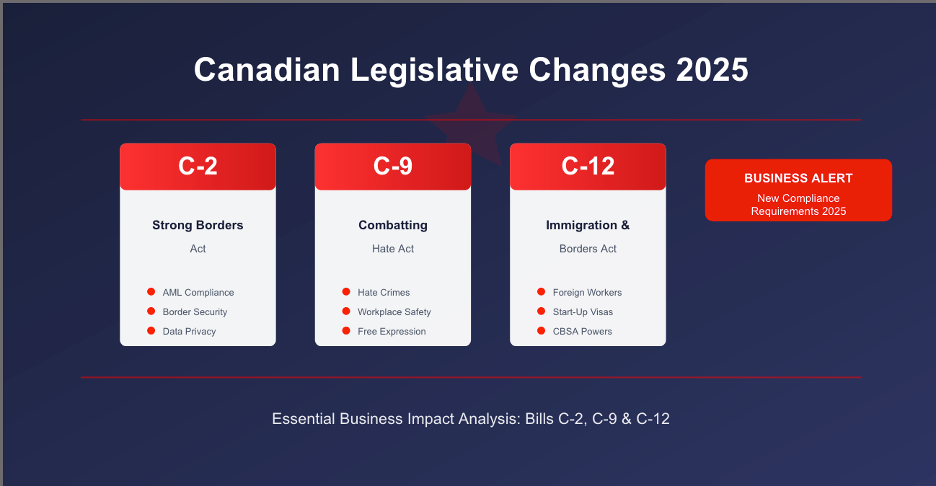
Three major pieces of legislation have been introduced in Canada's 45th Parliament in 2025, each with significant implications for businesses operating in Canada. This analysis examines Bill C-2 (Strong Borders Act), Bill C-9 (Combatting Hate Act), and Bill C-12 (Strengthening Canada's Immigration System and Borders Act) and their potential business impacts. There are more acts, but let's start with these and this might affect your business.

Bill C-2: Strong Borders Act

Introduced on June 3, 2025, and currently at second reading, this omnibus legislation amends multiple laws to enhance border security, combat organized crime, and modernize tools against money laundering and fentanyl trafficking.

Key changes include expanded Canada Border Services Agency inspection powers for exports, accelerated controls on drug precursors, and strengthened anti-money laundering enforcement through higher penalties:

  • Expanding Canada Border Services Agency (CBSA) powers for inspections of exports and mail (including searching Canada Post for fentanyl and precursors).
  • Creating an accelerated process to schedule chemical precursors used in illicit drugs like fentanyl.
  • Strengthening anti-money laundering rules and information sharing.

Businesses in finance, real estate, import/export, logistics, and pharmaceuticals face increased compliance costs, potential delays in supply chains, and risks of steeper fines for non-compliance. Tech and telecom firms may encounter new data-sharing obligations with law enforcement. Companies should review policies, upgrade systems, and prepare for enhanced inspections.

Canada also plans to continue its longstanding participation in Operation Caribbe, a multinational drug interdiction effort where Canadian forces identify and track suspect vessels, but hand them over to partners (like the U.S. Coast Guard) for boarding, search, and arrest. Despite U.S. escalation to lethal strikes, Canada has stated no plans to change this approach, emphasizing consistency with legal obligations.

Bill C-9: Combatting Hate Act

Introduced on September 19, 2025, and under committee review with amendments, this bill amends the Criminal Code to better address rising hate crimes.

It creates new offences for hate-motivated crimes, codifies a definition of "hatred" based on Supreme Court jurisprudence, removes the need for Attorney General consent in hate propaganda prosecutions, prohibits public display of certain hate or terrorism symbols, and criminalizes intimidation near protected spaces like places of worship or community centres.

A recent amendment removed a controversial religious exemption from hate speech provisions.

The prohibited symbols are specifically defined as:

  • The Nazi Hakenkreuz (also known as the Nazi swastika).
  • The Nazi double Sig-Rune (also known as the SS bolts).
  • Any symbol principally used by or associated with a listed terrorist entity under Canada's Criminal Code (e.g., flags or emblems of groups like Hamas, Hezbollah, Islamic State/ISIS, Proud Boys, Kahane Chai, or Tamil Tigers).
  • Any symbol that closely resembles the above and is likely to be mistaken for them.

Employers across sectors, particularly those with diverse workforces, event venues, retail, and media organizations, must update harassment policies, provide training on recognizing hate incidents, and review content standards. This could heighten workplace safety requirements and reputational risks from incidents.

Bill C-12: Strengthening Canada's Immigration System and Borders Act

Introduced on October 7, 2025, as a streamlined version extracting priority provisions from Bill C-2, it passed the House of Commons on December 11, 2025, and awaits Senate review in early 2026.

It focuses on asylum ineligibility rules, expanded information sharing, enhanced border inspections, and controls on precursor chemicals.

Here are three key asylum ineligibility rules under the bill:

  1. One-year deadline for claims: Asylum claims made more than one year after the claimant's entry into Canada are ineligible for referral to the Immigration and Refugee Board (IRB) for a full hearing. This applies broadly (with some transitional provisions) and aims to prevent delayed claims from those using the system as an alternative to regular immigration pathways.
  2. 14-day deadline for irregular border crossers: Individuals who enter Canada irregularly from the U.S. (e.g., between ports of entry) and file an asylum claim more than 14 days after arrival are ineligible for IRB referral. This targets potential abuse of the Safe Third Country Agreement loopholes.
  3. Termination for non-compliance: If a claimant fails to provide required documents, information, or appear for examinations during initial processing, the claim can be deemed abandoned or ineligible, requiring termination of processing before reaching the IRB.

Businesses reliant on international talent—especially tech, startups, agriculture, hospitality, and recruitment—should audit workforce immigration status, expedite applications, and diversify hiring. Import/export and manufacturing firms may face supply chain disruptions from stricter screenings.

Overall, these bills increase regulatory burdens, compliance expenses, and operational risks for Canadian businesses involved in cross-border trade, financial transactions, diverse workplaces, or foreign workers.

Leaders should conduct audits, engage legal experts, implement training, and monitor developments.Proactive measures will help mitigate penalties and disruptions while ensuring alignment with evolving laws.

Conclusion

In conclusion, Bills C-2 (Strong Borders Act), C-9 (Combatting Hate Act), and C-12 (Strengthening Canada's Immigration System and Borders Act) collectively mark a significant hardening of Canada's regulatory framework in response to rising concerns over national security, social cohesion, and border integrity.

Together, they impose substantial new compliance obligations on businesses through enhanced anti-money laundering rules and border inspections, stricter penalties for hate-motivated conduct, and tighter restrictions on asylum claims that could disrupt access to international talent.

While aimed at curbing fentanyl trafficking, organized crime, hate crimes, and perceived abuses of the immigration system, these measures will raise operational costs, introduce potential supply chain delays, heighten workplace policy requirements, and increase reputational risks for companies across finance, technology, trade, hospitality, and employment sectors.

For Canadian businesses, particularly those engaged in cross-border activities, employing diverse or foreign workforces, or operating in sensitive public spaces, proactive adaptation—through audits, policy updates, staff training, and legal consultation—will be essential to navigate the heightened enforcement environment and avoid severe penalties.

As these bills continue through Parliament, with C-12 already passed by the House and the others advancing amid amendments, their ultimate impact will depend on final provisions and implementation, but the direction is clear: a more stringent, security-focused approach that demands greater vigilance from the private sector.

Elke Porter at:
Westcoast German Media
LinkedIn: Elke Porter or
WhatsApp:  +1 604 828 8788.
Public Relations. Communications. Education

Let’s bring your story to life — contact me for books, articles, blogs, and bold public relations ideas that make an impact.

TAGS:

  • #Canadian Business
  • #Bill C2
  • #Bill C9
  • #Bill C12
  • #Compliance Matters
  • #Canadian Law 2025
  • #Business Regulation
  • #Immigration Reform
  • #WBN News Canada
  • #Elke Porter

Share this article
The link has been copied!