By Elke Porter | WBN News Vancouver | March 7, 2026
Subscription to WBN and being a Writer is FREE!
Walk into a 1950s newsroom and you'd feel the weight of it — the cigarette smoke, the clatter of typewriters, the sense that every word mattered because every word was fought for. A young journalist didn't just write a story and send it out into the world. That story passed through a junior editor, then a senior editor. A lawyer reviewed anything that carried legal risk. An accountant weighed the financial exposure.
The publisher had the final word — and that word was sometimes no. Stories were killed before they ever drew breath. Investigations were shut down before a single phone call was made. The gatekeepers were many, and they were powerful.
It was frustrating. It was sometimes corrupt. It protected the powerful and silenced the inconvenient. But it also meant that when a journalist knocked on a dangerous door, they didn't knock alone. There was an institution behind them — imperfect, yes, but present. A lawyer on retainer. A security consultant. A chain of command that, at the very least, knew where you were and why.
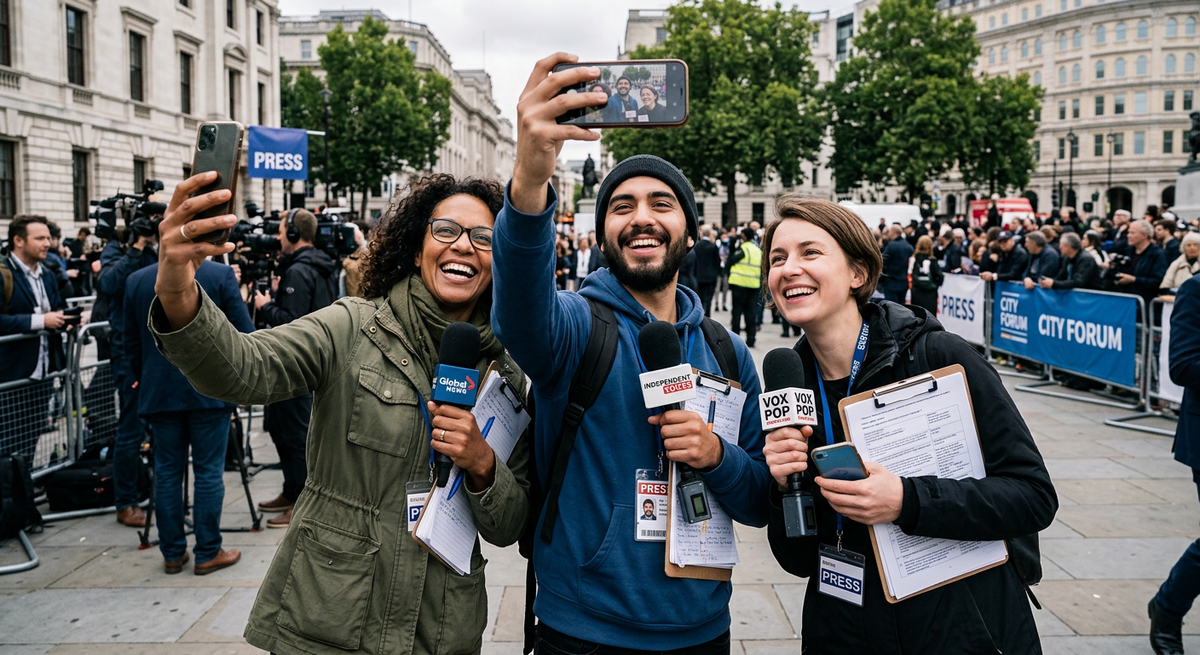
Fast forward to today. The gatekeepers are gone. In their place stands a single person — blogger, influencer, TikTok journalist, independent storyteller — who decides what to cover, how to edit it, when to publish it, where to post it, and why it matters. The entire editorial infrastructure of a mid-century newspaper now lives inside one human being, armed with a smartphone and a social media account.
This is extraordinary. It is also terrifying.
And sometimes, the consequences aren't physical. Sometimes they're professional — quiet, swift, and just as devastating.
A decade ago, a social media manager working for an unnamed environmental non-profit in Vancouver — an organization with hundreds of members passionate about recycling, clean energy, and greening the city — posted a photograph during a Twitter campaign. It was a simple image: an overflowing garbage can at Kitsilano Beach, surrounded by more garbage, an obvious snapshot of civic neglect on a warm Vancouver day. No caption required. The picture spoke for itself.
The problem? The City of Vancouver was a dues-paying member of that organization. And members, apparently, expected to be supported — not reported on. Within days, the social media manager was fired. No hearing. No editorial process. No senior editor to mediate between the public interest and the political pressure. No gatekeeper to ask whether this was really worth losing someone over. Just a photograph, a complaint, and a career consequence.
It was a perfectly innocent act of citizen journalism — precisely the kind of transparent, accountability-driven content that new media champions celebrate. And it cost someone their job. No lawyers, no process, no appeal. Just the raw, unmediated consequence of a single post.
Consider Rachel Gilmore, an independent journalist who broke a story about a group she described as neo-Nazis using a gym after hours for private meetings. The gym responded immediately — those men were removed. The story worked. But then came the consequence. Two of them showed up at a bar where Gilmore was watching her boyfriend perform. She felt their eyes on her — a deliberate, cold stare designed to unsettle her, to remind her that she was exposed. She photographed them and posted it online. Brave. Necessary. But deeply, soberly exposing.
And this story is not over. The photograph is public. Her face is known. Her location that night was broadcast to thousands of followers. Whatever comes next — another encounter, escalating harassment, or worse — she will face it as she faced the first moment: alone, without security, without institutional backing, armed with nothing but her own nerve. We are watching this one unfold in real time.
Now consider Mocha Bezirgan, an independent Canadian journalist who covers Khalistan-related protests across Canada, the UK, the US, and New Zealand. While filming a rally in downtown Vancouver, Bezirgan alleged he was surrounded and threatened by a group of Khalistan supporters, who briefly snatched his phone to stop him from recording. "It just happened two hours ago and I'm still shaking," he told a news agency afterward.
He alleged that one individual had been harassing him online for a long time using dehumanising language, and that this same person targeted him at the rally. Bezirgan said the attack was motivated by his editorial independence — that pro-Khalistan groups wanted to influence or buy him, and when they couldn't, they came for him in person. He filed a police report — not for the first time.
Three stories. Three very different consequences. The same brutal lesson underneath all of them.
That lesson is this: when you are a one-person newsroom, you carry not just the freedom of the press — you carry all of its risk, alone. No legal team. No security detail. No senior editor asking, quietly, over a cup of bad coffee, are you sure you want to poke this particular bear? Just your instincts, your judgment, your phone, and whatever courage you woke up with that morning.
In the old model, an editor might have caught that Kitsilano Beach photo before it went live and asked: who are our members? What are our obligations? Maybe the story would have been killed. Maybe that's wrong — the public deserved to see that overflowing bin. But at least someone would have asked the question. Today, there is no one to ask. You post, and then you find out what happens next.
"These intimidation tactics won't stop me," Bezirgan declared after the incident. That kind of resolve is admirable. It is also a reminder of how much we are asking of people who simply want to report the truth.
The old newsroom had its sins. But it understood, at least, that journalists operating in contested spaces needed protection — institutional, legal, physical. The new media landscape has democratised the press in ways that would have seemed miraculous in 1955. But it has also sent its practitioners out into the world without armour — to face angry crowds, intimidating strangers, and quietly furious employers, all without a safety net.
Write about goons, and goons may come looking. Cover a rally, and the crowd may turn on you. Post a picture of a garbage can, and you might lose your job by Monday.
The freedom is real. So is the danger. Be careful out there.
Elke Porter at:
Westcoast German Media
LinkedIn: Elke Porter or
WhatsApp: +1 604 828 8788.
Public Relations. Communications. Education
Let’s bring your story to life — contact me for books, articles, blogs, and bold public relations ideas that make an impact.
TAGS: #IndependentJournalism #NewMedia #FreePress #JournalismMatters #MediaFreedom #CitizenJournalism