The "Diplomat’s Notebook" No. 3
Nicholas Jeffery | WBN News – Global | February 17, 2026 Subscribe to WBN News
There is a moment, walking from the Danube into Budapest’s 9th district, when the city changes temperature and tone.
Buda is elevation — elegant sports arenas with cafés, fencing halls, and tennis courts behind tree-lined walkways. Pest is compression — tramlines, traffic, kebab and coffee shops, concrete stairwells. And in the middle of Ferencváros, rising like a declaration rather than a building, sits the stadium.
You do not need to understand football to understand what it means. In Hungary, as in much of Europe, sport has never simply been sport. It is infrastructure for belonging — not unlike the ancient amphitheatre in Rome.
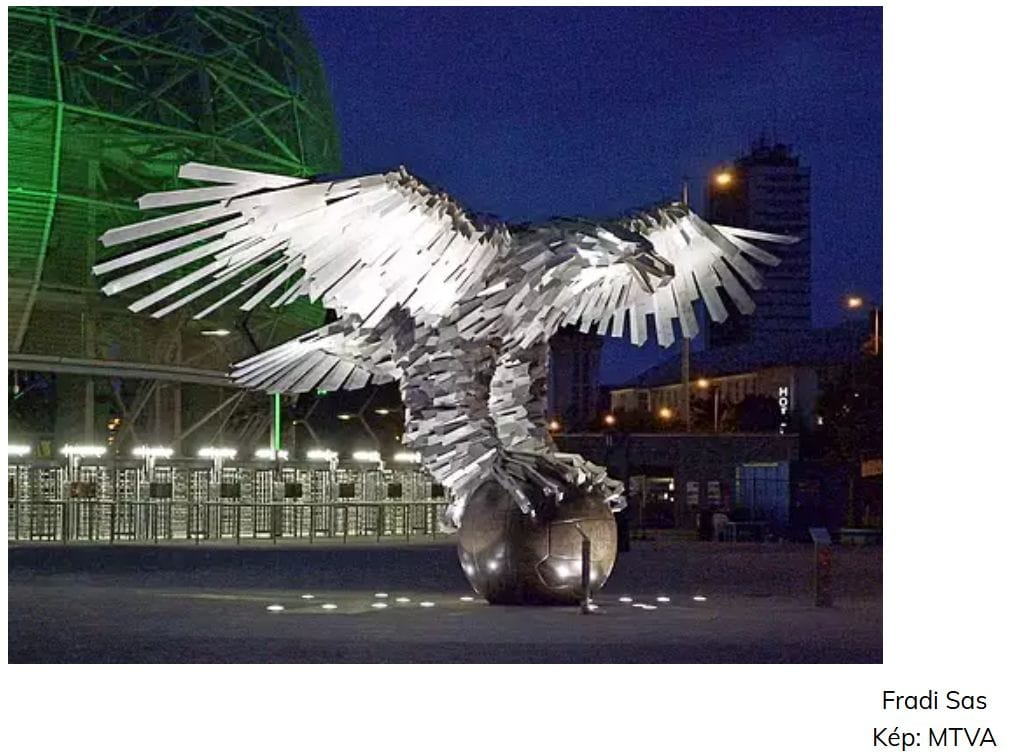
Ferencvárosi TC — Fradi — was never just a club. Founded in 1899, it became a neighbourhood identity. Overseen by the steel Turul, the falcon-like national symbol said to have guided the ancestors of the Hungarians to the Carpathian Basin in 896 AD, the club embodies more than sport. The Turul appears in the legend of Emese, representing the origin and destiny of the Árpád dynasty.
The 9th district was — and remains to some extent — industrial: railway workers, mechanics, market traders; now accountants, software firms, telecom companies — the so-called fifth industrial revolution. The club’s colours were worn less as merchandise than as a statement of who you stood beside on Monday morning.
In documentary films about the district, older supporters barely describe matches. They describe periods of life marked by seasons. Promotions are remembered like birthdays. Relegations like funerals. In places like this, a football club is not entertainment. It is social structure. Politics has always understood that.
Why Governments Build Stadia
Modern Hungary has built stadiums with unusual consistency, from Budapest to towns small enough to know each other’s dogs. Estimates suggest football-related spending since 2010 has reached into the multiple billions of euros, depending on how one counts public subsidies and redirected taxes.
To an outsider, this may appear irrational. Politically, it is precise.
Sport delivers three things governments struggle to manufacture:
- Emotion without debate — you inherit fandom; you do not reason your way into it.
- Collective ritual — thousands singing the same words still works better than any civic campaign.
- Visible achievement — concrete persuades faster than policy papers.
A hospital is necessary. A stadium is visible.
Pest and Buda: Two Sporting Cultures
Budapest has long sustained two sporting sensibilities.
On Buda’s hills: fencing, tennis, rowing along the Danube — individual disciplines of refinement, heirs to the Austro-Hungarian bourgeois world. They produce medals and diplomats.
On Pest’s flats: football, boxing, wrestling — collective, loud, bodily. They produce terraces.
Prestige sports create admiration.
Mass sports create identity.
Governments rarely need to mobilize admiration. They need to mobilize belonging.
So investment follows the chant, not the épée.
The Stadium as Social Policy
In much of Western Europe, stadiums are justified economically — regeneration, tourism, jobs. In Hungary, the logic often feels more sociological.
A stadium tells a district: you exist in the national story.
Mega-events impress the world. Domestic leagues shape the week — because they repeat. And repetition normalizes feeling. Club loyalty flows into city pride, and city pride into national pride. Not as propaganda, but as familiarity.
Many countries spend heavily to host a single great tournament. Hungary has instead built a permanent landscape — fewer fireworks, more habit. Although, on the banks of the Danube, national fireworks rival almost anywhere in the world — even New Year’s Eve in Sydney.
Looking to Reduce Your Credit Card Fees? Click here
Beyond Cynicism
It is tempting to call all of this manipulation. Sometimes it is. Often it is simpler. Politics seeks what sport provides effortlessly: shared belonging.
The Buda fencer perfects individual excellence.
The Fradi supporter participates in collective existence.
Governments can negotiate with voters. They cannot negotiate with belonging. So they build stadiums — not because football outweighs schools or hospitals in social spending priorities, nor simply to impress. But because identity operates on a different register than policy.
On a cold evening in the 9th district, when thousands sing in unison, the distinction between state, city, and self briefly dissolves.
For a politician, that is power.
For a supporter, it is simply home.
The election will pass. Hungary will remain — interpreted, debated, but ultimately itself.
I welcome your reflections and look forward to the next instalment of Danube Dispatches — “The Smart City Paradox.”
Thank you,
Nicholas Jeffery
By Ambassador Dr. Nicholas Jeffery
Nicholas Jeffery LinkedIn: http://linkedin.com/in/nicholas-jeffery
Tags: #Nicholas Jeffery #Danube Dispatches #Diplomat’s Notebook #Hungary #Budapest #European Affairs #Geopolitics #Sport and Society #WBN