By Troy Tyrell | WBN News Vancouver | Feb 25 2026
π’ Subscription to WBN and being a Contributor is FREE.
π Click here to begin reading or writing with us!
Artificial intelligence is transforming business, government, and everyday life. A recent WBN AI edition explainer breaks down the concept of the Technological Singularity, the idea that AI could eventually surpass human intelligence and reshape how decisions are made across every sector.
While the trajectory of the technology is exciting, the real world is reminding us of something important. Technology works best when it supports people, not when it replaces them.
What the Singularity Article Gets Right
The WBN article defines the Singularity as a hypothetical point where AI becomes so capable that it can improve itself autonomously, accelerating innovation and dramatically increasing efficiency.
Most experts agree we are not there yet. What is undeniable is this:
- AI is already reshaping how businesses generate marketing strategies, analyze data, and write software.
- Intelligence is becoming scalable, changing productivity and competitive advantage.
This is not science fiction. It is already happening.
Where Current AI Falls Short Especially in Public Service
Now letβs look at reality.
Canadians trying to navigate federal government automated systems are experiencing something very different from the Singularity theory. Instead of efficiency, many are encountering inefficient loops that feel like digital mazes rather than solutions. Users are sent back to the same forms, the same prompts, and the same instructions without meaningful resolution.
That is not intelligent automation. It is poor user design being labeled as AI.
AI should streamline processes. Instead, many current systems:
- fail to recognize context
- cannot properly escalate complex inquiries
- rely on rigid scripts instead of real problem solving
That is not what modern AI is capable of when designed properly. It is also not what Canadians want.
Human Intelligence Still Matters
AI can and should remove routine tasks from human workloads. Data entry, repetitive documentation, status updates, scheduling, and basic information lookups are ideal for automation.
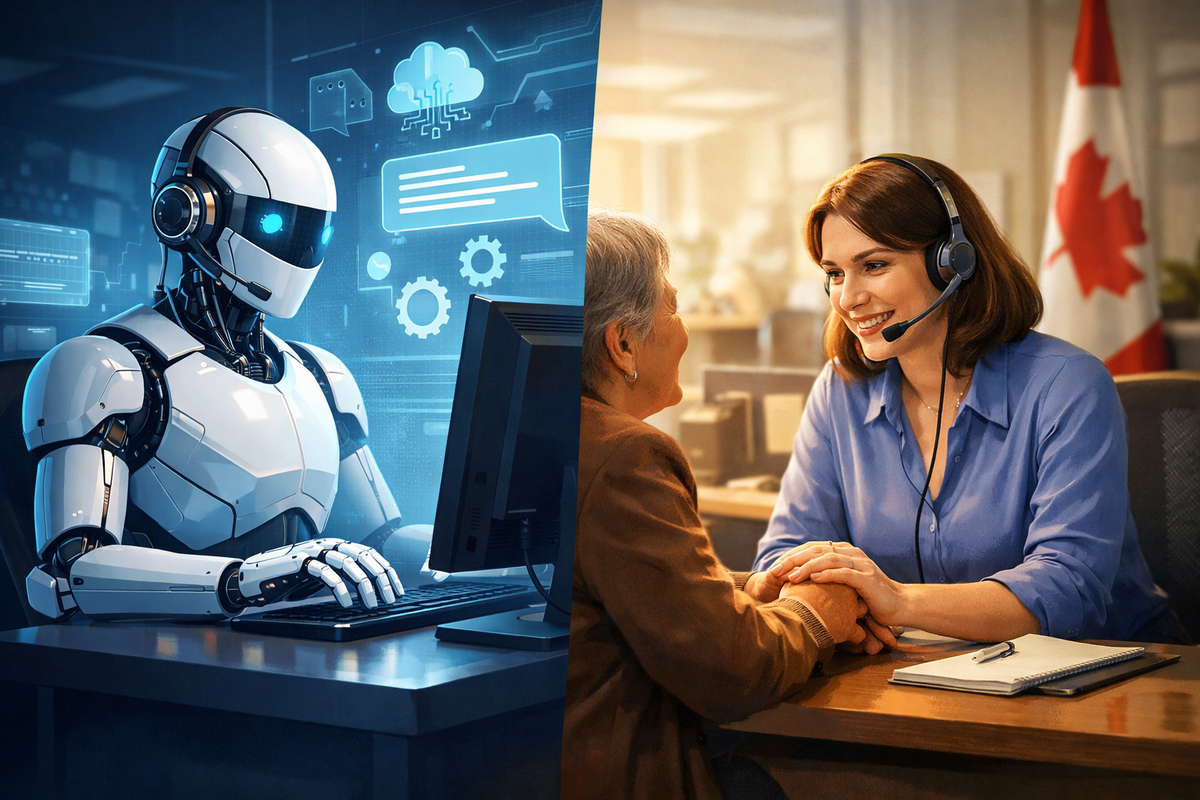
What AI should not become is the only point of contact for real human problems.
There are situations where people need people, especially when:
- circumstances are complicated or unique
- emotional stress is involved
- financial or life altering decisions are at stake
AI can deliver information.
AI can speed up processing.
AI can assist with triage.
But empathy, judgment, and understanding remain human strengths.
When someone is dealing with disability benefits, immigration status, taxes, or health coverage, they are not looking for a script. They are looking to be heard and understood. That requires a human being.
A Better Model Is AI and Human Collaboration
The smarter path forward is not AI only. It is AI assisted service.
Let automation handle:
- pre screening and routing
- repetitive documentation
- routine questions
- data processing
Let humans handle:
- final decisions
- appeals and exceptions
- emotional and sensitive cases
- complex problem solving
This model does not reject innovation. It improves it.
The Bottom Line
AI will continue to evolve. Whether or not we ever reach a true Singularity, artificial intelligence is already changing how institutions operate.
The opportunity is real. The efficiency gains are real. The cost savings can be real.
But human understanding cannot be removed from the equation.
The strongest systems will combine technological speed with human judgment and empathy. That is not resistance to progress. That is responsible progress.
By Troy Tyrell, ttyrell@wbnn.news
Founder of Tsquared Personal Training
WBN Contributor | Community Builder | Mountain Biker | Advocate for Local Business & Fitness
π Google Business Profile β Tsquared Personal Training,
π Connect on LinkedIn
π Follow on Facebook
Tags
#ArtificialIntelligence #HumanCustomerSupport #DigitalTransformation #PublicService #TroyTyrell