What Excessive Bike-Lane Brining Reveals About Cost, Risk, and Accountability in Vancouver
By Troy Tyrell | WBN News Vancouver | Dec 27, 2025
📢 Subscription to WBN and being a Contributor is FREE.
👉 Click here to begin reading or writing with us!
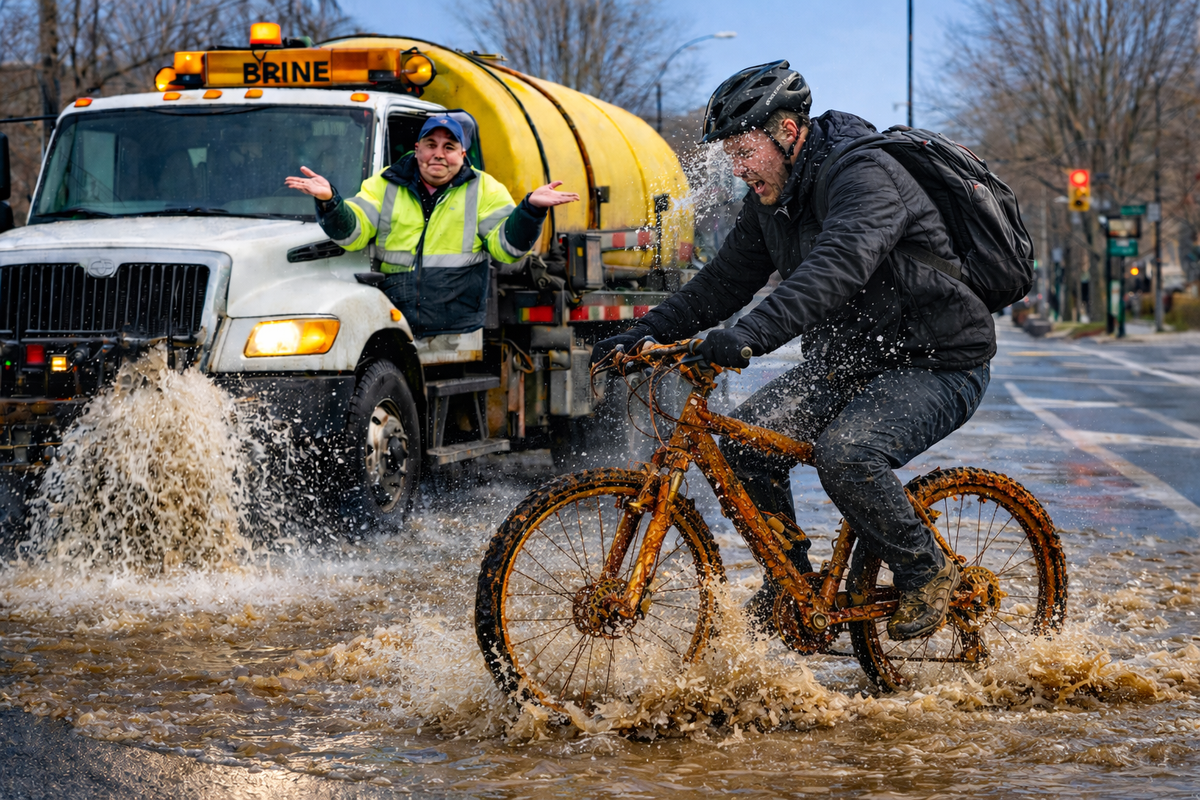
On a cold but sunny day in Vancouver, I followed a City brine truck make yet another pass down Ontario Street. No snow. No ice. Just a steady stream of brine soaking the bike lane again. This is not a one-off or a single-season anomaly. It is something I have observed repeatedly over several years, across multiple winters, under similar dry conditions.
By mid-afternoon, I had counted six, then seven, then eight passes over the same stretch.
When I asked the operator why the lane was being treated repeatedly, the response was simple:
“I’m doing my job.”
That answer is not the issue. It is the signal. It reveals how “the job” has been defined and how little outcome seems to matter once the truck is rolling.
A Near Miss That Should Not Have Happened
Earlier that same day, while cycling through the same corridor, I experienced a near-collision. The road surface was wet with fresh brine. As I approached an intersection, a driver, clearly distracted and looking at a phone, drove straight through a stop sign.
I attempted to stop. Under normal dry conditions, I would have. On a brine-coated surface, my braking distance increased just enough that a collision became a matter of inches. I avoided impact by luck, not by safe system design.
Distracted driving is already a known risk. Wet surfaces increase stopping distances. Combined, they create an avoidable hazard, one that disproportionately affects cyclists and pedestrians.
The Business Question No One Is Asking
In the private sector, sending a truck over the same route eight times a day without changing conditions would raise immediate concerns:
- What problem is being solved on the sixth pass that was not solved on the first?
- What is the marginal benefit of each additional application?
- What is the cost per pass, per hour, per corridor?
- What is the impact on equipment lifespan and maintenance budgets?
- Who is accountable for outcomes rather than activity?
If a logistics company burned fuel idling and looping the same block all day, it would not be praised as diligence. It would be flagged as inefficiency.
Public operations deserve the same scrutiny.
Real Costs, Quietly Compounding
Excessive brining carries real and accumulating costs.
For the City
- Fuel usage and idling costs
- Accelerated corrosion and wear on brine trucks, pumps, hoses, brakes, and drivetrains
- Increased maintenance cycles and shortened equipment lifespan
- Labour hours spent repeating tasks regardless of conditions
- Added emissions that conflict with stated climate goals
For Residents
- Accelerated corrosion of bicycles used for daily transportation
- Premature failure of chains, bearings, braking systems, and e-bike electronics
- Increased out-of-pocket maintenance costs
In business terms, this is cost shifting. The City absorbs operating costs. Residents absorb the damage.
Activity Is Not Productivity
When “doing the job” becomes synonymous with repeating the task, systems lose focus on outcomes.
Well-run organizations measure:
- Results, not repetition
- Risk reduction, not volume of action
- Cost per outcome, not hours logged
Repeatedly brining a dry corridor over multiple years suggests a schedule-driven process rather than a condition-based one. That is not a labour issue. It is a management and oversight issue.
What Smarter Operations Look Like
A business-minded model would ask:
- What conditions actually trigger brining?
- How is re-application justified and recorded?
- Are bike lanes treated more frequently than vehicle lanes?
- What are the per-day fuel, labour, and maintenance costs?
- Are safety outcomes improving, or just activity metrics?
These are standard operational questions in any accountable organization.
Why This Matters Beyond Cycling
This issue extends beyond bike lanes. It reflects how small inefficiencies, repeated daily across years, quietly erode:
- Budgets
- Asset lifespan
- Environmental credibility
- Public trust
When systems reward motion instead of results, costs rise and safety declines.
Redefining “The Job”
Winter maintenance matters. Over-application does not.
Redefining the job to prioritize conditions, outcomes, and cost awareness would:
- Improve safety
- Reduce unnecessary spending
- Protect City assets
- Reduce environmental impact
- Respect workers and taxpayers alike
No one benefits from brine puddles on dry days. Not cyclists. Not drivers. Only City crews' paychecks, and not the balance sheet.
By Troy Tyrell, Founder of Tsquared Personal Training
WBN Contributor | Community Builder | Mountain Biker | Advocate for Local Business & Fitness
📍 Google Business Profile – Tsquared Personal Training,
🔗 Connect on LinkedIn
📘 Follow on Facebook
Hashtags
#Excessive Brining #Troy Tyrell #WBN Vancouver #Vancouver Streets #Public Safety #Taxpayer Accountability #Road Safety