By Elke Porter | WBN News Global | January 20, 2026
Subscription to WBN and being a Writer is FREE!

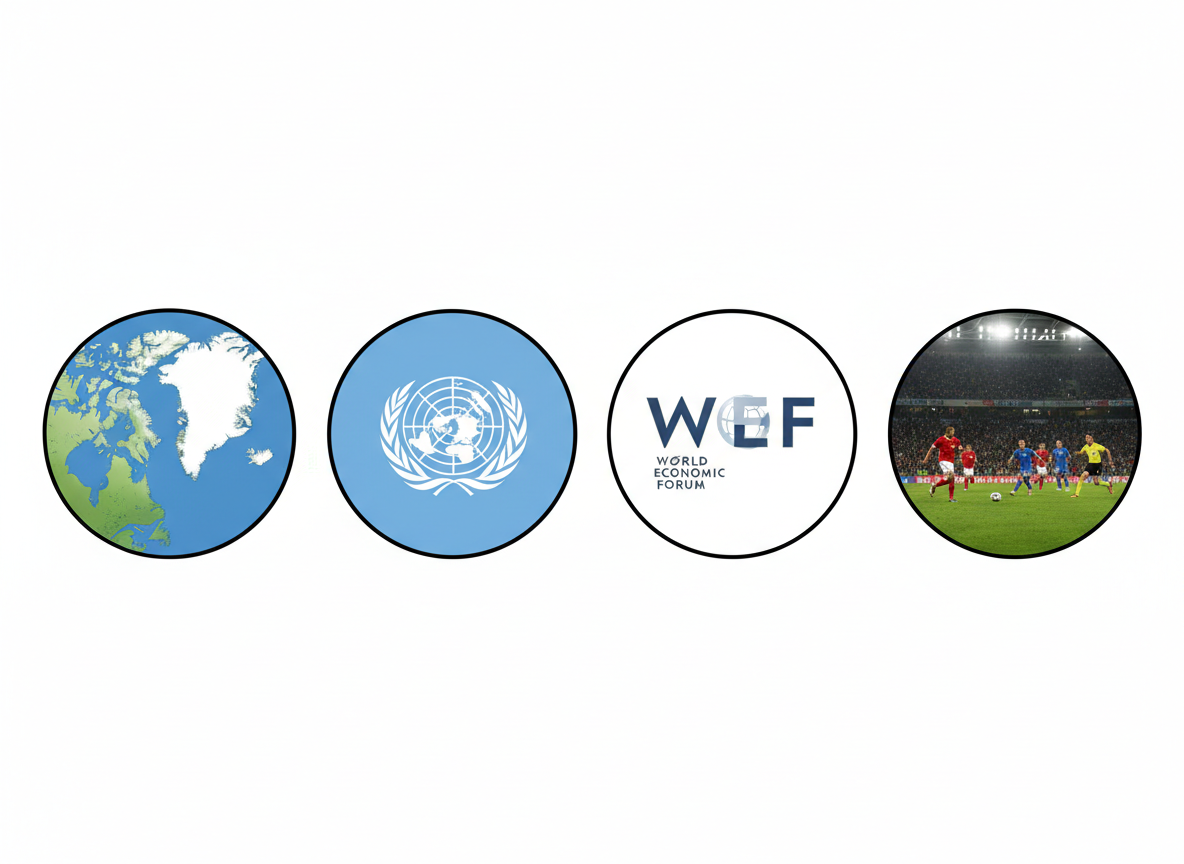
The Greenland Crisis Unfolds

Greenland dominates headlines as President Donald Trump escalates his campaign to acquire the world's largest island from Denmark, creating what experts describe as the greatest transatlantic crisis in generations. Trump has pushed to purchase (for $700 billion USD) or annex Greenland and imposed tariff threats on NATO allies opposing his ambitions, fundamentally shaking America's relationships with its closest partners.

According to NBC News, "“I’d love to make a deal with them,” Trump told reporters Sunday when he was asked whether there is a deal Greenland could offer. “It’s easier. But one way or the other, we’re going to have Greenland.”

Background: From Viking Settlement to Modern Autonomy

Greenland, spanning over 800,000 square miles with just 56,000 inhabitants, is an autonomous territory within the Kingdom of Denmark. Greenland was officially a Danish colony until 1953, when its status changed to a district within Denmark, according to denmark.dk.

Nearly 90% of its population is of Inuit heritage, and the territory exercises significant self-governance while Denmark handles foreign affairs and defense. In 2023, Greenland unveiled its first draft constitution, calling for the creation of a Greenlandic republic, signaling the territory's long-term independence aspirations.

Why Greenland Matters Now

The island's sudden importance stems from converging factors. Climate change is melting Arctic ice, opening new shipping routes and access to resources. Greenland holds deposits of rare earth minerals essential to modern technology, renewable energy and military systems—elements currently dominated by Chinese exports. The U.S. already operates Pituffik Space Base in northern Greenland, a crucial installation for monitoring Arctic activity.

Trump argues control of Greenland is vital for national security, claiming that without American ownership, Russia or China will seize influence. However, critics note that Denmark and NATO have protected Greenland for nearly 80 years, and recent intelligence assessments question the immediacy of these threats.

The Institute for China-America Studies (ICAS) is an independent think tank in Washington D.C. ICAS focuses on the evolving dynamics in the U.S.-China relationship to promote greater collaboration and mutual understanding through sincere exchanges of fresh ideas, objective policy-oriented research, and fair assessments of this critical bilateral relationship. 

They stated that, "In 2019, President Donald Trump famously floated the idea of purchasing Greenland — a move dismissed as absurd by many, but underscoring Washington’s deepening interest in the island. The same year, the US signed a memorandum of understanding (MOU) with Greenland to support sustainable mineral resource development.

Military Deployments and Operation Arctic Endurance

Denmark has deployed over 200 troops to Greenland, with 58 Danish soldiers arriving to join about 60 others already dispatched for Operation Arctic Endurance. Major General Søren Andersen confirmed about 100 Danish soldiers arrived in Nuuk, Greenland's capital, with similar numbers deployed to Kangerlussuaq. Denmark already had up to 150 troops stationed in Greenland available for the operation prior to its beginning, and as of January 18, over 100 troops were present in Nuuk and over 100 in Kangerlussuaq.

The Danish deployment has been joined by European allies. France deployed up to 15 military personnel, while Germany agreed to deploy 13 troops to the island. Finland is assessing Denmark's request to send troops, while Norway and Sweden have also committed forces. Denmark's defense minister indicated these forces might stay in Greenland for 1-2 years.

Canada's Greenland Connection

Canada shares a 3,000 kilometer maritime border with Greenland—the longest maritime border in the world. The two neighbors have strengthened ties through the 2022 Hans Island Agreement and discussions around free trade, critical minerals cooperation, and Arctic security. Canadian Prime Minister Mark Carney recently discussed Greenland with Chinese President Xi, finding alignment that Greenland should determine its own future. Canada has positioned itself as a potential partner for an independent Greenland, offering economic union possibilities rather than conquest.

The United Nations Budget Crisis: A Perfect Storm

While the Greenland crisis unfolds, the United Nations faces its own existential threat—one that receives far less media attention but carries equally catastrophic implications. UN Secretary-General António Guterres has warned the organization faces a "race to bankruptcy," presenting a sharply reduced budget of $3.238 billion for 2026, a 15% decrease from the 2025 funding level of $3.72 billion. This includes an 18.8% cut in staffing.

The financial crisis is severe. As of May 9, 2025, member states had paid just $1.8 billion towards the UN's $3.7 billion regular budget for 2025, with total unpaid assessments standing at approximately $2.4 billion as of April 30. The United States is the largest debtor at about $1.5 billion, with China owing $597 million, Russia $72 million, Saudi Arabia $42 million, and Mexico and Venezuela each owing $38 million.

The implications of UN collapse would be staggering. The organization's $3.7 billion regular budget represents only a fraction of the wider UN system, which had revenues totaling $67 billion in 2024. President Trump's FY 2026 budget request would eliminate funding to most UN bodies, including the UN regular budget and UN peacekeeping operations. This would mean the UN losing its main contributor accounting for approximately $13 billion of funding—more than a quarter of its collective budget.

High arrears totaling $760 million at the end of 2025, coupled with a requirement to return $300 million in credits to member states at the start of 2026, removes nearly 10% of the budget from available cash. Guterres warned the UN could face returning $600 million—potentially 20% of the budget—in 2027, accelerating the organization toward insolvency.

The humanitarian cost is already visible. In Sudan, only 13% of the $4.2 billion needed for 2025 has been received, forcing 250,000 children out of school. In the Democratic Republic of Congo, gender-based violence cases have surged 38% while programs shut down. In Haiti, cholera response efforts risk collapse, and only 25% of Ukraine's 2025 humanitarian appeal has been funded.

If the UN collapses, the world loses its primary forum for international cooperation, humanitarian coordination, peacekeeping operations, and human rights monitoring. The economic implications extend beyond the organization itself—a breakdown in international cooperation could disrupt global trade worth trillions, undermine disease control systems, fragment refugee assistance, and eliminate coordinated responses to climate change. No alternative institution exists with the UN's scope, legitimacy, or infrastructure.

Financial Implications of American Acquisition

If Greenland became U.S. property, the financial ramifications would be substantial. The territory receives approximately $860 million annually from Denmark. American acquisition would presumably require far greater investment in infrastructure, healthcare, and governance. Beyond direct costs, NATO's potential collapse would devastate European-American trade relationships worth trillions annually.

The United States currently manages 14 territories, including five inhabited ones: Puerto Rico (3.3 million people), Guam, the U.S. Virgin Islands, the Northern Mariana Islands, and American Samoa. Most were acquired through the Spanish-American War (Puerto Rico, Guam) or purchase (Virgin Islands from Denmark in 1916). Unlike states, territory residents cannot vote in presidential elections and lack full congressional representation, raising questions about what governance structure Greenland might face.

The WEF That Nobody's Watching

The World Economic Forum's 56th Annual Meeting is taking place January 19-23, 2026 in Davos, Switzerland, under the theme "A Spirit of Dialogue," with a record 400 top political leaders including nearly 65 heads of state and government, and about 850 of the world's top CEOs attending. President Trump is scheduled to deliver a speech on Wednesday, along with appearances by French President Emmanuel Macron, European Commission President Ursula von der Leyen, Canadian Prime Minister Mark Carney, and Ukrainian President Volodymyr Zelenskyy.

Yet the event that normally commands global media attention has been almost completely overshadowed by the Greenland crisis. On Monday, the World Economic Forum confirmed that the Danish government will not be represented in Davos this week, a symbolic absence that speaks volumes about how the crisis has upended normal diplomatic proceedings. The sessions on artificial intelligence, climate change, and global economic cooperation—topics that would typically dominate headlines—have been relegated to background noise as the world watches a potential NATO rupture unfold in real time.

The crisis continues to evolve, reshaping Arctic geopolitics and challenging the foundations of Western alliances while simultaneously distracting from both the existential budget crisis at the United Nations and the traditional forum for global cooperation in Davos. Denmark has deployed troops to Greenland alongside NATO allies, 85% of Greenlanders oppose an American takeover, and the international community watches anxiously as the rules-based order faces its most serious challenge in generations.

An Unlikely Unity: The World Cup Complication

Adding a surreal dimension to this geopolitical chaos is the fact that all three North American leaders—Trump, Carney, and Mexican President Claudia Sheinbaum—must collaborate on hosting the 2026 FIFA World Cup, described by FIFA President Gianni Infantino as the greatest event humanity has ever seen.

In December 2025, the three leaders appeared together at the Kennedy Center for the World Cup draw, smiling, chatting, and conducting what looked like a dress rehearsal for continental unity. Trump and Sheinbaum sat side by side, with Carney leaning across to engage both in friendly banter, and the trio later retreated for a private 45-minute meeting where they agreed to keep working together on trade issues. Trump even praised Sheinbaum as doing very excellent work.

The tournament, featuring 48 teams across 16 host cities in all three countries and beginning in June 2026, represents an unprecedented logistical challenge requiring seamless cooperation. Yet these same leaders find themselves on opposite sides of fundamental issues—Trump threatening tariffs and territorial expansion while Carney and Sheinbaum defend their nations' sovereignty and economic interests.

The World Cup, which would normally unite the continent in celebration, now serves as a painful reminder of how fractured North American relations have become, forcing leaders to maintain a veneer of partnership while navigating existential threats to their alliances.

The crisis continues to evolve, reshaping Arctic geopolitics and challenging the foundations of Western alliances while simultaneously distracting from both the existential budget crisis at the United Nations and the traditional forum for global cooperation in Davos.

Denmark has deployed troops to Greenland alongside NATO allies, 85% of Greenlanders oppose an American takeover, and the international community watches anxiously as the rules-based order faces its most serious challenge in generations—all while the world's largest sporting event looms as an unavoidable deadline for cooperation among increasingly antagonistic neighbours.

Elke Porter at:
Westcoast German Media
LinkedIn: Elke Porter or
WhatsApp:  +1 604 828 8788.
Public Relations. Communications. Education

Let’s bring your story to life — contact me for books, articles, blogs, and bold public relations ideas that make an impact.

TAGS: Greenland Crisis #Arctic Geopolitics #NATO #UN Budget Crisis #WEF 2026 #Denmark US Relations #WBN News World Sports Edition #WBN Finance #WBN News Global #Elke Porter

Share this article
The link has been copied!