By Elke Porter | WBN News World Sports | June 26, 2026
Subscription to WBN and being a Writer is FREE!
There should probably be a medical journal dedicated to it by now.
Not for torn hamstrings. Not for strained vocal cords from chanting "Ole, Ole, Ole."
No, this is something far more serious.
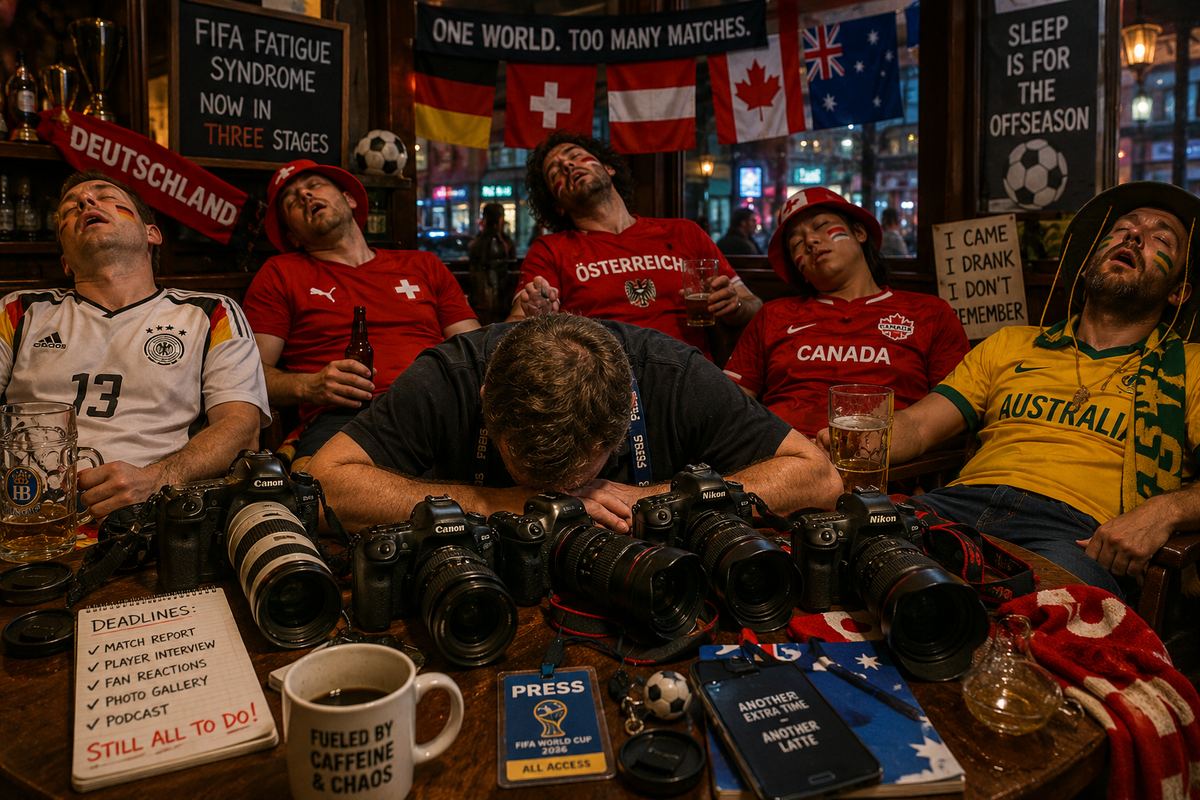
Welcome to FIFA Fatigue Syndrome (FFS)—the mysterious condition affecting thousands of otherwise healthy people during the 2026 FIFA World Cup.
Doctors haven't officially recognized it yet, but anyone walking down Granville Street or other main streets in World Cup 2026 Host Cities knows the symptoms are real.
Stage One: The Bar Owners
The first confirmed victims were, unsurprisingly, Host City bar owners.
At first, life was glorious.
Fans packed every patio. Beer taps worked overtime. Servers mastered the art of carrying twelve pints while dodging Argentine drums, German scarves, Swiss cowbells and Austrian flags.
Then came Match Day 18.
Nobody remembered what day of the week it was anymore.
Managers began greeting customers with, "Who are we cheering for today?"
Employees developed an uncontrollable twitch every time someone asked, "Can you put the other game on?"
Coffee replaced blood in their veins.
One owner was reportedly seen applauding when the referee blew the final whistle—not because his team had won, but because he finally had six whole minutes to mop the floor before the next crowd arrived.
Stage Two: The Fans
Next came the supporters.
The symptoms were unmistakable.
People started introducing themselves by their national team.
"Hi, I'm Austria."
"My name is Germany."
"I'm emotionally unavailable until penalties are over."
Entire friendships became dependent on VAR decisions.
Fans wore the same "lucky" jersey for twelve consecutive matches despite overwhelming evidence that luck had absolutely nothing to do with it.
Sleep schedules disappeared.
Breakfast happened at midnight.
Someone genuinely believed Tuesday was "Quarterfinal Eve."
Another insisted Vancouver had secretly moved into the Central European Time Zone.
The only language everyone understood was celebration.
Or heartbreak.
Sometimes both within ninety minutes.
Stage Three: FIFA Media
Finally, the illness reached the media.
Reporters.
Journalists.
Bloggers.
Podcasters.
Photographers.
Content creators.
Nobody escaped.
Media members developed an irresistible urge to photograph absolutely everything.
Fans waving flags?
Click.
Someone eating schnitzel?
Click.
Mascot dancing with police officers?
Twenty-seven photos.
Every interview began with the phrase, "Just one quick question..."
Forty-five minutes later everyone was still standing there discussing tactical substitutions from Group C.
Bloggers began dreaming in headlines.
Podcasters accidentally started narrating conversations with friends.
Journalists measured time not in hours but in deadlines.
"I'll meet you after the embargo lifts."
Even spellcheck surrendered.
Names like Kvaratskhelia, Wirtz and Šeško appeared so frequently that autocorrect quietly resigned.
There Is No Cure...
Medical experts—well, people standing in line for coffee—agree there is currently no cure for FIFA Fatigue Syndrome.
The only known treatment appears to be:
- One full night's sleep.
- Drinking water instead of a fifth espresso.
- Going at least three hours without checking match results.
- Remembering that your national team cannot hear you yelling at the television.
Unfortunately, compliance is almost zero.
With the Round of 32, Round of 16, quarter-finals, semi-finals and final still to come, experts predict cases will continue to rise.
Until one glorious day in July.
The final whistle blows.
Scarves are folded away.
The main streets of host cities becomes strangely quiet.
Bar owners sleep for fourteen straight hours.
Fans remember their real names.
Reporters rediscover weekends.
And somewhere, deep inside every football lover's heart, a tiny voice whispers:
"Only four more years until the next outbreak." ⚽😄
Elke Porter at:
Westcoast German Media
LinkedIn: Elke Porter or
WhatsApp: +1 604 828 8788.
Public Relations. Communications. Education
Let’s bring your story to life — contact me for books, articles, blogs, and bold public relations ideas that make an impact.
TAGS: #FIFAFatigueSyndrome #FIFAWorldCup2026 #GranvilleStreet #SoccerHumour #WorldCupFans #WBN News World Sports Edition