
Riding the Line: Who Keeps Vancouver Safe?
Vancouver transit safety is under scrutiny as riders face mental health crises and unhoused passengers. A call for policy action before tourist season peaks.


Vancouver transit safety is under scrutiny as riders face mental health crises and unhoused passengers. A call for policy action before tourist season peaks.
By Elke Porter | WBN News Vancouver | March 24, 2026
Subscription to WBN and being a Writer is FREE!
Public Safety on Vancouver’s Transit System and the Challenge of the Tourist Season — A Call for Thoughtful Policy Action
Vancouver is widely regarded as one of the most livable and visually stunning cities in the world. Each spring, summer, and fall, hundreds of thousands of tourists arrive to experience its mountains, waterfront, cultural institutions, and vibrant downtown core. Many of them — along with the city’s own residents — rely on TransLink’s buses and the SkyTrain to move safely through the city. It is precisely this reliance that makes the following question so urgent: are we doing enough to ensure that public transit in Vancouver is genuinely safe, welcoming, and dignified for everyone who uses it?
The answer, based on the lived experiences of everyday riders, is that we are falling short.
The incidents described below are not isolated. They are representative of a pattern that many Vancouver transit users encounter regularly, and they deserve to be taken seriously at a policy level.
Incident One: Granville Street, Late Evening
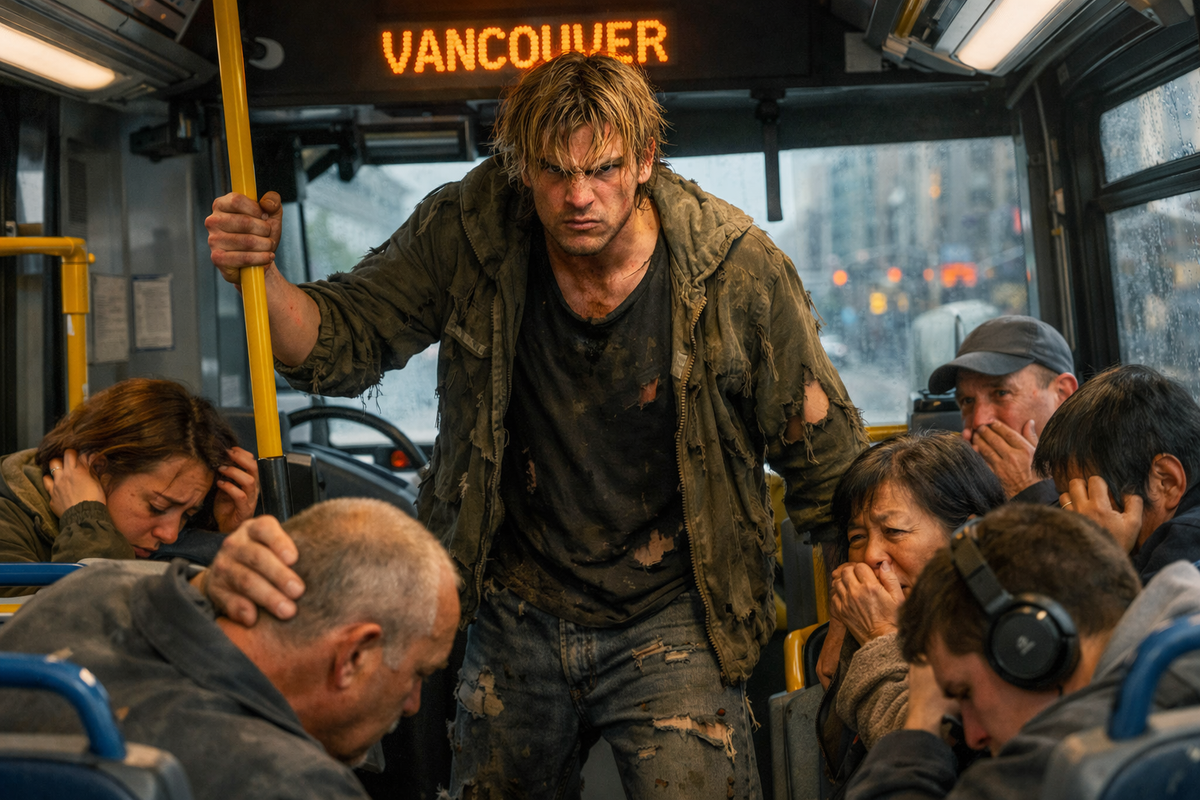
A rider departing a downtown cultural event around 10:30 pm on a Monday boarded a bus on Granville Street after an agitated young man — bellowing and jaywalking across the street — followed her onto the vehicle. Once aboard, this individual screamed, leapt into the air, and delivered a forceful kick to the side panel of the bus. Other passengers froze. No one intervened. The rider exited at the next stop, only to have the man follow her off the bus, where he continued his erratic behaviour — scattering papers across the street and pacing beside the bus before eventually walking away.
Was this person experiencing a mental health crisis? Under the influence of substances? Both? The rider — and every other passenger on that bus — had no way of knowing and no guidance on what to do. The bus driver, separated behind a partition, was either unaware or unable to act. The incident resolved itself only by chance.
Incident Two: Pender and Abbott — Two Worlds on One Street
In the area near Pender and Abbott, a rider observed the stark coexistence that defines parts of Vancouver’s Downtown Eastside. Tourists and residents in good health moved alongside individuals whose bodies bore the visible marks of long-term street life: malnutrition, untreated wounds, tattered clothing, and the fog of addiction. On the bus in that same area, a man experiencing what appeared to be a mental health episode began singing loudly and persistently. It took several minutes before another passenger intervened verbally. The rider felt a complicated mix of compassion, fear, and a deep frustration — not at the unhoused individuals themselves, but at a system that permits human beings to deteriorate so visibly and so publicly, in the name of personal freedom.
Incident Three: SkyTrain, Daytime
On a Saturday afternoon, in full daylight, a rider witnessed a man in apparent psychotic distress shouting inappropriate remarks on the SkyTrain. When he approached a teenage girl and attempted to physically engage with her, a bystander finally stood up — literally placing himself in the aisle as a physical barrier — and firmly instructed the man to remain seated. It worked, this time. But it required a private citizen to assume a risk that transit safety infrastructure should have mitigated before it reached that point.
These three accounts surface a set of interlocking challenges that no single agency can solve alone, but which collectively demand a coordinated municipal and provincial response.
1. Mental Health Crisis Response on Transit
All three incidents appear to involve individuals experiencing some form of mental health episode, substance-related crisis, or both. TransLink’s current model relies heavily on Transit Police, who are trained primarily in law enforcement rather than de-escalation and mental health intervention. While the Transit Police Service has made strides in community-based approaches, the gap between demand and capacity remains significant.
Cities such as Denver and Eugene, Oregon have pioneered co-responder and alternative response models in which mental health professionals ride alongside or respond in parallel to law enforcement. Vancouver should examine whether a dedicated mental health co-response unit, embedded within or partnered with TransLink operations, could reduce dangerous incidents on buses and SkyTrain while connecting individuals in crisis to appropriate care — rather than simply removing them from the transit system and returning them to the street.
2. Visibility and Response Time of Transit Staff
In the Granville Street incident, the bus driver appears to have had limited ability to intervene. Modern transit vehicles are equipped with cameras, but real-time monitoring of passenger compartments remains inconsistent. Panic buttons exist but depend on drivers noticing or being alerted to incidents behind them. Consideration should be given to enhanced driver training in de-escalation, clearer protocols for requesting emergency assistance, and technology that allows drivers to alert Transit Police more rapidly when a disturbance is in progress.
There is a painful irony embedded in TransLink’s current emergency contact system. If you are a passenger being harassed, followed, or threatened on a Vancouver bus or SkyTrain, the official guidance is to text #878787 — the Transit Police non-emergency and safety tip line.
You must remember a seven-character string under stress. You must unlock your phone without your hands shaking. You must open a messaging app, type out the number, compose a coherent message describing your location, your car number, the nature of the threat — and send it, all while the person who is frightening you may be standing directly in front of you, watching your every move. Texting requires you to look down at your screen. It requires time. It requires fine motor control. These are precisely the capacities that adrenalin, fear, and shock systematically strip away from the human body.
A phone call — one tap on a clearly labelled emergency button, or a single voice-activated command — is categorically faster, easier, and more accessible under duress. The fact that TransLink’s primary passenger safety tool relies on written text communication is a design choice that deserves serious re-examination.
The same logic applies to the physical emergency systems aboard transit vehicles. Passengers are instructed to smash glass to access emergency handles or stop mechanisms. Again — this presupposes a level of deliberate, forceful action that is extraordinarily difficult to execute when your body is flooded with cortisol, your hands are unsteady, and your instinct is to freeze, flee, or appease rather than break things. For elderly riders, tourists unfamiliar with the system, children, or anyone with a physical limitation, these barriers are even higher.
Emergency systems must be designed for the worst moment of a person’s day, not their best. A system that functions well only when you are calm, oriented, and clear-headed is not truly an emergency system — it is a formality.
Vancouver’s transit authority and its policy partners should urgently review whether a dedicated, voice-based emergency line — simple, memorable, and phone-call accessible — could replace or supplement the text model. Consideration should also be given to clearly marked, one-touch emergency alert buttons visible to passengers throughout vehicle interiors, with direct links to live Transit Police dispatch rather than a monitored text queue. The goal is frictionless access to help, precisely when friction is most dangerous.
The city asks its transit riders to trust the system. The system, in return, must be worthy of that trust.
Transit vehicles and stations in Vancouver serve, informally, as shelter for a portion of the city’s unhoused population. This is not a transit problem — it is a housing and social services problem that expresses itself on transit. Displacing individuals from buses and SkyTrain without addressing the underlying conditions simply moves human suffering from one public space to another.
Effective policy must coordinate between TransLink, the City of Vancouver, BC Housing, Vancouver Coastal Health, and community organizations to ensure that outreach workers are present in high-concentration areas, particularly during the tourist season when visibility is highest and tensions can be amplified.
In each of the incidents above, ordinary riders were left to make difficult, potentially dangerous decisions in real time with no guidance. Should you engage? Exit the vehicle? Press an emergency button? Alert the driver? In the third incident, a bystander’s courageous and effective intervention protected a teenage girl — but it was entirely improvised.
TransLink and the City should consider a public awareness campaign specifically aimed at transit riders — both locals and tourists — that provides clear, simple guidance on what to do when witnessing a threatening or distressing situation on transit. This is not about encouraging vigilantism. It is about ensuring that people are not paralyzed by uncertainty when seconds matter.
Spring through fall brings an enormous influx of visitors who are unfamiliar with Vancouver’s transit system, its geography, and the social dynamics of its downtown neighbourhoods. A tourist who boards the wrong bus near Granville Street at 10:30 pm and encounters a threatening situation does not know the routes, does not know which stop to exit at, and may not know how to summon help. Multilingual safety information at major tourist-facing transit stops, clearer emergency contact signage on vehicles, and partnerships with hotels and tourism organizations to brief visitors on transit safety are low-cost, high-impact measures worth pursuing.
It would be a mistake to frame transit safety purely as a matter of containing or excluding the city’s most vulnerable residents. The individuals described in these accounts — whether in mental health crisis, addicted, unhoused, or all three — are also members of this city. Many of them are on transit because they have nowhere else to go. The goal of sound policy is not to make them invisible, but to ensure that every person — the tourist seeing Vancouver for the first time, the resident heading home from the opera, the teenage girl on the SkyTrain on a Saturday afternoon, and yes, the man in crisis on the bus — has access to safety, dignity, and where possible, care.
Criminalizing poverty or mental illness is not a transit policy. But neither is silence in the face of incidents that frighten, endanger, and erode public trust in a system that this city cannot function without.
• Establish a mental health co-response pilot program embedded within TransLink operations, in partnership with Vancouver Coastal Health.
• Review and strengthen real-time incident reporting tools for bus drivers, including enhanced monitoring protocols and faster Transit Police dispatch triggers.
• Replace or supplement the #878787 text-only reporting system with a direct, voice-activated or one-touch emergency phone line accessible to all passengers.
• Conduct a usability review of all physical emergency mechanisms on TransLink vehicles, with a focus on accessibility under high-stress conditions, including for elderly riders, tourists, and those with physical limitations.
• Develop coordinated outreach protocols for high-concentration areas in the Downtown Eastside and along major tourist transit corridors during peak season.
• Launch a clear, multilingual bystander guidance campaign for transit riders, distributed digitally and at key transit hubs.
• Create a tourism-transit safety partnership with Destination Vancouver, major hotels, and visitor information centres to brief tourists on safety practices and emergency procedures.
• Commission a review of current Transit Police response times and de-escalation training standards, with benchmarking against peer Canadian and international cities.
Vancouver has built a transit system that is the envy of many cities. Ensuring that it is safe — not just statistically, but experientially, for every person who depends on it — is not an aspirational goal. It is a basic obligation of governance.
Elke Porter at:
Westcoast German Media
LinkedIn: Elke Porter or
WhatsApp: +1 604 828 8788.
Public Relations. Communications. Education
Let’s bring your story to life — contact me for books, articles, blogs, and bold public relations ideas that make an impact.
TAGS: #VancouverTransitSafety #TransLinkBC #UrbanSafety #VancouverTourism #MentalHealthMatters #PublicTransitBC #WBN News Vancouver #Elke Porter