By Elke Porter | WBN News Global | February 28, 2026
Subscription to WBN and being a Writer is FREE!
The United States and Israel launched coordinated military strikes against Iran on Saturday morning, with President Donald Trump announcing the U.S. had begun what he called "major combat operations" aimed at eliminating threats from the Iranian regime. The operation has been officially named "Operation Epic Fury" by the U.S. Department of Defense.
What Happened
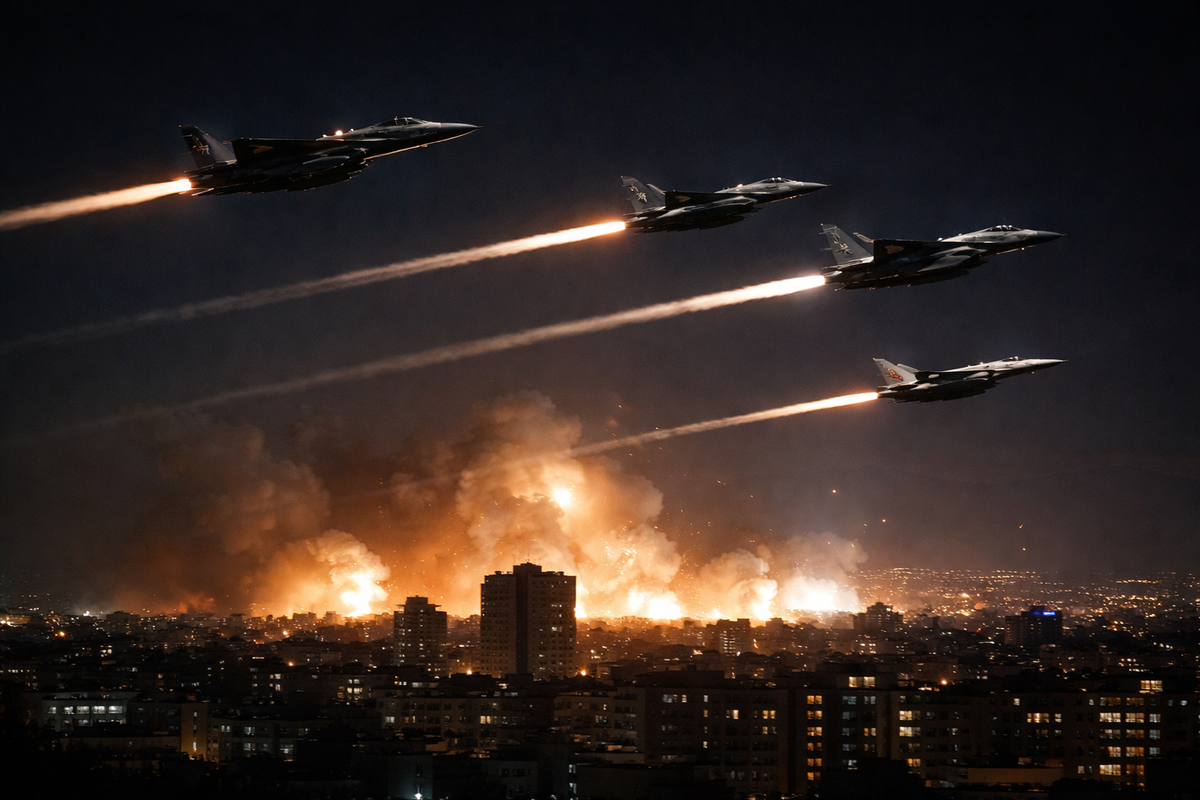
Explosions were heard and seen across Tehran and other parts of the country in the early morning hours. The Israeli Air Force said it struck 500 military targets in western and central Iran, including air defenses and missile launchers, using approximately 200 fighter jets.
The U.S. military targeted Iran's missile sites, air defense systems, and command and control centers for the Iranian Revolutionary Guard Corps. Iran's main intelligence agency was also targeted. The U.S. also used low-cost one-way attack drones for the first time in combat.
Among the targets were a district in Tehran where Iranian Supreme Leader Ali Khamenei normally resides, as well as the presidential palace and National Security Council. Seven missiles were confirmed to have struck this area.
Where
Strikes hit multiple areas in Tehran, including University Street and the Jomhouri area. Explosions also occurred in Tehran's northern Seyyed Khandan area, as well as in the western Ilam province and in Minab, in the Hormozgan province of southern Iran. Attacks were reported across 24 Iranian provinces in total.
When
Air strikes began during daylight on the morning of Saturday, February 28 — a regular workday in Iran. The decision to strike was made by President Trump on Friday, February 27, with the operation beginning the following morning.
Why
Israeli Prime Minister Benjamin Netanyahu said the attacks aimed to remove an "existential threat" posed by Iran, and were intended to "create the conditions for the brave Iranian people to take their fate into their own hands."
Trump urged Iranians to "take over your government" once the strikes were over, declaring "the hour of your freedom is at hand."
The strikes came against a backdrop of years of escalating tensions. A prior conflict between the U.S., Israel, and Iran had taken place in June 2025, during which the U.S. struck Iranian nuclear facilities at Natanz, Fordow, and Isfahan. The most recent round of U.S.–Iran nuclear negotiations, mediated by Oman in Geneva, had concluded just two days before Saturday's strikes, with Oman reporting "significant progress." Iran had reportedly agreed to reduce its nuclear stockpiles, yet the attacks proceeded regardless.
Beginning in late December 2025, massive anti-government protests had erupted across Iran, driven by economic hardship and the collapse of the rial — the largest protests since the 1979 revolution.
Who
Attacking forces: The United States military and the Israeli Defense Forces, in a joint operation planned for months. A senior Israeli defense official confirmed the operation had been planned for months, with a specific date set weeks in advance.
Key figures: U.S. President Donald Trump authorized the strikes. Israeli PM Netanyahu publicly confirmed and endorsed the operation. Israeli Defense Minister Israel Katz described it as a "preemptive attack" to remove threats to Israel.
Iran's response: Iran retaliated by targeting Israel and U.S. military assets in multiple Middle East countries, including Qatar, the UAE, Kuwait, Bahrain, Jordan, Saudi Arabia, and Iraq. An Iranian drone struck a densely populated neighborhood in Dubai. Netanyahu said there were "increasing signs" that Supreme Leader Khamenei had been killed, though this was unconfirmed.
Casualties and Damage
The Iranian Red Crescent reported more than 200 people killed and roughly 700 injured in Iran. An Israeli strike hit a girls' elementary school in Minab, killing at least 40 people, according to Iranian state media.
International Reaction
Criticism mounted internationally against Washington for launching military action while still engaged in nuclear negotiations with Tehran. The EU called for "maximum restraint." Mediator Oman warned the U.S. "not to get sucked in further." The International Atomic Energy Agency urged restraint to "avoid any nuclear safety risks." Top U.S. Democrats in Congress condemned Trump's decision, arguing the strikes require congressional authorization.
This is a developing story. Details, casualty figures, and the status of key individuals remain subject to change.
Sources & Further Reading
- BBC News Live Coverage: https://www.bbc.com/news/live/cn5ge95q6y7t
- Additional reporting was drawn from multiple wire services and news organizations covering the conflict in real time. Readers are encouraged to consult current coverage from Reuters, AP, BBC, Al Jazeera, The New York Times, and The Guardian for the latest developments.
Elke Porter at:
Westcoast German Media
LinkedIn: Elke Porter or
WhatsApp: +1 604 828 8788.
Public Relations. Communications. Education
Let’s bring your story to life — contact me for books, articles, blogs, and bold public relations ideas that make an impact.
TAGS: #IranAttack #OperationEpicFury #USIsraelIran #MiddleEastCrisis #IranStrikes2026 #WorldNews #WBN USA Edition #WBN News Global #Elke Porter