
On This Week | September 7–13: Discovery, Loss, Innovation And Change
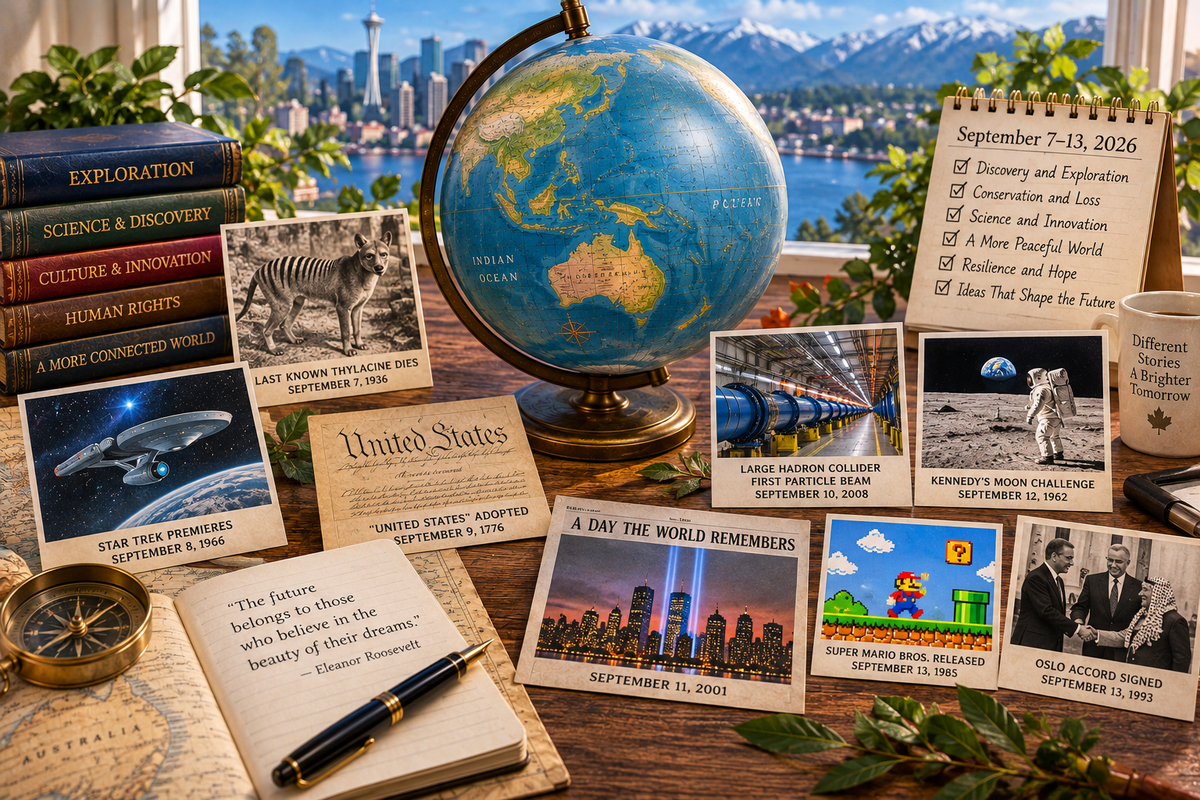
From Star Trek's 60th anniversary and 25 years since 9/11 to the Moon, CERN and the thylacine, September 7–13 shaped our world.

From Star Trek's 60th anniversary and 25 years since 9/11 to the Moon, CERN and the thylacine, September 7–13 shaped our world.
By Karalee Greer | WBN News - Vancouver | August 24-30, 2026
Subscription to WBN and being a Contributor is Free
One week can connect an extinct Australian animal, a television series that imagined humanity's future, the world's largest particle accelerator, a devastating terrorist attack, a challenge to reach the Moon and one of the most influential video games ever created.
September 7–13 is one of those remarkable weeks.
This year also brings two particularly significant anniversaries: 60 years since Star Trek first appeared on television and 25 years since the September 11 attacks.
Here is what happened On This Week.
On September 7, 1936, the last known thylacine died at Beaumaris Zoo in Hobart, Tasmania.
Often called the Tasmanian tiger because of the distinctive stripes across its back, the thylacine was not a tiger at all. It was a marsupial and was once the world's largest marsupial carnivore.
Hunting and trapping, along with habitat destruction and other pressures, contributed to its disappearance.
In a particularly tragic detail, Tasmania granted the species protected status just 59 days before the last known thylacine died.
September 7 is now observed in Australia as National Threatened Species Day, making the thylacine's story an enduring warning about protecting vulnerable species before it is too late.
On September 8, 1966, American television viewers were introduced to the starship Enterprise and a vision of humanity travelling among the stars.
Star Trek premiered on NBC and ran for three seasons from 1966 to 1969.
Its original television run was relatively short. Its influence was anything but.
The series imagined a future shaped by scientific discovery, exploration and people of different backgrounds working together.
September 8, 2026 marked the 60th anniversary of the original Star Trek premiere. The Smithsonian's National Air and Space Museum now holds the original Enterprise studio model among its collections.
Few television programs have had such a lasting relationship with real-world science and our imagination of the future.
Two months after declaring independence, America's former British colonies were still commonly referred to as the United Colonies.
On September 9, 1776, the Continental Congress formally adopted the name United States.
It was a seemingly simple change in wording that helped define the identity of the new nation.
Deep underground near Geneva, Switzerland, scientists switched on one of humanity's most ambitious scientific machines.
On September 10, 2008, the first particle beam successfully travelled around the entire 27-kilometre ring of CERN's Large Hadron Collider.
The LHC became the world's largest and most powerful particle accelerator.
Scientists built it to explore some of the most fundamental questions about matter and the universe.
Four years later, experiments at CERN announced the discovery of a particle consistent with the long-sought Higgs boson.
The enormous underground machine demonstrated something remarkable: sometimes understanding the smallest building blocks of nature requires building something extraordinarily large.
September 11 remains one of the most difficult dates in recent history.
On the morning of September 11, 2001, 19 al-Qaeda terrorists hijacked four commercial aircraft in the United States.
Two were flown into the World Trade Center towers in New York City. Another struck the Pentagon in Virginia.
Passengers and crew aboard United Airlines Flight 93 fought back against the hijackers before the aircraft crashed near Shanksville, Pennsylvania.
Nearly 3,000 people were killed.
The attacks transformed aviation security, international relations and national-security policy, and their effects continue to be felt today.
September 11, 2026 marked 25 years since the attacks.
For families who lost loved ones, survivors and first responders, however, September 11 is much more than a historical anniversary. It remains deeply personal.
On September 12, 1962, approximately 40,000 people gathered at Rice University in Houston to hear U.S. President John F. Kennedy speak about America's young space program.
Kennedy reaffirmed the national goal of landing a person on the Moon before the decade ended.
His message was that ambitious goals were worth pursuing not because they were easy, but because they were difficult.
At the time, sending people to the Moon remained an extraordinary technological challenge.
Less than seven years later, Apollo 11 astronauts Neil Armstrong and Buzz Aldrin walked on the lunar surface in July 1969.
The speech remains one of the defining moments of the Space Age.
A plumber named Mario was about to become one of the most recognizable characters in entertainment.
Nintendo released Super Mario Bros. for the Family Computer in Japan on September 13, 1985.
Mario had appeared in earlier games, but Super Mario Bros. helped turn him into a global cultural icon.
The game's side-scrolling worlds, hidden surprises and distinctive characters influenced generations of video games and players.
More than four decades later, Mario remains one of the best-known characters in gaming.
On September 13, 1993, representatives of Israel and the Palestine Liberation Organization signed a Declaration of Principles at the White House.
The agreement became commonly known as the Oslo Accord.
Israel recognized the PLO as the representative of the Palestinians, while the PLO recognized Israel's right to exist in peace and renounced terrorism. The agreement envisioned Palestinian self-government during an interim period, followed by negotiations over unresolved issues.
The agreement generated considerable hope at the time, but the peace process ultimately failed to resolve the Israeli-Palestinian conflict.
More than three decades later, the anniversary is a reminder both of the attempt at negotiated peace and of how difficult the unresolved issues have proved to be.
By the second week of September, the seasonal transition becomes increasingly noticeable across Vancouver and the rest of the Northern Hemisphere.
Days are getting shorter as Earth approaches the September equinox.
Morning temperatures begin cooling, leaves start changing in some areas and the long evenings of summer begin disappearing.
The equinox itself will arrive later in September, marking the astronomical beginning of autumn in the Northern Hemisphere and spring in the Southern Hemisphere.
While Vancouver moves toward autumn, Antarctica is heading in the opposite direction.
September brings the rapid return of daylight after the long Antarctic winter.
The continent's sea ice also normally reaches or approaches its annual maximum around this part of the year before beginning its seasonal retreat.
For scientists, wildlife and research stations, the returning light signals another major transition.
Soon, researchers will begin arriving for the Antarctic summer field season, while wildlife activity increases around the continent's coastal regions.
The contrast is remarkable: as our days become shorter in Vancouver, Antarctica's are rapidly becoming longer.
September 7–13 tells stories of what humanity has lost, what we have endured and what we continue trying to discover.
The disappearance of the thylacine reminds us that extinction can become permanent before society recognizes what is being lost.
Star Trek imagined a future of exploration.
The Large Hadron Collider was built to investigate the fundamental structure of our universe.
September 11 reminds us how dramatically history can change in a single morning.
Kennedy's Moon challenge demonstrated what can happen when an almost unimaginable goal is turned into a practical mission.
And Super Mario Bros. shows that history isn't made only by governments, wars and scientific discoveries. Sometimes something created simply to entertain people can become part of global culture.
Together, these moments make September 7–13 a week of discovery, loss, resilience, imagination and change.
By Karalee Greer | WBN News - Vancouver
LinkedIn: https://www.linkedin.com/in/karalee/
Subscription to WBN and being a Contributor is Free
Tags: #WBN News #On This Week #World History #Karalee Greer #Interesting Facts #Global Events