
Looking Ahead in Venezuela: Multiple Paths, Uncertain Outcomes
Unconfirmed reports of U.S. strikes on Venezuela spark fractured international response. Analysis of immediate economic impacts and diplomatic reactions.


Unconfirmed reports of U.S. strikes on Venezuela spark fractured international response. Analysis of immediate economic impacts and diplomatic reactions.
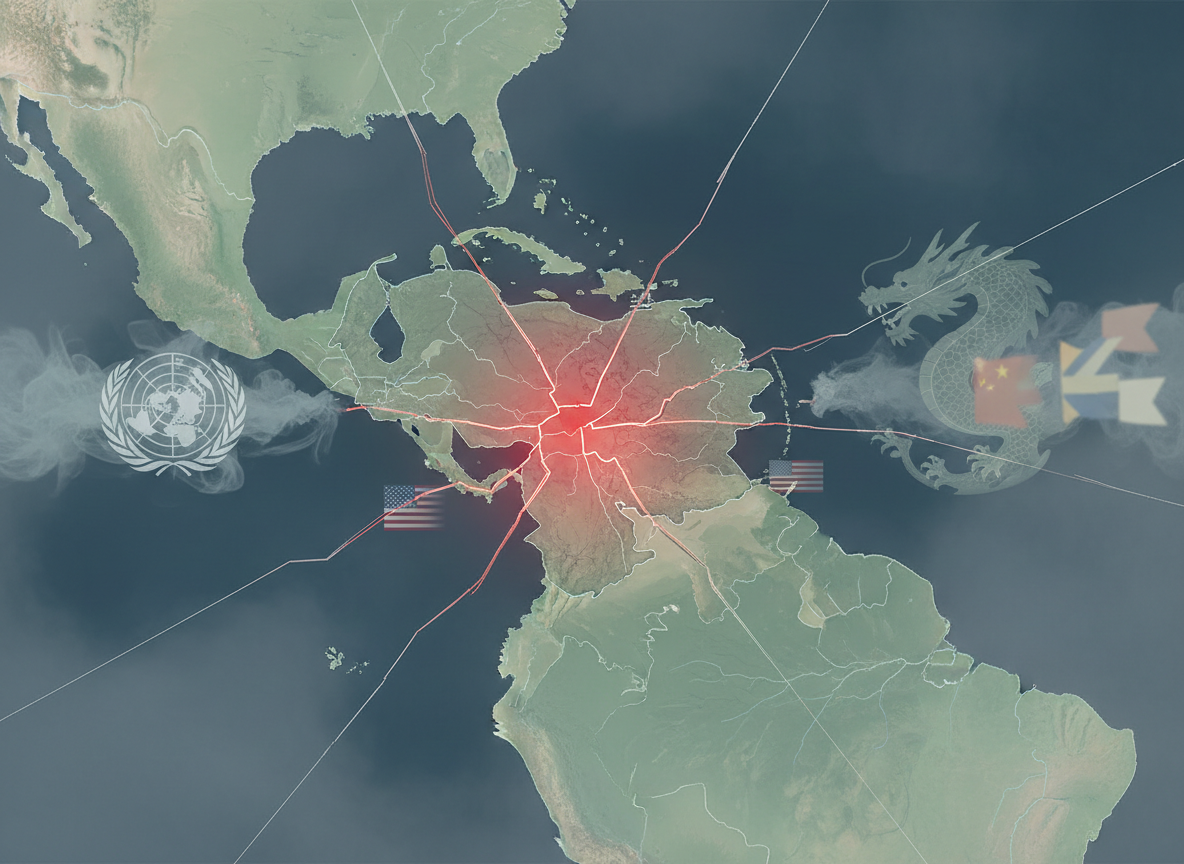
Part 2: International Response and Economic Implications
By Elke Porter | WBN News Global | January 3, 2026
Subscription to WBN and being a Writer is FREE!
On January 3, 2026, reports emerged that fundamentally altered Venezuela's trajectory and sent shockwaves throughout Latin America and beyond. Alleged U.S. military strikes on Venezuelan installations, coupled with unconfirmed reports of President Nicolás Maduro and his wife Cilia Flores being detained and removed from the country, created an unprecedented crisis of information and legitimacy.
Yet at this stage, no independent international verification has confirmed the status or location of Maduro and Flores. Diplomatic channels across Latin America and Washington remain largely silent as the situation continues to unfold. If confirmed, the capture of Venezuela's president would represent a historic geopolitical rupture, with immediate implications for regional stability, oil markets, and global diplomatic relations.
For Venezuelan families who weighed safety abroad against their duty to rebuild their homeland—families like the one you met in Vancouver who spoke of barbed wire, corruption, and fear—the calculus has never been more complicated. This is no longer just about recovering from economic collapse or political mismanagement. Venezuela now faces fundamental questions about sovereignty, legitimacy, and whether the path forward will be shaped by Venezuelans themselves or determined by external powers.
What happens next depends entirely on what actually occurred—and what the international community, regional powers, and the Venezuelan people themselves decide to do about it.
The first and most critical challenge is establishing basic facts. Reports suggest large-scale military operations targeted Venezuela's largest military complex, Fuerte Tiuna in Caracas, along with installations in Miranda, Aragua, and La Guaira states. Some sources claim President Maduro and First Lady Cilia Flores were captured and transported out of Venezuela. The U.S. Attorney General has reportedly announced charges including narco-terrorism conspiracy, cocaine importation conspiracy, and weapons offenses awaiting them in New York.
However, the absence of independent verification creates a crisis within the crisis. Without confirmed information from neutral international observers, credible diplomatic sources, or verifiable evidence, Venezuela exists in a dangerous state of limbo. This information vacuum itself has profound economic and political consequences:
Markets cannot function rationally without knowing whether Venezuela has a government, who controls military assets, or whether oil production continues. The "Venezuela risk premium" spikes not just from confirmed events but from the uncertainty itself. Investors, already wary of Venezuelan exposure, face impossible decisions about whether to flee entirely or position for potential opportunities if regime change proves real.
Neighboring countries cannot plan appropriately for refugee flows, border security, or regional stability measures without knowing the situation on the ground. Colombia reportedly sent forces to its border preparing for a potential influx, but is this precautionary or based on intelligence about actual population movements? Brazil, Guyana, and Trinidad and Tobago face similar dilemmas.
The Venezuelan people themselves cannot make informed decisions about their safety, their futures, or their actions. Should opposition figures emerge from hiding? Should Maduro supporters prepare to defend the regime? Should ordinary families flee immediately or wait for clarity? These life-and-death decisions hang on information that remains unverified.
The silence from diplomatic channels is particularly significant. Without statements from major governments, international organizations, or verified independent observers, the situation remains in dangerous flux. Are diplomatic channels silent because they're gathering information, because they're coordinating responses, or because events are still unfolding? Each possibility carries different implications for what comes next.
Even without full verification, the international response reveals deep fissures in the global order and vastly different interpretations of what may have occurred.
The United Nations response has been cautious but alarmed. UN Secretary-General António Guterres reportedly expressed being "deeply alarmed" by the developments and warned of "potential worrying implications for the region," calling the situation "a dangerous precedent." This language suggests UN officials believe something significant occurred, even if details remain unclear. International law experts have condemned what they characterize as effectively a "kidnapping" that violates core principles of the UN Charter, including prohibitions on the use of force against the territorial integrity or political independence of any state.
The legal arguments centre on fundamental questions about sovereignty and intervention. The UN Charter's Article 2(4) prohibits "the threat or use of force against the territorial integrity or political independence of any state." While exceptions exist for self-defence and Security Council-authorized actions, neither clearly applies to the Venezuelan situation. If the U.S. acted unilaterally to remove a sitting head of state, regardless of that leader's democratic legitimacy or human rights record, it sets a precedent that could justify similar actions by other powerful nations against weaker ones.
China firmly opposed what it termed violations of international law and Venezuelan sovereignty, calling the reported actions a threat to peace and security throughout Latin America. As one of Venezuela's largest creditors and a major purchaser of Venezuelan oil despite sanctions, China has enormous financial stakes in Venezuelan stability. Beijing has extended an estimated $60 billion in loans to Venezuela since 2007, much of it repaid through oil shipments. Any prolonged instability threatens these investments and China's energy security.
Beyond financial interests, Beijing's response reflects broader tensions with Washington over spheres of influence and the rules-based international order. China has consistently opposed what it characterizes as Western interventionism, whether in Iraq, Libya, or Syria. From Beijing's perspective, allowing the U.S. to unilaterally remove foreign leaders it dislikes undermines the sovereignty protections that prevent stronger nations from dominating weaker ones. China's own concerns about Taiwan and its disputed territories in the South China Sea make it particularly sensitive to precedents around sovereignty and territorial integrity.
Russia condemned what it called "armed aggression," though Moscow's response appeared more measured than might be expected given its close ties to the Maduro regime. Some analysts suggest President Putin may be calculating that helping broker Venezuelan stability could aid his negotiations with Trump over Ukraine. Russia has invested heavily in Venezuelan oil infrastructure, with Rosneft and other Russian companies holding significant stakes in PDVSA joint ventures. Russia has also provided military support to Maduro's government, including weapons sales, military advisors, and occasional deployments of strategic bombers to Venezuelan bases as shows of force.
However, Moscow may view Venezuela as a lower priority than its core interests in Ukraine and its near abroad. If cooperating with Washington on Venezuela creates diplomatic capital that Putin can spend on Ukraine negotiations, the calculation may favour restraint over confrontation. Russia's measured response contrasts with its more aggressive rhetoric during previous Venezuelan crises, suggesting Moscow is weighing options rather than automatically defending Maduro at all costs.
Latin American reactions split sharply along ideological lines, revealing the region's deep political divisions and different relationships with Washington.
Argentina's President Javier Milei, a Trump ally and libertarian who campaigned against socialism and state intervention, reportedly praised the reported capture as a blow against narco-terrorism and authoritarian socialism. Milei has positioned himself as the most pro-American leader in Latin America, breaking with the region's traditional wariness toward U.S. intervention. His support reflects both ideological alignment and practical calculation—Argentina faces severe economic crisis and seeks U.S. support for IMF negotiations and investment.
Colombia's President Gustavo Petro, by contrast, called for emergency UN meetings and deployed forces to the border, framing the situation as American imperialism threatening regional sovereignty. This represents a dramatic shift from Colombia's historically close relationship with Washington. Petro, a former guerrilla fighter and leftist, has sought to position Colombia as a leader of Latin American independence from U.S. influence. Colombia also faces the most direct consequences of Venezuelan instability—it already hosts roughly 2.5 million Venezuelan refugees and would bear the brunt of any new exodus.
Brazil, Mexico, and Chile have remained conspicuously cautious, likely gathering information before committing to positions that could define their relationships with Washington for years to come. Brazil's President Luiz Inácio Lula da Silva faces particular complexity—he has maintained relationships with both progressive Latin American leaders and the United States, while also positioning Brazil as a leader of the Global South. Mexico's President Claudia Sheinbaum must balance her party's historical anti-interventionist stance with the reality of economic dependence on the United States. Chile's President Gabriel Boric, a progressive who nonetheless maintains pragmatic relations with Washington, likely sees little benefit in taking strong positions before facts are clear.
This fractured international response matters profoundly for Venezuela's future. Will there be unified pressure for democratic transition or competing visions of what should come next? Will international cooperation help stabilize Venezuela or will great power competition make it a proxy battleground? The answer to these questions will shape not just Venezuela's trajectory but the broader patterns of international relations in Latin America and beyond.
The economic consequences depend entirely on what actually happened and what happens next, but we can identify several dimensions of impact already unfolding:
Venezuela possesses the world's largest proven oil reserves at approximately 304 billion barrels. Current production of roughly 1.1 million barrels daily represents only about one percent of global oil trade, but the strategic importance extends beyond volume. Venezuelan heavy crude requires specialized refining capacity, making it particularly valuable to certain buyers. Much of Venezuela's oil historically went to U.S. Gulf Coast refineries specifically designed to process heavy crude, though sanctions diverted flows to China, India, and other buyers willing to work around restrictions.
Industry experts predict minimal immediate impact on global prices beyond heightened risk premiums, partly because production was already declining under the U.S. blockade imposed in December 2025. The Trump administration seized oil tankers and imposed a naval blockade specifically targeting Venezuelan petroleum exports, reducing the country's ability to generate revenue even from non-U.S. buyers. This meant that even before the alleged January 3 strikes, Venezuelan oil exports were constrained, limiting the additional supply disruption from military action.
However, longer-term implications could be substantial. If a transition leads to sanctions relief and massive investment in PDVSA, Venezuela could eventually restore production toward its historical peak of 3.5 million barrels daily achieved in the late 1990s. This would require tens of billions of dollars in infrastructure investment, technical expertise, and years of sustained effort. PDVSA's capabilities have deteriorated dramatically—equipment has fallen into disrepair, skilled workers have fled, and operational knowledge has been lost. Rebuilding would essentially require reconstructing the company from the ground up.
Conversely, if civil conflict damages infrastructure or if international disputes prevent development, Venezuelan oil could remain largely offline for years or even decades. Libya's production still hasn't recovered to pre-civil war levels more than a decade after Gaddafi's fall. Iraq took years to restore production after 2003. The technical complexity of Venezuelan heavy crude production makes it particularly vulnerable to disruption—once wells are shut down improperly or infrastructure is damaged, restarting can be extraordinarily difficult and expensive.
The geopolitical implications extend beyond Venezuela itself. If Venezuelan production remains offline, it strengthens the position of other major producers like Saudi Arabia and Russia. If production eventually increases dramatically under new management, it could pressure global prices downward, particularly affecting other high-cost producers. For countries like Colombia, Brazil, and Guyana that have significant offshore oil development plans, Venezuelan instability creates both risks (regional volatility) and opportunities (less competition for investment and market share).
Latin American economies face spillover effects through multiple channels, some already visible and others likely to emerge as the situation develops.
Currency markets throughout the region have experienced volatility as investors reassess political risk premiums. When uncertainty strikes one Latin American country, investors often reduce exposure across the region, treating it as a single risk category rather than distinguishing between different national situations. This "contagion effect" means that even countries with sound economic management can see capital flight and currency depreciation when regional instability strikes. Brazilian, Colombian, Chilean, and Mexican financial markets all showed stress in the days following January 3, even though none face direct Venezuelan-style crises.
Countries hosting large Venezuelan refugee populations—Colombia with 2.5 million, Peru with 1.5 million, Ecuador, Chile, and Brazil with hundreds of thousands each—face potential new waves of migration if instability worsens. These nations already struggle to provide services, employment, and integration for existing refugee populations. Colombia spends an estimated $1.5 billion annually on Venezuelan refugees, Peru over $500 million. Local communities face pressure on schools, hospitals, housing, and labor markets. While Venezuelan migrants contribute economically through work and entrepreneurship, the scale and speed of the influx has created genuine challenges.
A new refugee wave could overwhelm these systems entirely. If hundreds of thousands or millions more Venezuelans flee, neighboring countries would face impossible choices about border control, humanitarian assistance, and internal stability. The political backlash against refugees has already strengthened anti-immigrant movements in several countries. Further influx could fuel xenophobia, undermine progressive governments, and destabilize countries that are themselves struggling with economic challenges.
Tourism and foreign investment across the region could suffer if Venezuela descends into prolonged conflict. Regional instability tends to be painted with a broad brush by international capital and tourists, who may not distinguish between countries directly affected and those merely nearby. The Syrian civil war affected tourism throughout the Eastern Mediterranean. Violence in Central America has impacted investment across that sub-region. If Venezuela experiences sustained conflict, the entire South American continent could see reduced tourism, higher borrowing costs, and decreased foreign investment as investors demand higher returns for perceived regional risk.
Trade relationships would also face disruption. While Venezuela's economy has collapsed to the point where it represents a small share of regional trade, Colombia, Brazil, and Caribbean nations still conduct commerce across Venezuelan borders. Closure of these borders, conflict affecting trade routes, or disruption of regional logistics networks would impose costs on neighbors. Additionally, Venezuela serves as a transit point for some trade between Caribbean islands and South America—disruption affects countries beyond immediate neighbors.
Venezuela's economy had already contracted approximately 75 percent between 2013 and 2025, creating what economists describe as a "survival economy" where over 70 percent of the population earned less than $50 monthly. This represents one of the most severe peacetime economic collapses in recorded history, comparable to the Great Depression in the United States or the post-Soviet collapse in Russia, but actually more severe in magnitude.
Any additional disruption—conflict, sanctions maintenance, infrastructure damage, or governance collapse—would deepen this catastrophe beyond what seems almost imaginable. Malnutrition is already widespread, with studies showing significant portions of the population experiencing food insecurity. Healthcare has collapsed, with hospitals lacking basic supplies, medicines, and functioning equipment. Preventable diseases have resurged. Maternal and infant mortality have increased dramatically. Life expectancy has declined.
The humanitarian situation before January 3 already constituted a crisis demanding international attention. If conflict erupts or if the transition is mismanaged, conditions could deteriorate to famine-like circumstances. The international community would face not just a refugee crisis but a humanitarian emergency requiring massive food aid, medical assistance, and basic service provision to millions of people.
Conversely, if legitimate transition occurs with international support, reconstruction could eventually require hundreds of billions of dollars in investment across multiple sectors. Oil infrastructure alone would require an estimated $50-100 billion to restore to full functionality. The electrical grid, which suffers daily blackouts even in good times, needs complete reconstruction—estimated at $20-30 billion. Water and sanitation systems, telecommunications, transportation infrastructure, schools, hospitals, and housing all need massive investment.
The sources of this capital—whether international financial institutions, private investment, Chinese loans, or U.S. assistance—will shape Venezuela's economic model and political alignments for decades. If reconstruction depends primarily on Chinese financing, Venezuela will likely remain aligned with Beijing and adopt economic models favoring state direction and Chinese companies. If U.S. and Western investment dominates, Venezuela might adopt more market-oriented policies and political alignment with Washington. If international financial institutions like the World Bank and IMF play major roles, they'll impose conditions around governance, transparency, and economic policy that shape Venezuela's development trajectory.
The scale of needed investment creates opportunities for corruption and misappropriation. Post-conflict reconstruction efforts in Iraq, Afghanistan, and elsewhere have often seen billions disappear into waste, fraud, and abuse. Without strong institutions, transparency mechanisms, and civil society oversight, Venezuelan reconstruction could enrich connected elites while failing to improve conditions for ordinary citizens. This would repeat the pattern that led to the current crisis—oil wealth benefiting few while most Venezuelans suffer.
The Trump administration justified escalating actions as combating narco-terrorism, with months of strikes on suspected drug-trafficking vessels and formal charges against Maduro for narcotics conspiracy. The intersection of Venezuela's political crisis with the global drug trade creates complex economic implications that extend far beyond Venezuelan borders.
Venezuela has indeed become a major transit point for Colombian cocaine heading to North America and Europe. Estimates suggest 200-250 metric tons of cocaine transit through Venezuelan territory annually, though exact figures are difficult to verify. This represents roughly 15-20 percent of global cocaine production. The drugs move through Venezuelan territory via multiple routes—overland through the porous Colombian border, through Caribbean ports, and via small aircraft using clandestine airstrips.
Regime officials, military leaders, and armed groups all allegedly profit from this trade. The U.S. Treasury and Justice Department have sanctioned numerous Venezuelan officials for narcotics trafficking, including current and former vice presidents, ministers, military commanders, and National Assembly members. The "Cartel of the Suns"—named for the sun insignia worn by Venezuelan generals—reportedly coordinates much of this activity, providing protection and logistics for Colombian cartels and collecting fees for safe passage.
If Maduro's removal disrupts these networks, several outcomes become possible. In the short term, cocaine flows through Venezuela might decline as established routes and protection arrangements break down. This could temporarily reduce supply to consumer markets, potentially driving prices up and reducing consumption. However, drug trafficking networks are remarkably adaptive—they would likely establish new routes through other countries or reconstitute Venezuelan routes under new management within months.
More likely, removing Maduro without establishing functional state control could intensify trafficking and violence. When drug trade protection breaks down, violent competition typically follows as different groups fight for control of lucrative routes. Mexico's experience shows how state weakness in areas of drug production and transit leads to extreme violence as cartels battle for dominance. If Venezuela fragments into zones controlled by different armed groups, each would likely finance operations through drug trafficking, leading to intensified cocaine flows and associated violence.
The economic impact extends beyond Venezuela to consuming countries, source nations like Colombia, and the criminal organizations whose profits depend on stable routes. The United States spends over $50 billion annually on drug enforcement and treatment. European countries spend billions more. Cocaine consumption causes enormous social costs through addiction, crime, and public health impacts. Any change in Venezuelan trafficking patterns affects this entire system.
For Colombia, Venezuelan instability creates particular challenges. Colombia has struggled for decades to reduce cocaine production and combat armed groups financing themselves through drugs. Colombian government control has improved significantly in recent years, with cocaine cultivation declining from peaks earlier. But if Venezuelan chaos creates safer operating environments for traffickers and provides new routes to markets, it could undermine Colombian progress. Colombian armed groups—including remnants of FARC, ELN guerrillas, and criminal organizations—operate on both sides of the border. Venezuelan instability gives them more space to operate and finance operations.
The narcotics dimension also complicates any political settlement. If significant portions of Venezuela's military and political elite profit from drug trafficking, they have strong incentives to prevent establishment of functional state control and rule of law. This creates misaligned incentives where those with power to influence outcomes benefit from continued chaos rather than stability. Breaking this dynamic requires either removing these actors from power entirely (difficult and potentially violent) or providing alternative economic opportunities that make cooperation more attractive than resistance (expensive and uncertain).
The immediate aftermath of January 3, 2026, has revealed more questions than answers. While international reactions have begun to crystallize—from China's firm opposition to Argentina's support, from UN alarm to Russian condemnation—the fundamental uncertainties remain. Without verified information about Maduro's status, Venezuela's governmental control, or the extent of military operations, the world watches and waits.
What is clear is that Venezuela now stands at a genuine crossroads, with its future trajectory dependent on rapidly unfolding events and decisions being made in capitals from Caracas to Washington, Beijing to Bogotá. The economic implications we've outlined—oil market volatility, regional contagion, humanitarian costs, and reconstruction needs—will play out differently depending on which path Venezuela ultimately takes.
But what does the future actually hold? Will Venezuela emerge from this crisis stronger, or descend into deeper chaos? Will democratic transition become possible, or will the country fragment into violent competition? And most importantly, what does each possible outcome mean for the millions of ordinary Venezuelans—like the family you met in Vancouver—who must make impossible choices about their futures with incomplete information?
In Part 3, we examine five distinct scenarios for Venezuela's path forward, from managed democratic transition to civil conflict, from U.S. occupation to international negotiated settlement. We explore what each scenario means economically, politically, and most importantly, for the Venezuelan families caught between safety abroad and duty to their homeland. The next chapter of Venezuela's story is being written now, and understanding the possibilities is essential for anyone trying to navigate this unprecedented moment in Latin American history.
Elke Porter at:
Westcoast German Media
LinkedIn: Elke Porter or
WhatsApp: +1 604 828 8788.
Public Relations. Communications. Education
Let’s bring your story to life — contact me for books, articles, blogs, and bold public relations ideas that make an impact.
TAGS: #Venezuela After Strike #International Response #Latin America Crisis #Geopolitical Tensions #Venezuelan Refugees #Global Oil Markets #WBN News Global #Elke Porter