
The Lies We're Sold





By Les Mottosky
For over five decades, the public school system has slid into obsolescence.
This is irrefutable.
The evidence for such a boldly confident claim won't be found in statistics, global scores or STEM enrolment. We don't even require internet access to see the proof, we just need to stroll a couple of downtown blocks in any major North American city.
Depression, addiction, mental illness, obesity, chronic disease in the population, decaying infrastructure, and maybe the most damning signal of an off-the-rails civilization: ubiquitous litter that hints at the runaway corporate and federal pollution. (The US military is the largest single institutional polluter on the planet.) We don't just poison each other, we poison the planet that hosts and nourishes us.
Humans are the only species that contaminate their environment.
This is insanity.
More tragically, it's preventable insanity.
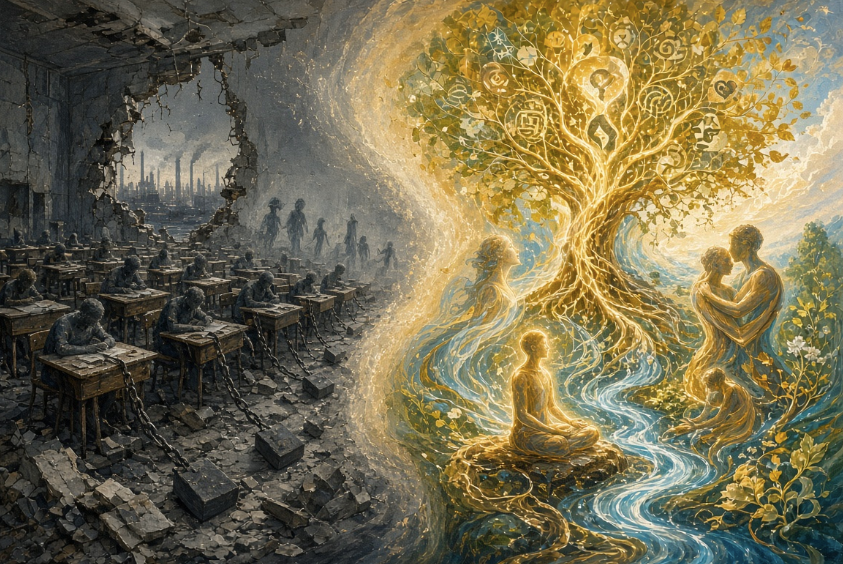
Western society has blown past 'crisis', is resting solidly in 'emergency' and could soon be flirting with 'catastrophe'. Much of this is the result of an approach to education designed to turn-out compliant personalities merely prepared to serve industrial-era needs. The challenges produced are as much the result of what is taught from K to 12, as what is not included in current curriculums.
Given the modern information ecosystem, much of what is considered compulsory to "learn" (ie: memorize) taxes our limited grey matter. It's largely unnecessary.
So what would be a more effective approach to educating our youth? Nobody has the billion dollar answer, but we might get closer to it if we began asking questions like:
• What if the system emphasized creativity over memorization?
• What if students were conditioned to adapt to reality instead of conform to society? What level of transformation awaits a civilization that doesn't just expect change but learns that anticipating, accepting, understanding and relishing it as opportunity is an expression – the highest expression – of intelligence?
• How many current costs to society would be avoided if ancestral nutrition, supplementation, fitness and wellness were taught, experienced and understood?What if young people learned to forage and craft their own tonics and medicines? Would litter and pollution be so ubiquitous?
• What if basic psychological tools and principles of attachment theory, personal discipline, resilience, empathy, purpose, adaptation, leadership and self-actualization were taught and practiced?
• Would we better serve our youth if critical thinking – instead of memorization – was emphasized as the tool to master before graduating?
• What if the whole person – strengths, gifts, interests, passions and personality – was taken into account, rather than the pursuit of a standardized outcome?
• If a vibrant curiosity – not the ability to acquire facts, figures and formulas – was the goal for every student, what would be possible for our communities? Not just eventually, but in coming weeks, months and years? How soon might that unrelenting inquisitiveness have an impact on those around them?
• Would students be better served in the short and long term if they were graded by the novelty or utility of their questions, rather than the accuracy of their answers?
• What if the high school opening bell rang at 11AM; balancing out the hormonal sleep-pattern-circus of adolescents?
• How would the world be different if students left school with a scientific understanding that everything and everyone is connected? What if that became a lifelong guiding belief? What is that was the guiding principle of every decision?
• What if students stepped into adulthood – not just in pursuit of fame, riches or impact – but with the awareness, willingness and ability to simply be content in themselves on the patch of ground they stand?
• What if 'Understanding Love 101' was a compulsory course?
• How soon might we expect the inklings of societal transformation, if the pursuit, recognition and application of wisdom by the student body was the core objective of education?
That last question is, perhaps, the biggest.
Ancient philosophers, especially the Greeks and later Stoics – people who spent their lives pursuing the meaning in and of life – elevated wisdom as the highest or only true good; essential to happiness, virtue, and a life worth living. (Chinese Philosophers arrived at a similar conclusion). They all treated the pursuit, identification, and application of wisdom as the central, necessary activity of a fully human life. One of those great Greek thinkers – Aristotle – taught: "The purpose of knowledge is action, not knowledge." But from what we can observe, action without the guardrails of wisdom can be disastrous.
As a parent, leader, politician or educator, how fulfilling would it be to know our young people were leaving school – not just in pursuit of adventure, further education or a career – but also possessed the tools to become more fully human at every stage of their life?
How different could the future of our planet look?
TAGS: #The Lies We're Sold
Les Mottosky
Writes to expand the capacity of the human behind the career.
Adaptation Strategist // I help organizations turn creativity into their competitive advantage by aligning leadership, culture and strategy to unlock adaptive innovations.
Members Discussion