
Danube Dispatches No. 7: The River Turns
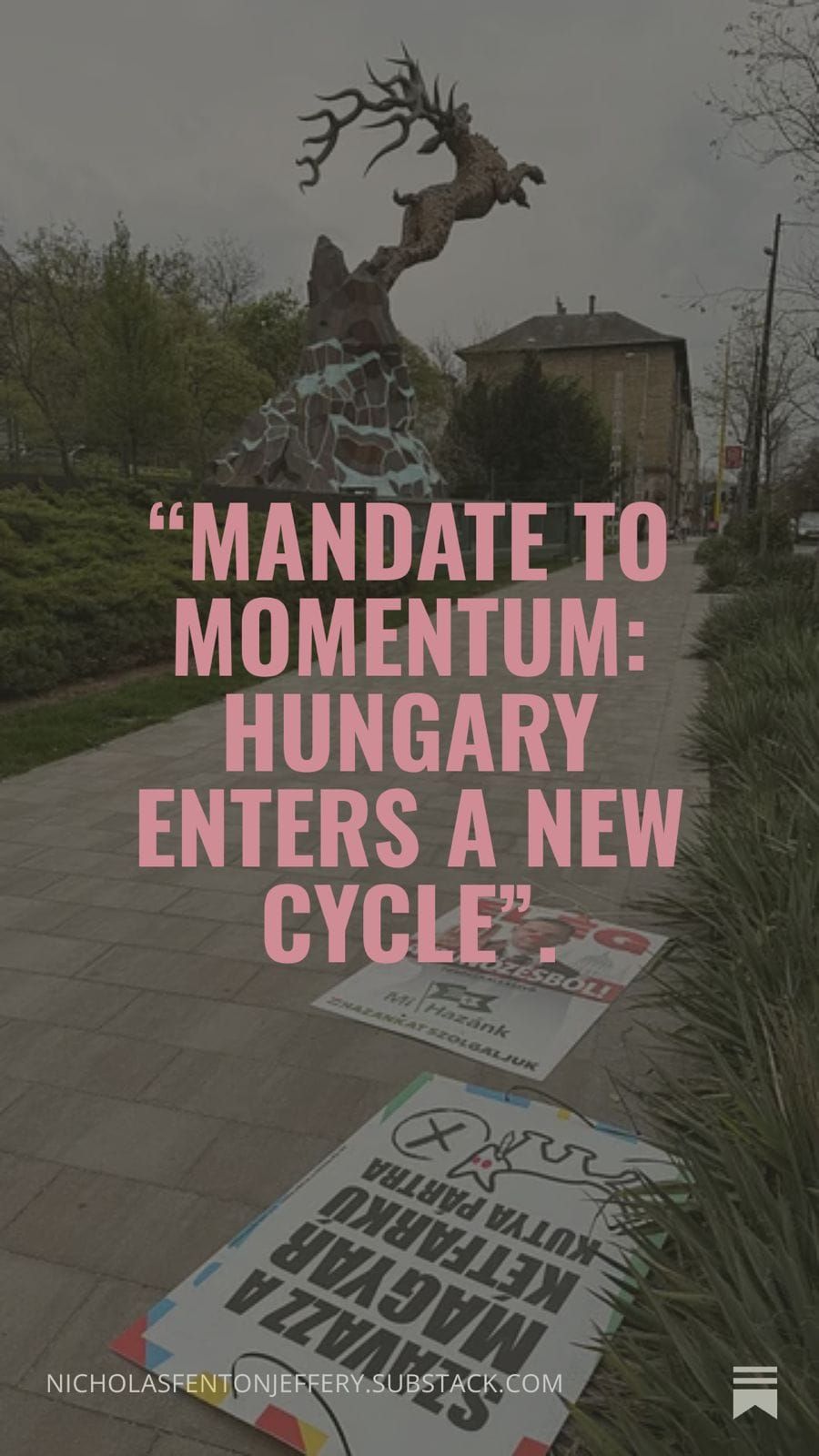
Hungary’s election delivers a decisive shift. A new mandate opens the door to institutional change, economic recalibration, and a potential rebalancing of its global position.




Hungary’s election delivers a decisive shift. A new mandate opens the door to institutional change, economic recalibration, and a potential rebalancing of its global position.
Nicholas Jeffery | WBN News – Global | April 21, 2026
Editor: Karalee Greer | Subscribe to WBN News
Some come to Hungary to study it; I married into it, which in this part of Europe tends to produce more durable conclusions. As a family, we moved back to our hometown of Budapest from Vancouver, just before the COVID pandemic. Now I am a resident here, pay my taxes here and own a business and service clients from here; I just can’t speak Hungarian, for which I constantly apologise.
Five days ago, Hungary stood before a general election framed by uncertainty. Today, uncertainty has been replaced by something rarer in European politics: clarity.
The result was not close. It was seismic.
Péter Magyar and the TISZA Party have swept to victory with 54% of the vote, converting that lead through Hungary’s mixed electoral system into more than two-thirds of parliamentary seats, a constitutional majority.
Viktor Orbán, dominant in Hungarian politics since 2010, falls to 38% of the vote and just 27% of seats. After sixteen years in power, he has conceded defeat.
Governments lose elections. Systems rarely do. Yet in Hungary, the electorate appears to have rejected both the government and its method of governing. That is why these matters beyond Budapest.
Hungary’s voting model, part constituency contests, part national list, often disproportionately rewards broad victories. This time, it transformed a clear win into a governing mandate of unusual force. TISZA has not merely won office. It has won room to act.
That matters because the next chapter will be written less in campaign slogans than in institutions.
Looking to Reduce Your Credit Card Fees? Click here
What Changes First?
Healthcare
Hungarians know the strain: long waiting lists, staffing shortages, uneven regional provision. If TISZA is serious about renewal, hospitals and GP access will be an early test. Competence is most visible where citizens queue.
Education
Teachers have protested, parents have worried, and employers have noticed. A modern economy cannot run on an exhausted school system. Reform here would signal long-term seriousness rather than short-term politics.
Energy
Hungary’s balancing act between affordability, Russian supply exposure and strategic autonomy now enters a new phase. Diversification may become less rhetorical and more practical.
Media Transparency
The concentration of influence across public discourse has long troubled critics. The question is whether a new government broadens the landscape or simply seeks to inherit it.
Democratic credibility often rests on what victors restrain themselves from doing.
Europe Watches the Bend in the River
In European Union capitals, this result signals both political change and administrative opportunity. Hungary’s access to significant funds has been slowed or frozen amid rule-of-law disputes. A more cooperative relationship with Brussels could unlock capital for infrastructure, schools, digitalisation, and regional development. But does TISZA need to reform before gaining access to much-needed capital, and can it do so quickly when mechanisms and contracts were put in place to make that almost impossible?
That would matter economically. But it would matter symbolically, too. Hungary has often cast itself as Europe’s dissenter. It may now try to be Europe’s reformer.
In Ukraine, the tone may shift from obstruction and ambiguity to firmer support. Some of the now Prime Minister's populist statements appeared aimed at winning votes rather than clarifying Ukraine policy. If Hungary wants European money, it must rejoin the club. Across the continent, allies will notice. So will Moscow.
The Deeper Meaning
This election was not simply left versus right, urban versus rural, young versus old. It was exhaustion versus renewal, although this was a masterclass on what happens if you abandon your core customers, as it appears that the younger generation and the rural citizens came out in droves because they feel they had been abandoned for eighteen years under FIDESZ.
Hungarians did not vote for revolution. They voted for the possibility that normal government might once again be enough. Roads repaired. Schools functioning. Institutions trusted. Intelligent observations aired, arguments conducted without the permanent warfare of fear of reprisals.
That sounds modest. In modern democracies, it is increasingly radical.
The Return Dividend
For seventy years, Hungary’s most valuable export was not steel, wheat or machinery. It was people.
The first great outflow came after the crushed Hungarian Revolution of 1956, when around 200,000 Hungarians departed and fled in a matter of months, many young, educated and entrepreneurial. They rebuilt lives in Britain, North America, Australia and beyond. Hungary lost not only citizens, but decades of taxable income, technical skill and family capital.
The second wave was slower but no less significant: the late communist and post-1989 era, when talented Hungarians increasingly looked westward for higher wages, better institutions and broader opportunity.
After EU accession in 2004, mobility accelerated sharply. By recent UN-based estimates, roughly 700,000 Hungarian-born people live abroad today, with some studies placing broader diaspora communities, counting descendants and historic communities outside current borders, well above 2 million, and wider cultural estimates higher still.
That matters because migration is rarely random. Countries tend to lose the mobile, employable and ambitious first.
If even part of that cohort were to return, Hungary would gain something more valuable than grants or loans: productive citizens in their prime earning years, often carrying foreign language skills, managerial habits, technical training and international networks.
Consider the arithmetic. If 100,000 returnees entered or re-entered the labour force, earning an average gross salary of €25,000 annually, that implies €2.5bn of annual wage income circulating through the domestic economy before multiplier effects. Add consumption, housing demand, VAT receipts, pension contributions and entrepreneurship, and the real impact rises quickly.
If only 10% of the roughly 700,000 Hungarian-born abroad eventually returned over a decade,
That would mean 70,000 people, equivalent to adding the population of a provincial city, but one disproportionately skilled and internationally experienced.
Then there is capital. Diaspora Hungarians often accumulate savings in stronger-currency economies such as Germany, Austria, and the United Kingdom. Returned household wealth can seed mortgages, SMEs, hospitality venues and capital city inflows.
A family returning with €100,000 in accumulated assets does more than buy a home; it recapitalises a local economy.
The strategic question, therefore, is not sentimental repatriation but economic competitiveness. People will return in my opinion when three conditions align: credible institutions, rising wages (which is more important than reducing taxation), implementing fair taxation, and confidence that merit can outpace patronage.
Hungary cannot command its diaspora home. But it can invite them back through performance, transparency, governance, and opportunity.
The country spent generations exporting talent. A successful next chapter would import experience.
Closing Observation
The Danube has seen empires, occupations, uprisings and reinventions. It knows that power looks permanent, until suddenly it does not.
Hungary has turned the page with unusual force. The question now is whether victory can become governance, and momentum can become maturity. I am just a little nervous about transitioning from one super majority to another, “because Absolute power corrupts absolutely”.
Because elections remove governments. Only governing well removes disappointment.
Next in Danube Dispatches No. 8: Can Hungary’s new era revive the provinces, not just the capital and a closer look at the Balaton region and water, one of Hungary's assets?
Thank you, Nicholas
About Dr. Nicholas Jeffery
After forty years in international banking and technology between London and Central Europe, I help companies and investors navigate the commercial currents in the United Kingdom.
And Hungary, as a regional hub, is establishing ventures, accelerating growth, or quietly arranging acquisitions. Like the Danube itself, commerce here flows best when one understands both banks.
The Diplomat’s Notebook
By Ambassador Dr. Nicholas Jeffery Nicholas Jeffery LinkedIn: http://linkedin.com/in/nicholas-jeffery
Editor: Karalee Greer | Subscribe to WBN News
Tags: #Danube Dispatches #WBN News Global #WBN News Vancouver #European Union #Nicholas Jeffery #Diplomat's Notebook #Budapest #Global Strategy