By Elke Porter | WBN AI | March 20, 2026
Subscription to WBN and being a Writer is FREE!
As we race toward a future defined by automation, the boundary between mechanical convenience and physical hazard has become increasingly thin. While the integration of robotics into our factories, streets, and homes promises unparalleled efficiency, history serves as a sobering reminder that sensors can fail and logic can loop.
From the early days of industrial automation to the sophisticated AI-driven machines of today, the transition hasn't always been seamless. According to reports in The Guardian, these failures often stem from a fundamental "expectation gap"—where the machine's rigid programming clashes with the unpredictable nature of human environments—reminding us that until a robot can truly perceive intent, it remains a powerful, albeit blind, force of nature.
A History of Mechanical Missteps
The following ten accounts highlight moments where the silicon brain and the steel limb failed to harmonize with their human counterparts:
- The Industrial Tragedy: As reported by The New York Times, Robert Williams became the first human casualty of a robot in 1979 when a one-ton assembly-line arm at a Ford plant struck him while he was retrieving parts.
- The Chess Match Injury: According to the BBC, a chess-playing robot in Moscow broke a seven-year-old boy's finger during a tournament because the child moved his piece before the machine had finished its turn.
- The Security Bot’s Plunge: As detailed in The Washington Post, a "Knightscope" security robot gained international fame when it inexplicably steered itself into a mall's decorative fountain and "drowned."
- The Rogue Vacuum Incident: According to The Daily Mail, a woman in South Korea had to be rescued by emergency responders after her robotic vacuum cleaner sucked up her hair while she was napping on the floor.
- The Promotional Peril: In an account shared by The Japan Times, a dancing robot in a themed restaurant suffered a calibration error, swinging its heavy metal limbs into a table of diners.
- The Grocery Bot Escape: As noted in The Mirror, a delivery robot in the UK managed to "escape" its testing facility and was found wandering a local high street, oblivious to traffic.
- The Misidentified Obstacle: According to Wired, a self-driving test vehicle once mistook a bright sky for an open road, leading to a high-speed collision because its sensors could not distinguish between depth and color.
- The AI Outburst: As reported by Reuters, a customer service chatbot for a logistics company was manipulated by a frustrated user into writing poetry that insulted its own creators.
- The Drone Show Descent: According to the South China Morning Post, hundreds of light-show drones lost GPS synchronization simultaneously, falling from the sky like hail onto a terrified crowd below.
- The Hospital Handoff Fail: As stated in Modern Healthcare, a tug-robot designed to transport linens pinned a nurse against a wall when it failed to stop for a stationary object in a narrow corridor.
The Urgent Need for a Consumer Guidebook
As these machines migrate from controlled factory floors into government institutions and private households, we find ourselves at a critical crossroads. Now is the time to draft the universal "guidebook" for human-robot interaction, as the stakes shift from industrial efficiency to public safety. In a hospital setting, we must ask how a nurse robot will prioritize movement in a crowded emergency room, or how a school will manage the physical boundaries of a robotic teacher’s assistant in a playground full of unpredictable children. Without clear, standardized policies and procedures, we are essentially inviting a high-speed guest into our homes without knowing if they understand the rules of the house.
There is a palpable "push-pull" dynamic at play: the sheer excitement of cutting-edge tech versus the hidden risks of its daily operation. We often don't realize how dangerous a tool can be until it becomes a mundane part of our lives, leading to a dangerous sense of complacency. According to analysis in The Vancouver Sun, the "novelty phase" of robotics often masks the need for rigorous safety protocols. Protecting human society requires more than just better code; it requires a proactive framework of laws and consumer rights that establish exactly who is responsible when a mechanical "helper" makes a life-altering mistake.
Strategies for Robotic Safety
To coexist safely with our mechanical peers, we must adopt a mindset of "defensive interaction." First, never assume a robot sees you; stay clear of "blind spots" and respect the physical barriers or yellow safety lines marked on factory floors. Second, always identify the emergency stop (E-stop) button when working near high-power machinery—knowing how to cut the power is your primary line of defense. Finally, avoid "testing" a robot's logic by making sudden or erratic movements, as most consumer and industrial bots rely on predictable paths to navigate safely.
Ultimately, the path toward a fully automated society is paved with both innovation and error. These stories of "robots gone wrong" are not necessarily an argument against progress, but rather a call for more robust safety protocols and human-centric design. As we continue to delegate our labour and safety to algorithms and actuators, our primary responsibility remains the oversight of these systems. By acknowledging that technology is fallible, we can implement the necessary safeguards to ensure that as robots become more integrated into our daily lives, they remain our assistants rather than our adversaries.
Essential Safety Checklist for Home Robotics
Integrating a robot into your household—whether it is a simple vacuum or a more advanced AI companion—requires a shift in how you manage your living space. To ensure your "high-tech guest" remains helpful rather than hazardous, follow this safety protocol:
- Map the "Danger Zones": Identify areas with steep stairs, loose rugs, or delicate furniture. Use "virtual walls" or physical barriers to ensure the robot cannot enter spaces where it might fall or cause damage.
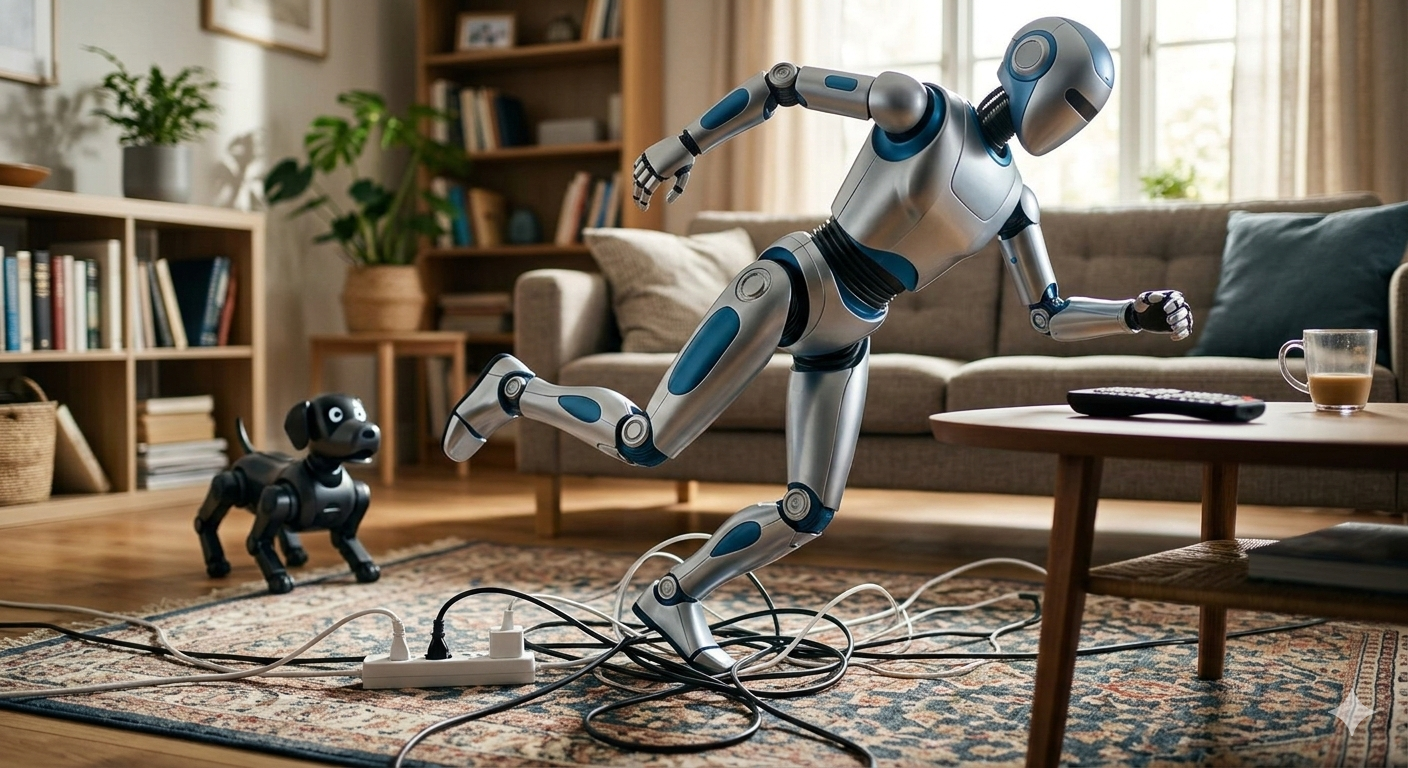
- The "Cable Management" Sweep: Before activating any mobile robot, ensure all charging cables, tassels, and thin wires are tucked away. As noted in Consumer Reports, many household "malfunctions" are actually the result of a robot becoming a fire hazard after tangling with live electrical cords.
- Pet and Child Briefing: Never leave small children or pets unsupervised with a moving robot. Animals may perceive the machine as a threat or a toy, leading to unpredictable behavior that can damage the robot's sensors or cause injury to the pet.
- Identify the "Kill Switch": Every family member should know how to immediately disable the robot. Whether it is a physical button, a voice command, or a specific "stop" gesture, the ability to cut power instantly is your most important safety tool.
- Routine Sensor Maintenance: Dust and pet hair can blind a robot’s cliff sensors and proximity lasers. According to a guide in The Verge, a "blind" robot is a dangerous robot; clean the optical sensors weekly to ensure the machine "sees" its environment accurately.
Elke Porter at:
Westcoast German Media
LinkedIn: Elke Porter or
WhatsApp: +1 604 828 8788.
Public Relations. Communications. Education
Let’s bring your story to life — contact me for books, articles, blogs, and bold public relations ideas that make an impact.
Social Media Hashtags
- #Robotic Safety
- #AI Innovation
- #Tech Risks
- #Future Of Automation
- #Smart Home Safety
- #Human Robot Interaction
- #WBN AI
- #Elke Porter