By Elke Porter | WBN News Vancouver | September 11, 2026
Subscription to WBN and being a Writer is FREE!
VANCOUVER — There was a time, not so long ago, when a Tuesday night dinner at a local neighborhood bistro was a unremarkable fixture of middle-class life. In 2019, a family of four in Vancouver could reasonably expect to spend $60 for a casual meal out.
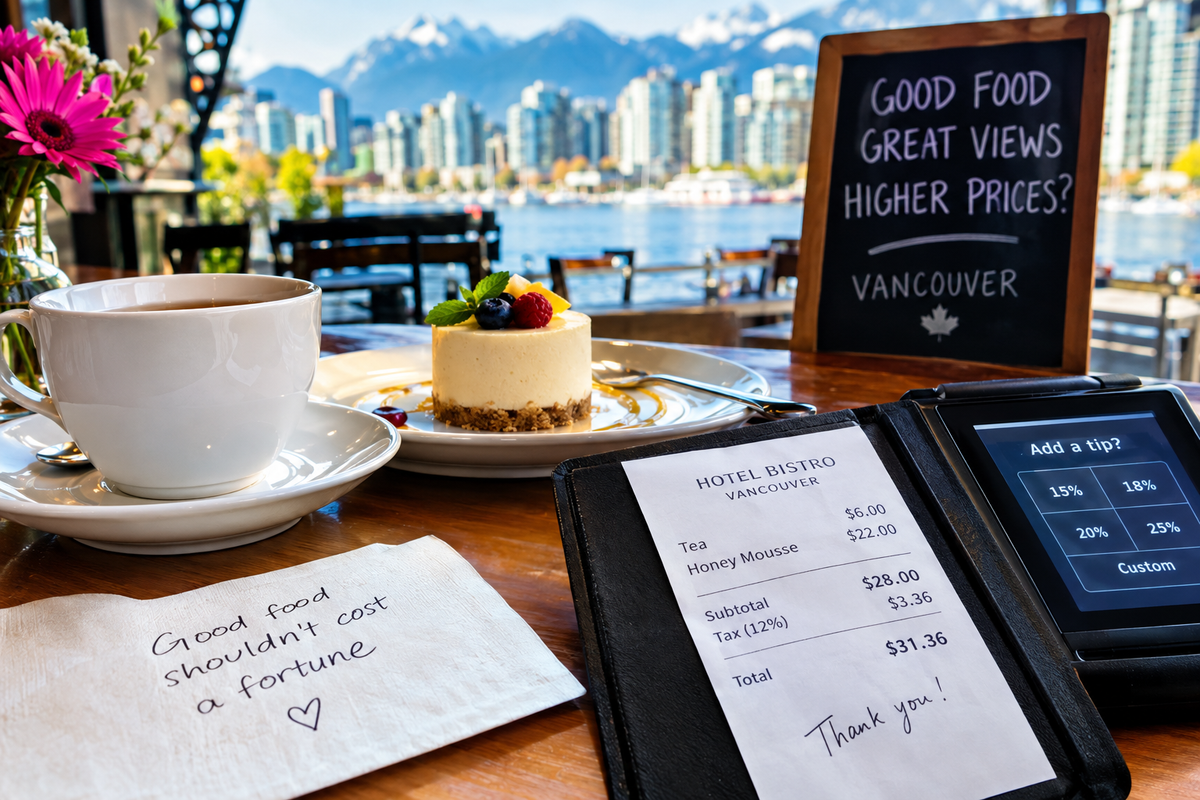
Today, that same family is easily confronted with a bill exceeding $200. Even the smallest indulgences carry sticker shock; a simple cup of tea and a modest honey mousse at a downtown hotel can now comfortably approach $30.
What was once an affordable luxury has rapidly morphed into an existential question for urban consumers: Where, precisely, is the money going?
The obvious culprit is the lingering aftermath of the pandemic, which severed supply chains and saddled operators with historic debt. Yet while public health restrictions vanished, inflation did not. According to Statistics Canada, restaurant food prices rose 7.8 percent year-over-year in February 2026, following an 8.5 percent surge just two months prior. Compounding the burden is the ubiquitous payment terminal, where automated prompts routinely push tip suggestions to 20 or 25 percent, transforming a casual outing into a exercise in psychological resistance.
Yet the industry’s ledger paints a paradoxical picture. High prices have not translated into prosperity. Data from Restaurants Canada reveals that 36 percent of the country's dining establishments were operating at a loss or merely breaking even in early 2026—triple the rate seen in 2019. Over 70 percent reported declining profitability.
"The math simply no longer works the way it used to," said one local industry observer. Across British Columbia, the floor has moved dramatically. B.C.’s minimum wage reached $18.25 an hour in June 2026, up from $13.85 in 2019. Over the past two years alone, sector-wide food costs jumped 13 percent, labour increased 11 percent, and insurance climbed 14 percent. Paired with Vancouver’s punishing commercial real estate market, more than 250 local businesses—heavily concentrated in food service—publicly shuttered over a two-year span.
The result is a classic economic doom loop. High operating costs force restaurants to raise menu prices. Squeezed consumers respond by dining out less, eroding venue volume and prompting owners to raise prices higher still to cover fixed overhead.
For an industry striving to survive in an increasingly expensive city, the path forward will likely not involve a return to 2019 pricing. Instead, survival may hinge on a fundamental recalculation of value—through streamlined menus, efficient kitchen operations, and realistic lease structures. Diners have not lost their desire to gather over a meal; they have simply exhausted their willingness to feel exploited by the bill.
Elke Porter at:
Westcoast German Media
LinkedIn: Elke Porter or
WhatsApp: +1 604 828 8788.
Public Relations. Communications. Education
Let’s bring your story to life — contact me for books, articles, blogs, and bold public relations ideas that make an impact.
TAGS: #VancouverRestaurants #RestaurantIndustry #VancouverFood #DiningOut #FoodInflation #RestaurantPrices #TippingCulture #CostOfLiving