
WBN Morning Brief – March 16, 2026: Oil Shock Continues To Pressure Global Markets
Oil above $100, AI spending surges, and central banks rethink the path ahead as the March 16 WBN Morning Brief tracks the 10 biggest global business stories

Oil above $100, AI spending surges, and central banks rethink the path ahead as the March 16 WBN Morning Brief tracks the 10 biggest global business stories
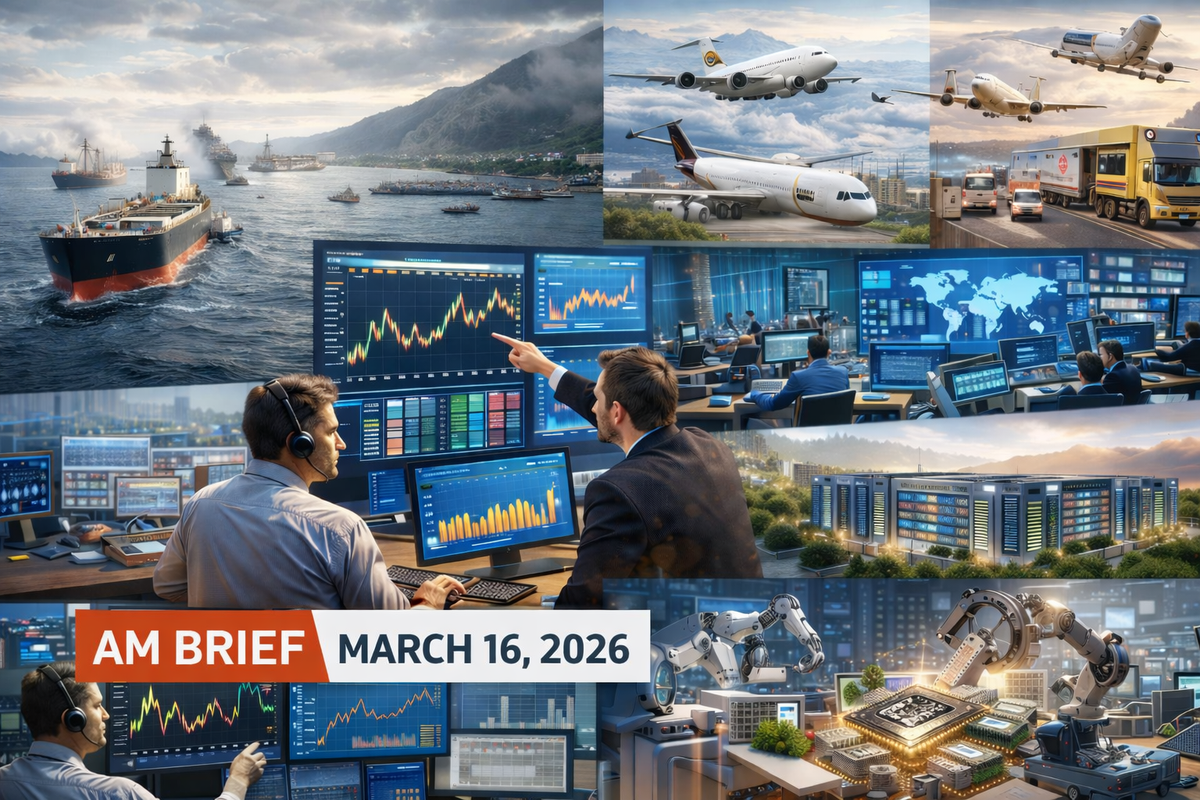
By WBN Global News Desk | Global Edition | March 16, 2026 | 6:00 AM
Global markets begin the new week under pressure from the biggest energy shock in years. Oil pushed above $100 a barrel after further disruption around the Strait of Hormuz, while governments and traders weighed the fallout for inflation, freight, central banks, and consumer demand. The conflict has turned energy back into the dominant macroeconomic signal, with markets now repricing both growth and policy risks.
At the same time, the AI buildout remains one of the few forces still pulling capital aggressively into technology. NVIDIA’s GTC conference, renewed data-center spending, and fresh reports of AI-linked layoffs at major tech firms show that the next phase of the market is being defined by two competing realities at once: inflationary supply shocks in the real economy and relentless capital concentration in AI infrastructure.
Oil remained the defining story overnight as attacks on Middle East export infrastructure kept traders focused on disrupted supply and shipping. Brent rose above $105 and US crude touched $100, with the Strait of Hormuz still acting as the key chokepoint for roughly a fifth of global oil and LNG flows.
The market is no longer reacting as though this is a temporary spike. Benchmark dislocations in Middle East crude and reduced exports into Asia suggest refiners, freight markets, and governments are now pricing in a longer disruption window.
Source: Reuters | Date: March 16, 2026
Why It Matters
• Higher oil raises inflation risk across transport, food, and manufacturing
• Energy-driven uncertainty is now influencing central bank expectations
• Entrepreneurs should expect renewed pressure on freight and input costs
The International Energy Agency said more than 400 million barrels of emergency oil will be released into disrupted markets, making it one of the largest coordinated stockpile responses in history. The release is meant to ease shortages triggered by the Hormuz crisis and calm a market that is repricing global energy security.
While the release may soften the immediate blow, it does not remove the structural problem: export routes remain vulnerable, insurance costs are rising, and physical supply remains uncertain.
Source: Reuters | Date: March 15, 2026
Why It Matters
• Emergency reserves can stabilize prices temporarily, not permanently
• The move shows governments view this as a severe supply event
• Businesses should not assume energy volatility is ending soon
Washington is pressing allies and major importers to help secure the Strait of Hormuz, with President Trump warning partners that countries benefiting from Gulf energy should contribute to reopening the route. The diplomatic push now includes pressure on NATO members and China as the US runs short of tools to offset the oil shock on its own.
The problem for markets is that political consensus is still incomplete. Japan says it is not yet planning an escort mission, while Europe remains divided over how far to extend naval operations.
Source: Reuters | Date: March 16, 2026
Why It Matters
• The energy crisis is now a diplomatic and military coordination issue
• Delays in securing shipping lanes prolong market instability
• Businesses tied to fuel, chemicals, and imports face elevated uncertainty
US and Chinese officials wrapped another round of talks in Paris aimed at keeping the trade relationship stable ahead of a possible Trump-Xi summit later this month. Discussions reportedly covered agriculture, managed trade, investment mechanisms, and critical minerals.
That matters because the global economy is now dealing with two simultaneous threats: energy disruption and unresolved trade friction. Even limited stability between Washington and Beijing helps reduce the chance of an additional tariff shock hitting an already fragile market.
Source: Reuters | Date: March 16, 2026
Why It Matters
• Trade stability between the US and China remains a major market anchor
• Critical minerals and agriculture are back at the center of negotiations
• A calmer trade backdrop could help offset some energy-driven stress
US stock futures moved higher, supported by big tech, even as the wider market kept one eye on oil and the Middle East. Meta, Micron, NVIDIA, and Tesla all helped lift sentiment, reinforcing the idea that AI capital spending still commands investor attention even during a geopolitical shock.
This divergence is notable: traditional sectors are more vulnerable to higher energy costs, while large-cap tech continues to benefit from AI positioning and the US market’s relative insulation as a net oil exporter.
Source: Reuters | Date: March 16, 2026
Why It Matters
• Markets are still rewarding AI-linked scale and infrastructure exposure
• Tech strength is helping offset broader macro anxiety
• Small businesses should watch whether this resilience spreads beyond mega-cap stocks
NVIDIA’s GTC conference opens with expectations that Jensen Huang will unveil new chips, software, and infrastructure plans for the next wave of AI deployment. The event is being watched not just as a product launch, but as a signal for the pace of global AI capital expenditure.
With demand shifting from model training toward inference and real-world deployment, investors are looking for clues on where spending goes next across data centers, robotics, software stacks, and sovereign AI projects.
Source: Reuters | Date: March 16, 2026
Why It Matters
• NVIDIA remains a bellwether for AI infrastructure spending worldwide
• The story is moving from hype toward deployment economics
• Businesses building on AI should watch where the ecosystem is maturing fastest
Meta is reportedly considering sweeping layoffs as it tries to fund massive AI infrastructure commitments and adapt to AI-driven productivity gains. The proposed cuts could exceed 20% of its workforce if finalized, reflecting how expensive the AI arms race has become even for the largest platforms.
The broader signal is clear: companies are not only spending more on AI, they are also redesigning labor models around it. That creates a split economy in which capital expenditure rises while payrolls in some functions fall.
Source: Reuters | Date: March 14, 2026
Why It Matters
• AI is changing both spending patterns and staffing models
• Efficiency gains are increasingly being used to justify restructurings
• Business owners should expect more “do more with fewer people” pressure across software and media
The Bank of Japan is expected to keep rates steady, but the surge in oil prices is complicating its policy path. Japan remains highly exposed to imported energy, and the latest shock is reinforcing inflation concerns at a moment when the BOJ had already been leaning toward further normalization.
Markets are increasingly focused on whether elevated oil prices force policymakers to maintain a tightening bias even as growth risks rise. That makes the BOJ meeting more important than usual for currency and bond markets across Asia.
Source: Reuters | Date: March 16, 2026
Why It Matters
• Japan is a major test case for oil-driven imported inflation
• Rate expectations in Asia could shift quickly if the shock persists
• Currency volatility may rise for businesses buying globally in yen-linked markets
The Bank of England is now expected to hold rates steady rather than move toward an early cut, as higher oil and gas prices feed directly into the UK inflation outlook. Economists now see policymakers taking a more cautious tone, with markets even beginning to price some chance of a hike later in the year.
This shift shows how quickly the energy shock is changing the rate conversation. Just days ago, the narrative was about easing; now it is about waiting, reassessing, and avoiding another inflation mistake.
Source: Reuters | Date: March 16, 2026
Why It Matters
• Rate-cut expectations can reverse fast when energy spikes
• The UK may be an early example of oil shock feeding monetary caution
• Borrowing cost assumptions for 2026 may need to be revised upward
The Middle East conflict is now disrupting pharmaceutical cargo routes through Gulf air hubs, raising concern about future shortages of temperature-sensitive medicines, including cancer drugs. Companies are rerouting through alternative corridors, but logistics are becoming more expensive and more fragile.
This is one of the clearest signs yet that the conflict is spreading beyond oil into critical supply chains. If disruptions persist for weeks, the issue could become both a healthcare problem and a wider logistics story.
Source: Reuters | Date: March 16, 2026
Why It Matters
• Supply-chain stress is spreading beyond energy into essential goods
• Air cargo disruption can become a major cost and delivery issue quickly
• Businesses should monitor secondary effects, not just headline oil prices
Macron Urges Iran To Restore Navigation In Hormuz
Source: Reuters | Date: March 15, 2026
UK Says It Will Not Be Drawn Into Wider Iran War
Source: Reuters | Date: March 15, 2026
Germany Questions Expanding EU Naval Mission To Hormuz
Source: Reuters | Date: March 15, 2026
Japan Says It Is Not Planning A Hormuz Escort Mission
Source: Reuters | Date: March 16, 2026
Swiss National Bank Expected To Hold Rates At Zero Through 2026
Source: Reuters | Date: March 16, 2026
Gold Falls As Inflation Fears Pressure Fed Rate-Cut Outlook
Source: Reuters | Date: March 16, 2026
British Pound Emerges As Surprise European Currency Outperformer
Source: Reuters | Date: March 16, 2026
European Shares Slip As Middle East Conflict Enters Third Week
Source: Reuters | Date: March 16, 2026
Middle East Oil Benchmarks Hit Record Highs As War Cuts Supply
Source: Reuters | Date: March 16, 2026
Shell Says Global LNG Demand Could Rise At Least 54% By 2040
Source: Reuters | Date: March 16, 2026
Pound Edges Up As Investors Focus On Middle East And Bank Of England
Source: Reuters | Date: March 16, 2026
WBN Global News Desk | Global Edition
Email: news@wbn.global
TAGS: #Breaking News #Global Economy #Markets #Energy #Technology #Geopolitics #WBN Global