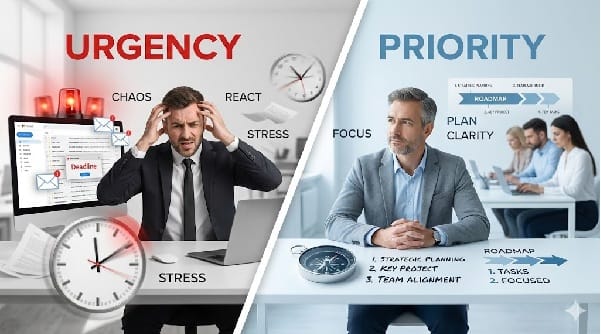
The Leadership Distinction That Protects Your Focus in a Noisy World

We are living in an age where it’s easy, almost automatic, to confuse motion with progress.

When political systems feel fractious, economies feel unsure, inflation distorts decision-making, and climate impacts add a constant undertone of risk, leaders face a daily barrage of signals that all sound like: “Now. Immediately. Fix it.”

That’s urgency.

But urgency is not the same thing as priority, and confusing the two is one of the fastest ways to exhaust yourself, destabilize your team, and drift away from what matters most.

Full Spectrum Leadership is built for times like these because it asks leaders to hold more than one truth at the same time: we must respond to what’s real, while still acting in alignment with values, long-term vision, and the needs of people.

So let’s put a clean distinction on the table.

A simple definition

Urgency is a time pressure signal. It speaks to immediacy: “This must be addressed quickly.”

Priority is a value and impact signal. It speaks to importance: “This matters most, even if it isn’t loud.”

Urgency is often driven by the external environment (deadlines, disruptions, complaints, crises). Priority is driven by internal clarity (values, strategy, commitments, and intended outcomes).

In practical leadership terms:

  • Urgency pulls attention.
  • Priority directs attention.

Leaders who master this distinction don’t become slow or indifferent. They become deliberate. They respond with speed when speed is truly required, but they don’t let speed become the boss.

Why urgency is seductive (and dangerous)

Urgency has a special kind of emotional power. It creates adrenaline, focus, and a short-term sense of accomplishment. When you “put out a fire,” you feel useful. You feel effective.

But urgency also has a shadow side:

  1. Urgency is contagious. One anxious person can infect a team with panic.
  2. Urgency crowds out thinking. It narrows attention to the immediate issue, even if the real cause is systemic.
  3. Urgency erodes trust. When everything is urgent, people stop believing you, because nothing can truly be urgent all the time.
  4. Urgency creates reactivity as culture. Teams start optimizing for speed instead of outcomes, and mistakes increase.

In other words: urgency is sometimes necessary, but it is never a complete operating system.

Priority is a leadership act, not a personal preference

Priority isn’t “what I feel like doing.” Priority is what you choose to protect because it serves the mission, the people, and the longer-term outcome.

This is why priority requires self-leadership: you must have enough clarity and regulation to resist the emotional pull of the loudest signal. Full Spectrum Leadership emphasizes this kind of grounded decision-making, leadership that isn’t dependent on ideal conditions, but is often forged “in the fires of adversity,” using resilience and forward-thinking instead of panic.

And priority is not passive. Priority has teeth. Priority says:

  • “Not yet.”
  • “Not now.”
  • “Not like that.”
  • “Yes, but here’s the boundary.”
  • “We’ll address this, but it doesn’t get to displace what we’ve committed to.”

If urgency is the siren, priority is the steering wheel.

The missing link: intention (and why actions reveal it)

Here’s where the conversation gets even more real.

Most leaders say they have priorities. But teams don’t follow what you say. They follow what you fund, schedule, reward, tolerate, and repeatedly do.

As your own writing puts it: actions are a direct reflection of underlying intentions, behavior becomes a form of communication.

So if a leader claims “people first” but constantly rewards overwork and last-minute scrambling, the team will believe the calendar, not the slogan.

Priority becomes credible only when it shows up in consistent action, time allocation, and boundaries.

A practical model: The Urgency - Priority Filter (5 questions)

When something lands on your desk (or your phone) with heat and intensity, run it through these five questions:

  1. What happens if we do nothing for 24 - 72 hours?
    If the answer is “irreversible harm,” it’s likely truly urgent.
  2. Is this a symptom or a cause?
    Urgency often points to symptoms. Priority often addresses causes.
  3. Who is asking—and what do they need?
    Emotional Intelligence matters here: are they anxious, frustrated, overwhelmed? Listening well helps you separate felt urgency from real urgency. Full Spectrum Leaders emphasize empathy and clear communication to build psychological safety.
  4. What priority will this displace if we act immediately?
    This question forces the trade-off into daylight.
  5. What decision aligns with our values and desired outcomes?
    Priority is ultimately values-driven and future-aware. Full Spectrum Leadership explicitly calls leaders to consider longer-term impacts, not only short-term wins.

These questions create space between stimulus and response, and space is where leadership lives.

How Full Spectrum Leadership strengthens this distinction

Full Spectrum Leadership is not about choosing calmness over action. It’s about integrating capacities so you can act wisely under pressure.

Here’s how the framework supports “priority over panic”:

  • Visionary thinking helps you choose what matters beyond the short-term horizon.
  • Adaptability helps you pivot without abandoning the mission.
  • Emotional Intelligence helps you de-escalate noise, resolve conflict, and keep humans engaged through uncertainty.
  • Ethical decision-making helps you avoid “fast but wrong” choices that create downstream harm.
  • Collaboration prevents the leader from becoming the single choke point for every “urgent” request.

Priority is not a solo activity; it’s a shared language. Teams do better when leaders make the criteria visible, repeatable, and fair.

What it looks like in a real conversation

When a client or colleague says, “We need this ASAP,” the Full Spectrum Leader doesn’t dismiss it. They translate it.

Try language like:

  • “I hear the urgency. Let’s clarify what makes it urgent.”
  • “Let’s separate timing from importance, what outcome are we protecting here?”
  • “If we treat this as urgent, what do we delay, and are we willing to make that trade?”

This approach is both compassionate and clear: it acknowledges emotion without surrendering to it.

The deeper payoff: less burnout, more trust, better results

Leaders who consistently choose priority create:

  • Psychological safety (people stop living in constant alert mode)
  • Operational reliability (fewer “urgent” emergencies created by neglect)
  • Strategic momentum (the important work actually gets done)
  • Credibility (teams believe your words because your actions match)

In uncertain times, leadership isn’t proven by how fast you move. It’s proven by how well you decide what deserves speed, and what deserves steadiness.

Urgency will always exist. But priority is what prevents urgency from owning you.

Call to action: This week, pick one recurring “urgent” item and ask: What priority would reduce this urgency if we handled the cause instead of the symptom? Then schedule that work like it matters, because it does.

Let’s Keep Talking!

Peter Comrie Co-Founder and Human Capital Specialist at Full Spectrum Leadership Inc. Reach out to me at peter@fullspectrumleadership.com Or connect with me here to book a call!

Reach me on Linkedin; https://www.linkedin.com/in/petercomrie/

Tags: urgency vs priority, leadership focus, full spectrum leadership, decision making under pressure, strategic prioritization, executive leadership coaching

Share this article
The link has been copied!