By Elke Porter | WBN Ai | June 4, 2026
Subscription to WBN and being a Writer is FREE!
The humble backache has quietly become one of the most expensive problems in the modern economy. Musculoskeletal injuries are among the leading causes of workplace disability claims, costing employers and healthcare systems billions annually. Now, a new generation of wearable lift-assist devices — ergonomic exoskeletons and mechanical lift systems — promises to fix that. The economic ripple effects, however, cut both ways.
Two Technologies, One Goal
The lift-assist market is broadly divided into two categories, each suited to different work environments.
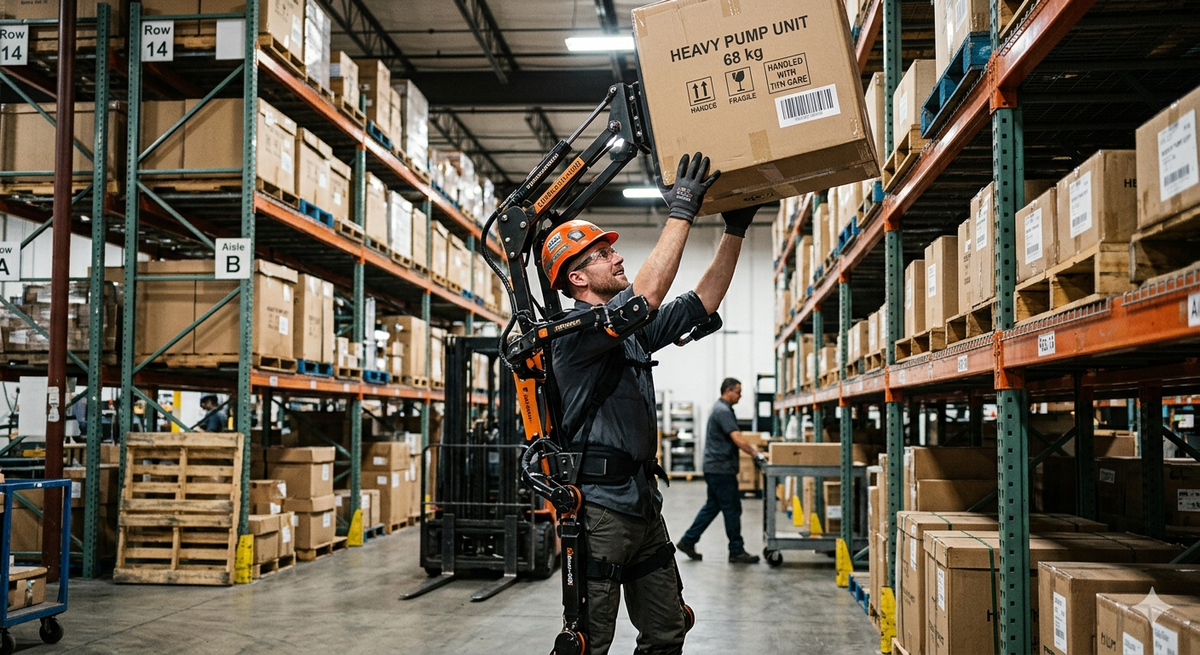
The first is the wearable exoskeleton. These backpack-style harnesses are worn over the shoulders and strapped around the thighs, moving with the worker throughout their shift. The leading example is the Verve Motion SafeLift — a motorized, battery-powered exosuit weighing just 6.5 lbs. It uses sensors to detect lifting motions in real time and provides active support to the lower back and shoulders during repetitive lifts. The result is complete mobility with dramatically reduced cumulative muscle fatigue, while helping workers maintain proper lifting form across an entire shift — not just when they remember to.
The second category is mobile vacuum and mechanical lifters — cart-based units that follow the worker rather than being worn. The TAWI Mobile Order Picker, for instance, is a portable vacuum lift that mounts to a pallet jack or forklift, allowing a single worker to handle boxes and bags without physical strain. The Magliner LiftPlus takes a different approach: a battery-powered, folding mobile lift truck capable of pushing or pulling loads up to 1,000 lbs, ideal for crates, barrels, and oversized boxes at varying heights. The key economic advantage of these systems is stark — they can eliminate 100% of the load's weight, enabling one worker to accomplish tasks that previously required two.
The Industries That Win
Warehouses and logistics operations are perhaps the biggest winners. With e-commerce demand at record highs and worker injury rates stubbornly elevated, both wearable exoskeletons and mobile lift systems could dramatically reduce compensation claims, lower insurance premiums, and extend the productive careers of physically capable employees. That translates directly to lower operating costs and stronger margins — a meaningful competitive advantage in an industry where thin margins are the norm.
Grocery chains and restaurants face similar math. Back injuries among stock clerks and kitchen staff are routine and costly — in lost shifts, training replacements, and liability exposure. Outfitting workers with lift-assist technology turns a chronic operational drain into a solved problem.
"In fifteen years running this kitchen, I've lost more good people to back injuries than to anything else," says Marco Delgado, owner of a busy Vancouver bistro. "You train someone for months, they're finally indispensable, and then one morning they're hauling a stock pot and that's it — they're out for six weeks, or gone for good. If a device can stop that, I don't care what it costs. I'd buy ten of them tomorrow."
Moving companies and appliance delivery services — industries built entirely on human beings carrying brutally heavy objects up staircases and through narrow hallways — stand to gain enormously. Fewer injuries mean fewer disruptions, reduced insurance overhead, and leaner, more reliable teams. For companies delivering refrigerators or washing machines, the downstream savings on logistics, scheduling, and liability alone could fundamentally reshape operating economics.
The Industries That Don't
The economic losers are equally easy to identify. Chiropractors, physiotherapists, and kinesiologists have long operated with a reliable, self-replenishing client base: people who lift things badly and pay for it for months afterward. Widespread adoption of exoskeleton technology would meaningfully reduce that pipeline. Clinics that depend heavily on workplace injury referrals could face a structural decline in demand that no amount of wellness rebranding will fully offset.
Workers' compensation insurers, too, may find their actuarial models quietly disrupted as injury frequency drops in the sectors that adopt these technologies earliest and most aggressively.
The Bottom Line
The broader economic case is straightforward: preventable injuries are expensive, and the technology to prevent them now exists — in two distinct, proven forms. For employers, insurers, and workers alike, lift-assist devices represent a rare alignment of interests. The upfront investment is real, but so is the return.
Some backs will be saved. Some business models will not.
For more information on wearable exoskeleton solutions, visit Verve Motion at vervemotion.com. For vacuum and mechanical lift systems, explore TAWI at tawi.com.
Elke Porter at:
Westcoast German Media
LinkedIn: Elke Porter or
WhatsApp: +1 604 828 8788.
Public Relations. Communications. Education
Let’s bring your story to life — contact me for books, articles, blogs, and bold public relations ideas that make an impact.
TAGS: #ExoskeletonTech #WorkplaceWellness #FutureOfWork #ErgoTech #WearableRobotics #WorkerSafety