
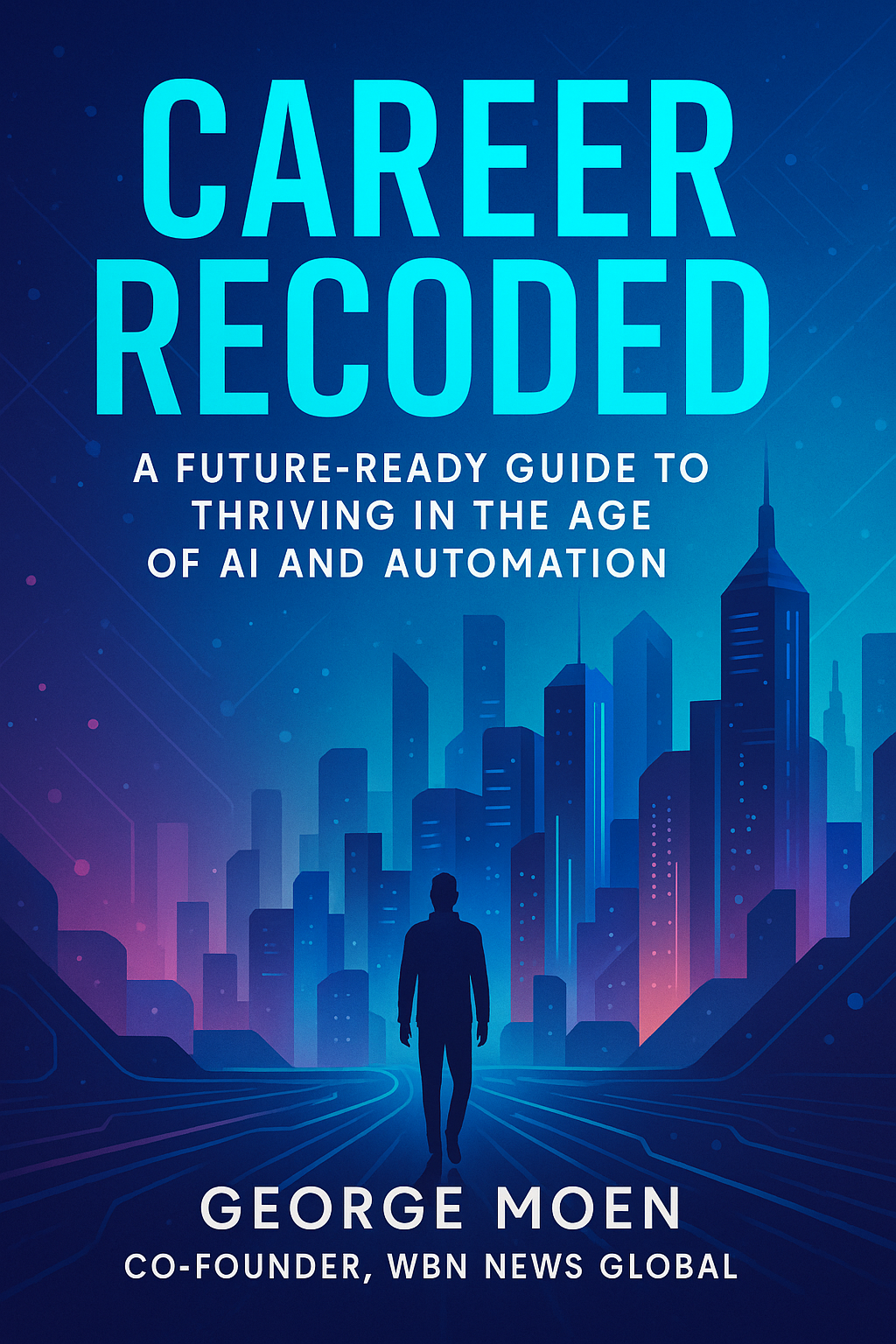
By George Moen – Co-Founder, WBN News Global
The Book: This is a WIP book, and as I build it out, I will post it here. The rest of the world canNOT see it.
YOUR EYES ONLY DO NOT SHARE THE LINK - Thanks
>>>>>>>>>>>>>>>>>>>>>>>>>>>>>>>>>>>>>>>>>>>>>>>>>>>>>>>>
The Initial Prompt
I used Elk's Guide as the Prompt. I said, " I am writing a Book about the future of work, and here is the guide I want to use." The book will be approximately 100-125 pages. " Generate me a chapter outline."
>>>>>>>>>>>>>>>>>>>>>>>>>>>>>>>>>>>>>>>>>>>>>>>>>>>>>>>>
Elke’s Guide: WBN Digital Book Store E-Book Specification Sheet
Contact Information
📞 Phone: 604-828-8788 (WhatsApp, Text, or Call)
📧 Email: porterprvancouver@gmail.com
📘 Book Format & Dimensions
- Page Size: 8.5 x 11 inches (standard letter size)
- File Format: PDF (preferred), DOCX also accepted
- Image & Cover Resolution: Minimum 300 DPI (high-resolution print quality)
📚 Required Book Components (in order)
1. Front Cover
- Must be 8.5” x 11” at 300 DPI resolution
- Include:
- Title
- Subtitle (if applicable)
- Author’s name
- Optional:
- Author image
- Logo or tagline
2. Copyright Page
- Example: © [Year] by [Author Name]
- “All rights reserved” statement
- ISBN (if applicable)
- Publisher: WBN Digital Book Store
- Contact info: Email or Website
- Disclaimers: Legal, medical, or financial if applicable
3. Introduction and/or Conclusion (Optional)
- Personal story, context, or takeaway message
4. Main Content / Chapters
- Use titled chapters and headers
- Support content with:
- Bullet points, lists, subheadings, charts
- Perform a full spell-check and grammar review
5. Works Cited / References
- Required for any third-party info or stats
- Use MLA, APA, or Chicago style (be consistent)
- Include full citations or URLs
6. Back Cover
- May include:
- Author bio
- Endorsements
- Contact info
- Teaser for next book
- Must be 300 DPI if using images or graphics
🖼️ Image Guidelines
- Resolution: 300 DPI minimum
- Placement: Inline with appropriate captions
- Usage Rights: Must have permission or licensing
- Alt Text (Recommended): For accessibility
✅ Submission Checklist
📄 Content Review
- All required sections in correct order
- Spell-checked & grammar reviewed
- Clear headers/subheadings
- Logical chapter organization
🛠️ Technical Specs
- PDF or DOCX format
- Page size set to 8.5” x 11”
- Images are 300 DPI or higher
- Cover meets specs
⚖️ Legal & Attribution
- Copyright page complete
- Citations for all third-party material
- Image permissions documented
- Legal disclaimers included (if needed)
🔍 Final Quality Check
- File opens correctly
- Images are clear and positioned properly
- Text formatting is consistent
- Accurate contact and publisher info
💼 Ready to Submit?
📧 Email: porterprvancouver@gmail.com
📞 Call/Text/WhatsApp: 604-828-8788
✨ Optional Extras (Additional Fee Required)
- Front Cover Design
- Back Cover Design
- Professional Editing (Grammarly, AI tools, or human editor)
- Works Cited Compilation Assistance
>>>>>>>>>>>>>>>>>>>>>>>>>>>>>>>>>>>>>>>>>>>>>>>>>>>>>>>>
📑 Book Components Overview
This book has been designed to deliver maximum clarity and actionable insight. Here are the major components included:
- Front Cover
• Title, subtitle, author name, and optional branding - Copyright Page
• Legal rights, publisher, ISBN (if applicable), and disclaimers - Table of Contents
• A navigational guide to all 25 chapters - Wireframe
• Describes the layout and structure of every chapter - Introduction
• Context on why this book exists and who it’s for - Chapters 1–25
• Each chapter includes a stat, context, insights, a checklist, action steps, and optional tools or bonus content - Works Cited / References
• All sources and citations used throughout the book - Back Cover
• Author bio, contact details, and teaser for next book or offer
>>>>>>>>>>>>>>>>>>>>>>>>>>>>>>>>>>>>>>>>>>>>>>>>>>>>>>>>
📘 Wireframe of the Book
This book follows a consistent, reader-friendly format throughout each chapter to help you absorb the insights and take meaningful action:
🔷 Chapter Structure
- 🔍 Stat to Know: A powerful data point to open the chapter.
- Opening Context: A brief overview of the chapter’s theme.
- Key Insights & Breakdown: Analysis, examples, and case studies.
- Action Steps: Specific things you can do immediately.
- 📋 Checklist: 4–6 point checklist to reinforce chapter goals.
- 🛠️ Tool Set (when applicable): Free and paid tools to support your journey.
- 🎯 Bonus Section (when applicable): Extra content like templates, interviews, or frameworks.
- 🧭 Conclusion: For the Chapter
>>>>>>>>>>>>>>>>>>>>>>>>>>>>>>>>>>>>>>>>>>>>>>>>>>>>>>>>
📚 Planned Chapters
- The Great Disruption – What’s Coming in the Next 5 Years
- How Many Jobs Will Be Lost (And Where?)
- Why AI and Automation Aren’t Slowing Down
- Where the Jobs Are Now Growing
- Mindsets That Win in the AI Economy
- The New Resume: What Employers Want Now
- Your 30-Day Reskilling Blueprint
- Free Learning Platforms & Certificates That Matter
- AI Tools You Should Be Using (Even Now)
- How to Build an AI-Ready Career Plan
- Becoming a Problem Solver, Not Just a Job Seeker
- Side Hustles That Survive (and Thrive) in the AI Era
- Freelancing & Remote Work: The New Global Talent Market
- Recession-Proof Roles You Can Train for Fast
- The 50/30/20 Strategy: Balancing Job, Skill, and Hustle
- Don’t Get Scammed: Navigating the Online Course Jungle
- Getting Hired by AI: How Hiring Algorithms Work
- What Hiring Managers Look For Now
- The Pivot Portfolio: How to Showcase Your Shift
- LinkedIn Optimization for the AI Era
- Building a Personal Brand That Opens Doors
- Interviewing with Confidence (Even in New Fields)
- How to Turn Job Loss Into Reinvention
- Reclaiming Your Future: Final Challenge & Workbook
Bonus Chapter: Why You Need a “Today Plan,” Not a One to Three Or Five-Year Plan
>>>>>>>>>>>>>>>>>>>>>>>>>>>>>>>>>>>>>>>>>>>>>>>>>>>>>>>>
Introduction – Reclaim Your Future
In the next five years, millions will lose their jobs—not because they did something wrong, but because the world is changing faster than anyone imagined.
Artificial Intelligence, automation, and global market shifts are transforming every corner of the economy. From retail to finance, transportation to customer service, even white-collar jobs are no longer safe from disruption. The numbers are staggering. And the change isn’t coming—it’s already here.
But this book is not about fear.
This book is about recoding your mindset, skills, and career to win in the AI era.
If you’ve been watching headlines and wondering if your job is next...
If you’ve felt the pressure to “reskill or upskill” but don’t know where to begin...
If you’ve been working harder and earning less, wondering how to keep up...
You’re in the right place.
Reclaim Your Future is your roadmap for navigating—and thriving—in the new world of work. Inside, you’ll find clear answers to the big questions:
- What kinds of jobs will still exist—and pay well?
- What do I need to learn to stay relevant?
- How can I earn money without a traditional employer?
- Where are the hidden opportunities everyone else is missing?
More importantly, you’ll discover how to:
- Adapt faster than AI can replace you
- Build a future-proof personal brand
- Launch a one-person business using tools you already have
- Use AI to your advantage, not fear it
This isn’t theory. It’s a practical playbook. Each chapter includes specific steps, resources, and insights from people who’ve already leaped—from laid off to thriving, uncertain to unstoppable.
You don’t need to be a tech genius. You don’t need another degree.
What you need is a mindset shift, a toolkit, and a plan.
This book gives you all three.
Let’s begin.
>>>>>>>>>>>>>>>>>>>>>>>>>>>>>>>>>>>>>>>>>>>>>>>>>>>>>>>>
Chapter 1: The Great Disruption – What’s Coming in the Next 5 Years
We are living through the early tremors of a massive economic quake. The ground beneath our feet—how we work, earn, and build careers—is shifting faster than most people realize. And this is only the beginning.
The Big Picture
Experts from McKinsey, PwC, and the World Economic Forum estimate that between 83 million and 300 million jobs globally could be impacted by AI and automation by 2030, with some estimates putting as high as 800 million. In North America alone, tens of millions of roles—especially in retail, transportation, administration, and customer service—are either being eliminated or radically changed.
But it’s not just blue-collar or low-skill jobs. AI is now writing reports, reviewing contracts, analyzing medical data, and managing portfolios. White-collar professionals—from junior accountants to project managers—are just as vulnerable.
This disruption is different from previous industrial shifts. Why?
Because the machines now learn faster than we do.
Every month, AI systems become smarter, faster, and more capable of handling tasks that were once considered uniquely human. That pace is accelerating, not slowing down.
We’re not talking about science fiction. We’re talking about ChatGPT writing college-level essays, Midjourney generating ad-ready images, and autonomous robots stacking warehouse shelves in real-time. What used to take teams of people can now be done with a laptop and the right software.
The 5-Year Forecast
Let’s get specific. Here's what’s projected by 2030:
- Retail & Service Jobs: Up to 50% reduction in traditional cashier, inventory, and frontline roles due to automation and AI checkout systems. Walmart and Amazon are investing in automated stores and robotics to reduce human labor.
- Transportation & Delivery: Autonomous vehicles and drones may replace up to 40% of driving-related jobs. Uber is investing heavily in self-driving research. FedEx and UPS are experimenting with delivery drones.
- Office & Administrative Roles: AI assistants and workflow automation will eliminate or reduce 30–45% of tasks in HR, data entry, and scheduling. Companies like Salesforce and Zapier now offer “no-code” automations that replace repetitive office work.
- Financial Services: Expect widespread AI-driven disruption in banking, insurance, and accounting roles. Robo-advisors manage billions in assets, and algorithms underwrite insurance claims in seconds.
Add to that the quiet but steady rollout of “digital workers” — cloud-based AI agents that never sleep, never call in sick, and can handle thousands of requests per minute. The economics are irresistible to companies. The implications for workers? Transformational.
Not All Doom and Gloom
History teaches us that every disruption creates new opportunities.
The printing press destroyed the scribe industry, but launched publishing.
The internet killed video rental stores—but gave rise to streaming giants.
AI will eliminate some jobs, but create new ones in emerging fields.
New roles are already being born: AI prompt engineers, data ethicists, virtual experience designers, remote team facilitators, solopreneur consultants, and creators who combine human intuition with machine power.
We are entering a Skills Renaissance in which adaptability, creativity, and tech fluency will outperform degrees or tenure.
Your job is to see it coming, prepare strategically, and act early.
From Disruption to Direction
Here’s what this means for you:
- Don’t wait for a layoff to start learning new skills.
- Start treating your career like a business, not just a job.
- Think of yourself as a brand, not just an employee.
- Leverage tools that multiply your impact, not compete with you.
The people who will thrive in this transition aren’t the ones with the fanciest degrees. They’re the ones who choose to stay in motion, who take advantage of free tools, cheap certifications, peer support, and high-impact communities.
If you can see the signals and respond decisively, your career can grow faster and more flexible than ever before.
Action Steps
- ChatGPT “AI in [Your Industry]” and read the top 5 headlines. Start your awareness journey.
- List three parts of your job that could be automated in 3 years. Be honest.
- Ask yourself: What can I learn that AI can’t easily replicate?
- Write one sentence describing your job as a business: “I help X do Y by Z.”
- Start tracking your time at work this week. What are you doing that could be automated or delegated?
The disruption is here, but so is your moment to lead.
Let’s move forward.
✅ Chapter 1 Recap: Are You Future-Ready?
Use this checklist to assess your readiness for the AI-driven shift quickly:
🧠 Awareness
- I understand how AI and automation are affecting my industry
- I’ve read at least three recent articles about AI trends in my job field
- I can name three emerging roles that didn’t exist 5 years ago
🔍 Self-Assessment
- I’ve listed parts of my job that could be automated
- I know what value I offer that machines can’t replicate
- I’ve written a personal mission statement (e.g., “I help X do Y by Z.”)
⚙️ Tools & Learning
- I’ve tried at least two free tools from the Tool Set list
- I’ve signed up for one online course or skill-building platform
- I’m using a planner, tracker, or system to monitor my progress
🧭 Mindset
- I see disruption as an opportunity, not just a threat
- I’m committed to learning and staying in motion
- I’m building a network or community of others, also adapting
🎯 Pro Tip:
Check off at least 7 out of 12? You're on your way.
Less than 7? Don’t worry—this book is your map. Keep going.
Tool Set: Free First, Then Paid
🚀 Free Tools to Get Started
Learning & Upskilling
- Coursera / edX
- Google Digital Garage
- Khan Academy
- HubSpot Academy
Productivity & AI Tools
- ChatGPT Free Tier
- Canva Free
- Notion
- Trello
Job Search & Freelancing
- Indeed / Glassdoor
- Upwork / Fiverr
- RemoteOK / AngelList
💼 Paid Tools Worth the Investment
AI & Automation
- ChatGPT Plus / Claude Pro
- Simplified.ai
- Zapier / Make
Branding & Marketing
- Canva Pro
- Pictory / Lumen5
- TidyCal / Calendly Pro
Business & Career Growth
- GoHighLevel
- Skillshare / LinkedIn Learning
- Grammarly Premium
🧩 Tip:
Start with free. Grow with paid. The goal isn’t to spend more—it’s to choose tools that return time, money, or opportunities. If a tool saves you 2 hours a week or helps you land a client, it’s already earned its place.
📊 Bonus Section: Job Loss Projections
🔢 Global Job Impact Projections
| Source | Job Displacement Estimate | Timeline | Notes |
|---|---|---|---|
| McKinsey & Co. | Up to 800 million jobs | By 2030 | Includes displacement & transformation |
| World Economic Forum | 83M lost / 69M created | 2023–2027 | Net loss of 14M jobs |
| Goldman Sachs | 300 million jobs | Unspecified | Focus on white-collar & admin |
| PwC | 30% of global jobs | By mid-2030s | Heaviest in developed economies |
🇺🇸 United States
- 1.4M workers may need to change occupations by 2030 (BLS)
- AI could affect 40% of all U.S. jobs within 5 years
- Highest risk: retail, transport, admin, food service
🇨🇦 Canada
- 50% of Canadian jobs will require a new skill mix by 2030 (RBC)
- Up to 7 million jobs may be affected by automation
🌍 Global
- Developing nations may lose jobs in agriculture, textiles, and customer service first
- These regions need support for reskilling and digital inclusion.
📌 Key Takeaway: No country, no sector, no skill level is immune. Adaptability isn’t optional—it’s essential.
🧭 Conclusion: Disruption Is the Signal—Not the End
What’s coming isn’t just a change in tools—it’s a full-scale rewrite of the career playbook. Chapter 1 laid out the roadmap of disruption, not to create fear, but to awaken awareness.
Yes, the future will challenge old assumptions—but it will also reward those who are ready to adapt, learn, and lead.
This isn’t about what’s being taken—it’s about what’s opening up.
The first step to thriving in the AI age is understanding where the winds are blowing—so you can set your sail.
>>>>>>>>>>>>>>>>>>>>>>>>>>>>>>>>>>>>>>>>>>>>>>>>>>>>>>>>
Chapter 2: How Many Jobs Will Be Lost (And Where?)
🔍 Stat to Know
According to the 2023 McKinsey Global Institute, up to 800 million jobs—or roughly 1 in 5 jobs globally—could be displaced by automation by 2030. In advanced economies, this could rise to one-third of the workforce.
🔷 Opening Context
The future of work is accelerating faster than expected. AI and automation are no longer future threats—they are present disruptors. Millions of workers across every continent are at risk, but the impact will vary widely by region, role, and readiness.
🔍 Key Insights & Breakdown
The Scope of the Shift
Automation is expected to displace up to 800 million jobs by 2030. This includes both blue-collar and white-collar professions. Most displacement will happen through task-level automation rather than complete role elimination.
Who’s At Risk?
Jobs most susceptible include:
- Routine-based tasks (e.g., data entry)
- Predictable environments (e.g., warehousing)
- High-volume decision-making (e.g., claims processing)
Sectors impacted:
- Manufacturing
- Retail
- Transportation
- Finance & Insurance
- Admin Support
The Geography of Displacement
- U.S.: Rust Belt states are most at risk.
- Europe: Eastern nations face sharp disruption.
- Asia: Millions of low-wage jobs are vulnerable in China, Vietnam, and India.
Urban areas may recover faster; rural zones may fall behind.
What AI Can’t Replace—Yet
- Roles needing empathy, creativity, or complex physical skills: teachers, mental health workers, tradespeople, entrepreneurs.
- But AI augmentation is already affecting even these spaces.
✅ Action Steps
- Identify if your job includes routine or automatable tasks.
- Begin tracking AI trends in your industry.
- Explore upskilling in non-routine areas: creativity, strategy, empathy.
- Seek roles where human judgment is hard to replicate.
📋 Checklist – Are You Future-Proofing Your Career?
- I’ve assessed how much of my current job could be automated.
- I know which industry sectors are most at risk in my region.
- I’ve identified whether my role involves routine, repetitive tasks.
- I’m actively tracking how AI is changing my industry.
- I’ve started upskilling in creativity, strategy, and emotional intelligence.
- I’ve explored or joined industries likely to grow with AI, not shrink.
- I’m connected to at least one professional or community focused on AI transition.
- I’ve looked into tools and programs that can help me reskill quickly.
🛠️ Tool Set
- McKinsey Job Explorer (Free): Job impact simulator by industry and country
- Coursera / edX (Free & Paid): AI and digital economy training
- FutureFit AI: Personalized reskilling pathfinder (enterprise version available)
- ReSkills.org: Database of fast-track retraining programs
🎯 Bonus Section: Red Flag Roles To Watch. Here are examples of roles highly vulnerable to automation:
- Data entry clerks
- Insurance underwriters
- Telemarketers
- Checkout clerks
- Delivery drivers (long haul and urban)
If you or someone you know works in these areas, it’s time to start preparing a transition plan.
🧭 Conclusion: Awareness Is Power
Job displacement isn't a distant threat—it's already unfolding. But this chapter isn’t a warning—it’s a wake-up call. You now know which sectors and roles are at risk and where the opportunities lie. The most crucial action you can take is to stay informed and adapt now.
>>>>>>>>>>>>>>>>>>>>>>>>>>>>>>>>>>>>>>>>>>>>>>>>>>>>>>>>
Chapter 3: Why AI and Automation Aren’t Slowing Down
🔍 Stat to Know: According to McKinsey, by 2030, up to 30% of the hours worked globally could be automated, with AI and robotics rapidly accelerating the transformation across industries.
Opening Context
Contrary to the belief that AI is just a passing trend, the data tells a different story—automation is ramping up, not down. Businesses, governments, and consumers are all driving its adoption, making it essential to understand how it will shape the future of work.
Key Insights & Breakdown
- The Cost Advantage
- AI and automation reduce labor costs, improve speed, and minimize errors.
- Companies adopting automation early often outcompete slower-moving rivals.
- Productivity vs. Employment
- Productivity gains don’t always translate into more jobs.
- Some roles are disappearing (data entry, telemarketing), while others are evolving (marketing analysts, AI support).
- Automation in Unexpected Places
- Agriculture, construction, legal review, and journalism are seeing increased automation.
- Even jobs with human intuition are being reshaped by AI-enhanced tools.
- Generative AI's Disruption
- Tools like ChatGPT, Midjourney, and Copilot are replacing and augmenting creative, administrative, and technical work.
- Roles that were once “safe” are now vulnerable to disruption.
- The Acceleration Loop
- As AI improves, it helps build better AI faster—a compounding feedback loop.
- Companies that resist adoption risk being left behind.
Action Steps
- Map your current job tasks to see which ones could be automated.
- Experiment with AI tools relevant to your industry (e.g., ChatGPT, Notion AI, Zapier).
- Stay current by subscribing to AI trend reports and newsletters.
- Take a course on AI basics or industry-specific automation trends.
📋 Checklist – Are You Future-Proofing Your Career?
- I understand how AI and automation are reshaping my industry.
- I’ve identified at least three tasks in my job that could be automated.
- I’ve started using one or more AI tools in my daily work.
- I’ve invested time in learning new tech or automation-related skills.
- I regularly follow AI and future-of-work trends from trusted sources.
- I’ve explored how to shift from repetitive tasks to strategic work.
🛠️ Tool Set Free
- FutureTools.io – Daily updates on the latest AI tools.
- Zapier – Free automation workflows for repetitive tasks.
- ChatGPT – Free AI assistant for ideation and communication.
Paid
- Jasper – AI copywriting and marketing automation.
- Notion AI – Enhanced productivity for planning and content.
- Runway ML – Creative automation for video and design professionals.
🎯 Bonus Section: The 10 Roles Most at Risk—and What To Do
- Data Entry Clerk → Re-train in data analysis or AI QA.
- Telemarketer → Shift to customer success or live onboarding.
- Legal Assistant → Explore legal tech and contract AI review tools.
- Travel Agent → Focus on personalized travel consulting.
- Cashier → Transition into store operations or logistics.
- Payroll Clerk → Upskill to HR analytics or compliance.
- Paralegal → Specializing in e-discovery and legal automation tools.
- Copywriter → Become an AI editor or brand strategist.
- Customer Support Rep → Train in chatbot management and service flows.
- Journalists → Focus on investigative, long-form, and niche reporting.
🧭 Conclusion: AI isn’t coming—it’s already here. Automation is not slowing down; it’s speeding up. Those who cling to the past will feel its impact the hardest. But those who prepare, adapt, and leverage it will not only survive—they’ll thrive. Let this chapter be your wake-up call: the future favors the adaptable. You don’t need a 5-year plan. You need a Today Plan—a small, strategic step you can take right now to stay ahead of the curve.
>>>>>>>>>>>>>>>>>>>>>>>>>>>>>>>>>>>>>>>>>>>>>>>>>>>>>>>>
Chapter 4 – Where the Jobs Are Now Growing
🔍 Stat to Know
Over 85 million jobs may go unfilled by 2030 due to talent shortages, according to a study by Korn Ferry — potentially resulting in $8.5 trillion in unrealized annual revenues globally.
Opening Context
While headlines focus on the jobs lost to automation, few discuss the jobs being created. Entire sectors are expanding — not shrinking — and new roles are emerging in response to technological shifts, sustainability demands, and demographic changes. The key to thriving? Knowing where to look and how to align your skills.
Key Insights & Breakdown
- Green Jobs Surge: Roles related to renewable energy, sustainability consulting, electric vehicle infrastructure, and climate tech are growing rapidly. Solar and wind technician roles are among the fastest-growing in North America.
- Health & Aging Services: As populations age, there's an explosive demand for roles in elder care, mental health support, telehealth, and holistic wellness.
- AI and Data Roles: AI isn’t just displacing jobs — it’s creating them. Roles like AI prompt engineer, machine learning operations, data labeling, and AI ethics compliance are emerging rapidly.
- Skilled Trades Rebound: Ironically, while white-collar automation increases, hands-on skilled trades (electricians, plumbers, HVAC techs) are in growing demand, with younger generations not filling the gap.
- Remote Work Infrastructure: Companies need digital project managers, cybersecurity experts, online educators, and virtual customer experience professionals to support distributed teams.
- Education & Re-skilling: As businesses invest in talent reinvention, new jobs are expanding in workforce training, curriculum design, and career coaching.
Action Steps
- Run a Future Fit Test: Compare your skill set with growth job clusters (e.g., via LinkedIn Career Explorer or Coursera Skills Reports).
- Audit Your Industry: Is your sector growing, plateauing, or shrinking? Shift horizontally to adjacent growth areas.
- Invest in Microcredentials: Platforms like edX, Skillshare, and Google Career Certificates offer low-cost, high-value credentials in in-demand fields.
- Talk to Hiring Managers: Informational interviews can reveal real-time hiring needs in your desired field.
- Look Local + Think Global: Explore regional workforce trends, consider international hotspots offering remote opportunities.
📋 Checklist – Are You Tracking Where Opportunity Is Growing?
✅ I know which sectors are adding jobs (not just losing them)
✅ I’ve identified at least two industries I could pivot or grow into
✅ I’ve taken at least one course or certification in a growth field
✅ I’ve reviewed job postings weekly to see trend patterns
✅ I’ve spoken to someone recently working in a growing industry
Tool Set – Navigate Where the Jobs Are Growing
Free Tools
- LinkedIn Career Explorer
Explore in-demand roles based on your current job title and see common career transitions. - Indeed Hiring Trends
Monitor real-time job market activity across industries and regions. - World Economic Forum: Future of Jobs Report
Download global reports identifying fast-growing sectors and skill clusters. - Replit & GitHub (for Tech Skill Demos)
Practice or build small tech projects to show your abilities for emerging jobs. - Google Trends + Google News
Search growth in emerging job titles or technologies to track real-time interest.
Paid Tools
- Coursera Plus
Annual subscription with unlimited access to certificates in AI, project management, and more. - Google Career Certificates
Job-ready credentials in IT support, data analytics, UX design, and more. - Lightcast (formerly Emsi)
An enterprise-level labor market analytics platform used by workforce planners and educators. - Skillshare Premium
Creative and tech upskilling courses — from freelance branding to automation workflows. - LinkedIn Premium Career
Access to insights on job applications, who's viewing your profile, and in-demand skill data.
🎯 Bonus Section – Sector-by-Sector Cheat Sheet: Fast-Growth Fields
| Sector | Example Roles | Skill Focus |
|---|---|---|
| AI & Automation | Prompt Engineer, AI Ops Manager | Python, prompt design, ethics |
| Health & Wellness | Telehealth Coordinator, Wellness Coach | Behavioral science, communication |
| Green Economy | Solar Tech, ESG Analyst | Environmental science, reporting |
| Trades | Electrician, HVAC Specialist | Certification, apprenticeships |
| Remote Work Support | Online Educator, Remote PM | Digital tools, time zone coordination |
🧭 Conclusion
The future of work isn’t just about loss — it’s about shift. Job destruction and job creation are two sides of the same coin. By identifying where the growth is happening and aligning yourself with emerging needs, you’re not just future-proofing your career — you’re becoming an early mover in tomorrow’s economy.
>>>>>>>>>>>>>>>>>>>>>>>>>>>>>>>>>>>>>>>>>>>>>>>>>>>>>>>>
Chapter 5: Mindsets That Win in the AI Economy
🔍 Stat to Know
📊 A 2024 LinkedIn survey found that 92% of U.S. executives believe soft skills—like communication, critical thinking, and adaptability—are more important than ever in the age of AI.
Opening Context
The rapid rise of AI has made one thing clear: your mindset can be your biggest asset—or your most significant liability. In an era of constant disruption, those who thrive aren’t necessarily the most technical but the most adaptable. This chapter explores the core mental frameworks that help individuals survive and win in the AI economy.
Key Insights & Breakdown
1. Growth Mindset > Fixed Mindset
People who view abilities as developable (growth mindset) are more willing to reskill, test tools, and try new approaches.
2. Abundance Thinking vs. Scarcity Fear
Abundance thinkers look for AI-enhanced opportunities, while scarcity thinkers worry AI will take everything. One group adapts, while the other resists.
3. Curiosity is the New Superpower
Being curious, not just about tools but about trends and systems, leads to better career agility. Ask more. Explore more.
4. Emotional Resilience Beats Technical Perfection
The ability to bounce back from change is more valuable than knowing Python. Emotional intelligence helps in managing uncertainty.
5. Long-Term Adaptability > Short-Term Reaction
The winners play the long game. They build habits of learning, not panic-reskilling. They track where the world is going—and move early.
Action Steps
- Audit your beliefs: Are you AI-curious or AI-fearful?
- Subscribe to one AI trend newsletter and read it weekly.
- Journal once a week: What did you learn this week about technology, your industry, or yourself?
- Identify 1 limiting belief about your career or skillset, and rewrite it.
- Pair up with an "AI Buddy" to share discoveries and boost confidence.
📋 Checklist – Are You Cultivating a Future-Ready Mindset?
✅ I regularly seek out new learning opportunities
✅ I view AI and change as a chance to grow, not a threat
✅ I reflect on my limiting beliefs and challenge them
✅ I surround myself with forward-thinking peers
✅ I take time to learn from failure, not fear it
✅ I stay curious about trends shaping my industry
🛠️ Tool Set
Free Tools
- Mindset Works (Free resources based on Carol Dweck’s research) – www.mindsetworks.com
- FutureMe.org – Write a letter to your future self and schedule mindset check-ins.
- Grow with Google / ChapGPT – Free courses on digital skills and career adaptability.
Paid Tools
- MasterClass: Mindset & Leadership Courses – Learn from experts like Sara Blakely and Robin Arzón.
- Calm or Headspace – Build emotional resilience with guided meditation.
- LinkedIn Learning – Courses on adapting to change, leadership in AI, and cultivating a growth mindset.
🎯 Bonus Section – The 5-Minute Reframe Template
Use this quick journaling exercise weekly to train your mind to reframe challenges:
Prompt 1: What challenge did I face this week?
Prompt 2: What limiting belief came up?
Prompt 3: What would a growth mindset version of me say instead?
Prompt 4: What's one small action I can take based on that new belief?
🧱 Conclusion
Your mindset is your multiplier. In an economy where AI can do more than ever, what only humans can bring—adaptability, creativity, and emotional resilience—is more valuable than ever. The difference between those who fear the future and those who shape it isn’t access, intelligence, or luck. It’s a mindset. And that, thankfully, is within your control.
>>>>>>>>>>>>>>>>>>>>>>>>>>>>>>>>>>>>>>>>>>>>>>>>>>>>>>>>
Chapter 6 – The New Resume: What Employers Want Now
🔍 Stat to Know
A 2023 LinkedIn survey found that 69% of hiring managers say skills-based hiring is more valuable than a traditional degree when evaluating candidates for AI-era roles.
🔓 Opening Context
The days of sending out the same generic resume to every employer are over. In the AI-driven economy, your resume isn’t just a list of past jobs—it’s a strategic marketing document that proves your value in a fast-changing world. Employers are no longer impressed by job titles—they’re scanning for skills, adaptability, and results. This chapter walks you through a new resume and how to build one that gets interviews and offers.
💡 Key Insights & Breakdown
1. Skills Over Schooling
Degrees still matter in some fields, but employers are increasingly scanning for demonstrable skills, certifications, and micro-credentials. Platforms like Coursera, LinkedIn Learning, and Google Career Certificates are showing up more on resumes, and recruiters are taking note.
2. Results, Not Responsibilities
Job descriptions are out, and bullet points that start with “Responsible for…” are passé. Today’s resume needs quantified achievements, like “Reduced onboarding time by 45%” or “Increased campaign ROI by 62% in 3 months.”
3. Soft Skills Are Now Hard Requirements
AI can write emails and analyze data. But can it lead a team, navigate ambiguity, or inspire change? Show you’re human: highlight collaboration, emotional intelligence, and adaptability.
4. ATS-Friendly Formatting
Applicant Tracking Systems (ATS) filter resumes before a human sees them. That means no fancy graphics. Use clean layouts, simple fonts, and keywords pulled directly from job listings.
5. Proof You Can Learn Fast
Add them if you’ve taken online courses, completed bootcamps, or earned AI tools certifications. Employers want proof that you can reskill on demand and aren’t afraid of evolving roles.
6. LinkedIn = Resume 2.0
Your resume should mirror your LinkedIn, but not duplicate it. Optimize your LinkedIn profile with keywords, media (videos, links, projects), and social proof (recommendations).
✅ Action Steps
- Audit your resume: highlight 3–5 specific, quantifiable achievements.
- Swap “Responsibilities” for “Results” on every job entry.
- Add a “Key Skills” section with tools, tech, and soft skills.
- Take one free online course and list it in a new “Certifications” section.
- Match your resume keywords to at least five job listings you’re targeting.
- Update your LinkedIn profile focusing on your future role, not your past.
📋 Checklist – Is Your Resume Future-Ready?
- Includes measurable accomplishments for each role
- Lists current digital skills and certifications
- Uses ATS-optimized format and keywords
- Highlights soft skills like adaptability and collaboration
- Is synced with your updated LinkedIn profile
- Shows proof of continuous learning or upskilling
🛠️ Tool Set
Free Tools
- Canva Resume Builder – Clean, ATS-friendly templates
- Jobscan.co – Matches your resume against job descriptions
- Zety.com – Resume templates with built-in guidance
- LinkedIn Learning – Free month trial to boost your resume with new skills
- Rezi.ai – AI-assisted resume optimization for job descriptions
Paid Tools
- TealHQ – Complete job search and resume tracking system
- TopResume – Professional resume writing services
- Enhancv – Visually polished, modern resume designs
- Resume.io – Premium templates with customization options
🎯 Bonus Section: The One-Page Resume Formula
If you only have 6 seconds to impress, make them count. Use this formula:
Top third: Summary + Skills
Middle third: Recent accomplishments (with data!)
Bottom third: Certifications, education, and tools
Bonus: Add a QR code linking to your portfolio or LinkedIn
🧭 Conclusion
Your resume isn’t a history of where you’ve been—it’s a preview of where you’re going. In a world transformed by AI and automation, employers want problem-solvers, not position-fillers. Treat your resume like your personal pitch deck—tailored, optimized, and built to show you’re already working in the future.
>>>>>>>>>>>>>>>>>>>>>>>>>>>>>>>>>>>>>>>>>>>>>>>>>>>>>>>>
📘 Chapter 7 – Your 30-Day Reskilling Blueprint
🔍 Stat to Know:
According to Coursera's 2023 Learner Outcomes Report, 77% of learners reported career benefits after completing a course, and 25% of entry-level Professional Certificate completers landed a new job within six months.
🌐 Opening Context
The job market is moving faster than ever, and so is the shelf life of your skills. But here's the good news: you don’t need a two-year degree or a five-year plan to stay competitive. In just 30 days, you can make a measurable leap forward. This chapter gives you a proven roadmap for fast-tracking your reskilling, without burning out or getting overwhelmed.
💡 Key Insights & Breakdown
1. Reskilling ≠ Reinventing Your Life
You don’t need to start over. You need to upgrade what you already have. Think of it like adding plugins to your career—not replacing your entire system.
2. Skill Stacking Beats Specialization
In the AI era, being good at a few things is more valuable than being great at one. Combining customer service skills with AI chatbot training or marketing with data analysis can double your value.
3. Micro-Credentials Are the New Degrees
97% of higher education leaders say micro-credentials strengthen students' long-term career prospects. Additionally, 85% of employers are more likely to hire someone with a micro-credential.
4. Momentum Is More Important Than Mastery
You’re not aiming to become an expert in 30 days. You’re building confidence, curiosity, and traction. Once the flywheel turns, it gets easier.
✅ Action Steps
Week 1 – Discover
- Take a free career assessment (e.g., MyNextMove or FutureFit AI).
- Identify 2–3 in-demand skills in your field or industry of interest.
- Block off 30–45 minutes/day for learning.
Week 2 – Learn
- Enroll in one free or low-cost course on a targeted skill.
- Join a LinkedIn or Reddit group related to the skill.
- Start a learning journal or log to track insights.
Week 3 – Practice
- Complete 1–2 mini-projects or assignments.
- Share your learning publicly (LinkedIn post, blog, video).
- Ask for feedback from someone in the field.
Week 4 – Showcase
- Add your new skills and credentials to your resume and LinkedIn.
- Reach out to at least five people for informational interviews.
- your new skill to a job, gig, or volunteer project
- Apply your new skill to a job, gig, or volunteer project.
📋 Checklist – Are You Moving Forward With Purpose?
- I’ve chosen one skill to improve that aligns with future trends.
- I’ve completed at least one online course or certification.
- I’ve applied my skills in a real or simulated project.
- I’ve updated my resume and online presence.
- I’ve made 3–5 new connections in my target field.
🛠️ Tool Set
Free Tools:
- MyNextMove – Career path exploration to help you identify fields that align with your interests and transferable skills.
- Coursera Free Courses – Offers a wide range of university-backed tech, business, and personal development classes.
- LinkedIn Learning (Free Trial) – Business, creative, and tech courses that provide completion certificates recognized by employers.
- FutureFit AI – Uses AI and labor market data to recommend personalized reskilling paths based on over 350 million profiles.
- SkillUp by Simplilearn – Free short courses in high-demand areas like AI, data analytics, marketing, and cloud computing.
Paid Tools:
- Google Career Certificates – Job-ready credentials in fields like IT support, data analytics, and UX design. Most take 3–9 months to complete.
- DataCamp or Codecademy Pro – Interactive platforms for learning coding, data science, and AI tools. Monthly plans are available.
- Udemy Specializations – One-time payment for lifetime access to courses in digital skills, business, and productivity.
- Reforge – High-end programs for marketers, product managers, and growth professionals seeking advanced skill stacking.
🌟 Bonus Section – 30-Day Reskill Challenge Template
Download our printable 30-Day Reskill Tracker. Each day includes:
- Learning target
- Time spent
- Key takeaway
- Confidence rating (1–5)
Use this to reflect daily and stay consistent. At the end of 30 days, you’ll have a portfolio piece and momentum to keep going.
🪩 Conclusion
Your career doesn’t need a complete overhaul—it needs an upgrade. One month from now, you can be more confident, capable, and in demand. The 30-day blueprint is your starting point. What you do next will define your future.
>>>>>>>>>>>>>>>>>>>>>>>>>>>>>>>>>>>>>>>>>>>>>>>>>>>>>>>>
Chapter 8: Free Learning Platforms & Certificates That Matter
🔍 Stat to Know:
According to Coursera’s 2022 Impact Report, 77% of learners globally reported career benefits—such as a new job, promotion, or skill development—after completing a course or certificate.
(Source: Coursera 2022 Impact Report)
📖 Opening Context:
You don’t need a fortune—or even a formal degree—to level up in the age of AI. The rise of free learning platforms has democratized access to high-impact skills training. Whether you’re reskilling, upskilling, or starting over, the correct certificate or course can get your foot in the door faster than ever. The best part? Leading companies and educational institutions now offer micro-credentials recognized in hiring pipelines, especially in tech, digital marketing, and customer service roles.
💡 Key Insights & Breakdown:
- Free Doesn’t Mean Low Quality: Top-tier institutions now offer free versions of their curriculum, often with the same content as paid courses but without official certificates.
- Micro-Credentials Are on the Rise: Stackable credentials from sources like Google and IBM are gaining ground in HR screening processes.
- High-Demand Skill Areas: Focus on digital literacy, project management, AI fluency, and cybersecurity, which are forecasted to grow.
- Self-Paced = Self-Directed: You’re in charge of your momentum—ideal for working adults or those managing a pivot.
✅ Action Steps:
- Identify a career path or skill area from your reskilling plan.
- Choose 1–2 platforms aligned with your goals (see Tool Set).
- Commit to completing one full course with a certificate by the end of the month.
- Post your progress on LinkedIn—get visible while you learn.
- Add completed certifications to your resume and online profiles.
📋 Checklist – Are You Leveraging Free Education?
- Do you have a learning goal aligned with your career pivot?
- Have you signed up for at least one platform?
- Have you completed a course and received a certificate?
- Have you added this to your LinkedIn or resume?
- Have you shared your learning publicly to build visibility?
🛠️ Tool Set
✅ Free Platforms
- Coursera (Audit Mode) – Courses from Yale, Google, and more. [coursera.org]
- edX – Harvard, MIT, and Berkeley courses are available for free. [edx.org]
- FutureLearn is UK-based and has strong humanities and business offerings. [futurelearn.com]
- Khan Academy – Great for math, science, and personal finance. [khanacademy.org]
- Alison – Free certifications in workplace skills, IT, and more. [alison.com]
- MIT OpenCourseWare – Full syllabi and lectures from MIT. [ocw.mit.edu]
- Harvard Online (Free Tier) – Selected short courses. [pll.harvard.edu]
💸 Freemium & Low-Cost Certificates
- Google Career Certificates – IT Support, UX Design, Digital Marketing, and more via Coursera.
- Meta Blueprint – Digital marketing and Facebook Ads courses. [facebook.com/business/learn]
- IBM SkillsBuild – Cybersecurity, AI, and data skills. [skillsbuild.org]
- LinkedIn Learning – Free for 1 month. Strong career focus. [linkedin.com/learning]
- Simplilearn SkillUp – Free tier with 1,000+ courses. [skillup.online]
🎯 Bonus Section: How to Pick a Course That Signals Value
Ask these before you start:
- Is the course from a recognized institution or brand?
- Does it offer a certificate with your name and verified issuer?
- Are the skills directly tied to job postings you’re targeting?
- Are there projects or assessments you can showcase?
🧭 Conclusion
Free learning platforms have shifted from “nice to have” to “need to have.” They are the fast lane to relevance in today’s job market, especially when paired with strategic intent and visibility. Stack your skills, earn certificates that matter, and start building the career you want—without waiting or paying tuition.
>>>>>>>>>>>>>>>>>>>>>>>>>>>>>>>>>>>>>>>>>>>>>>>>>>>>>>>>
Chapter 9: AI Tools You Should Be Using (Even Now)
🔍 Stat to Know:
According to a 2024 Microsoft study and other industry surveys, over 50% of small business owners report that AI tools have improved efficiency, and more than 40% say AI adoption has contributed to business growth and new client acquisition.
🧭 Opening Context:
You don’t need to wait for the future—AI tools are now available and making a measurable difference. Whether you're a solopreneur, freelancer, team leader, or job seeker, AI tools can supercharge how you work, create, and grow. But the real challenge isn’t access—it’s knowing which tools to start with and what problems they solve.
💡 Key Insights & Breakdown:
- AI isn’t one tool—it’s a toolbox. From content generation and customer support to data analysis and workflow automation, AI is showing up in every corner of modern business.
- Tool fatigue is real. Many people sign up for multiple AI apps but don’t fully use any of them. Start with 1–2 tools and build from there.
- No-code revolution. You don’t have to be technical to use powerful AI tools. Platforms are designed with user-friendliness in mind, often using drag-and-drop or prompt-based interfaces.
- Business-critical tasks are automated: marketing content, email sequences, lead scoring, social media posts, ad creatives, scheduling, data entry, customer service chatbots, and more.
✅ Action Steps:
- Choose one AI tool from each core area of your business: content, automation, and communication.
- Block 30 minutes to explore each tool’s tutorial/onboarding.
- Try using one tool daily for the next 7 days.
- Track the time or money it saves—or the results it enhances.
📋 Checklist – Are You Leveraging AI Tools Wisely?
- I use at least one AI tool for content creation or editing.
- I have automated one repetitive task in my workflow.
- I’ve explored AI tools specific to my industry.
- I set aside time monthly to review new AI tool launches.
- I track the ROI or time savings from the AI tools I use.
🛠️ Tool Set
🆓 Free Tools to Start With:
- ChatGPT (Free Tier) – Generate content, brainstorm ideas, research, and support.
- Tome.app – AI-generated presentations and storytelling decks.
- Grammarly – AI-powered writing assistant.
- Perplexity.ai – An AI search engine that gives cited answers.
- Simplified – Free content creator tools for video, image, and social posts.
- TidyCal – Free/low-cost AI-powered booking calendar.
💼 Paid Tools Worth the Investment:
- GoCharlie – AI for blog posts, images, ads, and social content.
- Copy.ai / Jasper – Advanced AI copywriting for business and marketing.
- Descript – AI video editor with transcription, voice cloning, and screen recording.
- Zapier AI – Automate tasks between apps using natural language.
- Surfer SEO – AI-backed SEO optimization for web content.
- ElevenLabs – High-quality AI voice generation for creators and businesses.
🎯 Bonus Section: AI Starter Stack for Small Business
Use this mini-stack to become instantly more productive:
- GoCharlie (content) + TidyCal (calendar) + Descript (media) + ChatGPT (ideation)
→ This combination covers marketing, scheduling, production, and innovation.
🧭 Conclusion:
AI isn’t just about the future, but what you do today. Start small, stay consistent, and soon discover that AI isn’t here to replace you—it’s here to amplify you.
"You don’t need 50 tools. You need three that work hard for you every day."
>>>>>>>>>>>>>>>>>>>>>>>>>>>>>>>>>>>>>>>>>>>>>>>>>>>>>>>>
>>>>>>>>>>>>>>>>>>>>>>>>>>>>>>>>>>>>>>>>>>>>>>>>>>>>>>>>
🔁 Bonus Chapter: Why You Need a “Today Plan,” Not a Five-Year Plan
📌 Overview
In a world changing faster than planning cycles, five-year strategies are often outdated before they begin. The new competitive edge? A “Today Plan” is a clear, focused strategy you can act on now.
💡 Why This Matters
- AI disruptions don’t wait for long-term timelines.
- Most job pivots happen due to rapid changes, not long-term goals.
- Clarity today creates momentum and builds adaptability for tomorrow.
🎯 The “Today Plan” Framework
- What can I do today to make myself more valuable?
- What one skill or task can I improve or learn now?
- Who can I talk to today to open doors or gain clarity?
- How do I stay in action, not in analysis?
📋 Mini Checklist
- I’ve taken one micro action toward reskilling today
- I’ve reached out to someone in a future-ready field
- I’ve reviewed my task list for low-value, replaceable work
- I’ve committed to daily momentum, not someday perfection
>>>>>>>>>>>>>>>>>>>>>>>>>>>>>>>>>>>>>>>>>>>>>>>>>>>>>>>>
🔁 BONUS CHAPTER: Your 30-Day Pivot Plan for Your Business
🔍 Stat to Know:
42% of startup founders say a pivot “saved” their business, and 70% of successful startups report having pivoted at least once before achieving sustainable growth.
(Sources: Startup Genome, Harvard Business Review)
📖 Opening Context:
Disruption is no longer the exception—it’s the new normal. Whether it’s AI reshaping your industry, rising costs, or shifting customer expectations, small business owners are under pressure to adapt faster than ever. In fact, only 59% of business owners say they feel equipped to pivot effectively.
(Source: LivePlan 2023 Survey)
This 30-Day Pivot Plan gives you a tested, structured roadmap to make a confident business shift without guessing, panicking, or starting from scratch.
📊 Key Insights & Breakdown
🔹 What Is a Business Pivot?
A business pivot is a purposeful change in direction—your product, service, audience, or delivery model—to better align with market realities or new opportunities. It’s a move toward survival and growth, not an admission of failure.
🔹 Why Pivots Work
Startups that pivot once or twice experience 3.6× higher user growth and are over 50% less likely to scale prematurely. Meanwhile, ~75% of founders report their pivot was ultimately successful.
(Sources: Duet Partners, Founders’ Network)
🔹 Signs You May Need to Pivot:
- Sales plateau or decline
- Industry or tech disruption (e.g., AI replacing core services)
- Customer behavior has changed
- A competitor is outpacing you with new delivery models
- You’re losing passion or clarity
Still wondering if pivoting is worth it? Here’s a snapshot of what the research shows about pivoting, preparedness, and business success:
| Insight | Stat |
|---|---|
| Pivoting to survive | 42% of startup founders |
| Successful pivots | 70% of startups pivoted before success |
| Growth impact | Pivoters had 3.6× user growth |
| Pivot outcome | ~75% report pivot success |
| Business failure rates | 20% year‑1 / 50% by year‑5 / 65% by year‑10 |
| Pivot preparedness | Only 59% feel ready to pivot |
🗓️ The 30-Day Pivot Plan (Week by Week)
WEEK 1: Diagnose & Decide
- Analyze what’s working, what’s broken, and why.
- Interview top customers or review recent churn.
- Choose: Pivot the offer, audience, platform, or business model?
WEEK 2: Design the New Direction
- Use a Lean Canvas to map your new model.
- Define your ideal client in this new direction.
- Draft messaging and brand promises for the pivot.
WEEK 3: Test the Waters
- Build a simple MVP (Minimum Viable Product) or trial service.
- Test it with current or new leads.
- Gather immediate feedback—revise if needed.
WEEK 4: Commit & Communicate
- Update your website, offers, and social presence.
- Announce your pivot with clarity and confidence.
- Launch a 90-day action plan to gain traction and proof.
✅ 📋 Pivot-Ready Checklist:
- I’ve identified clear reasons to pivot.
- I’ve selected one strategic direction, not five.
- I tested a new version of my offer and gathered feedback.
- I’ve updated brand and messaging to reflect the pivot.
- I have a 90-day plan with revenue or client goals.
🛠️ Tool Set
🔓 Free Tools:
- Lean Canvas (leanstack.com) – Fast pivot modeling.
- Google Forms – Instant market feedback.
- Canva – Design new offer graphics quickly.
- Calendly – Easy client/tester scheduling.
- ChatGPT – Outline messaging, ideas, and product variants.
💼 Paid Tools:
- GoHighLevel – Build funnels, automate email/SMS follow-ups.
- Simplified – Quick pivot-based marketing content creation.
- Kajabi or Podia – Ideal for digital offers or coaching pivots.
- TidyCal – Integrates scheduling with email offers and CRM.
🎯 Bonus Section:
Mini Pivots You Can Test in 7 Days
- Introduce a new pricing option or packaging.
- Test a fresh niche audience with a Facebook ad.
- Launch a beta round of a reimagined offer.
- Host a short, focused webinar for feedback and visibility.
🧭 Conclusion:
Pivoting is no longer optional—it's a necessary skill for survival and scale. The most successful businesses don’t just weather change—they initiate it. With this 30-Day Pivot Plan, you’ll shift from reactive to proactive, from uncertain to confident.
In a world where 50% of small businesses fail by year five, this chapter could be the difference between fading out or breaking through.
(Source: U.S. Bureau of Labor Statistics)