
Lab-Grown Brain Cells Play Video Games With No Hands
Discover how Melbourne-based Cortical Labs created DishBrain—human neurons grown in a lab that learned to play Pong using synthetic intelligence.



Discover how Melbourne-based Cortical Labs created DishBrain—human neurons grown in a lab that learned to play Pong using synthetic intelligence.
By Elke Porter | WBN AI | March 18, 2026
Subscription to WBN and being a Writer is FREE!
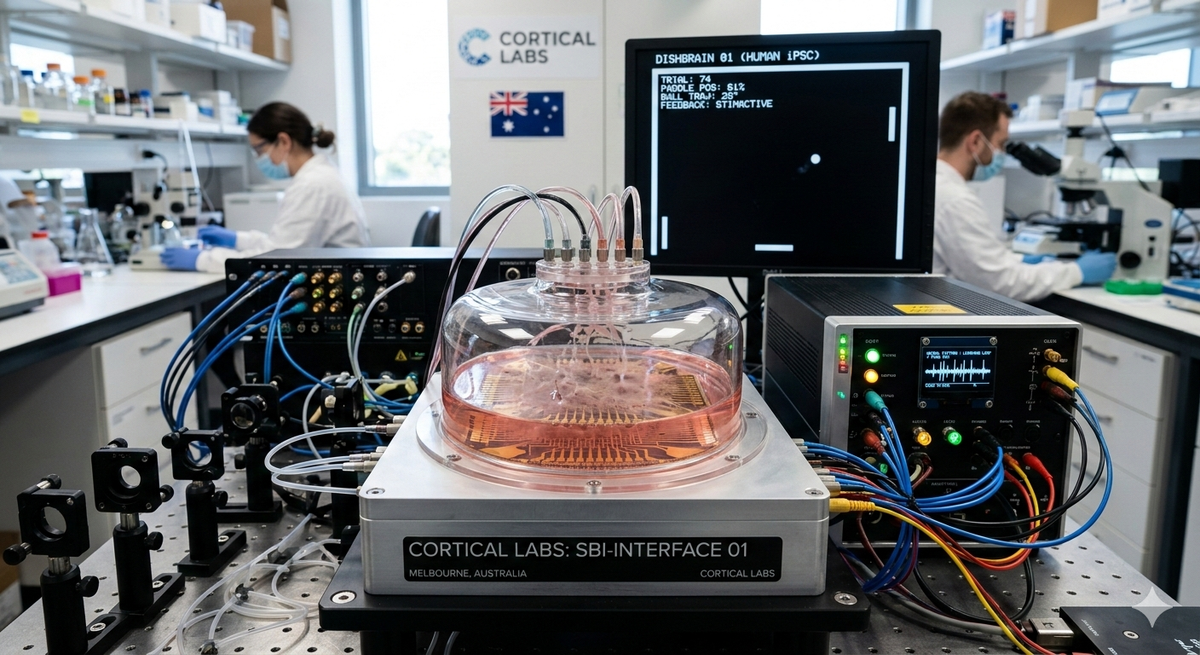
In a nondescript laboratory in Melbourne, Australia, the boundary between computer science and biology has officially dissolved. Within a specialized vessel known as the DishBrain, a colony of roughly 800,000 living neurons—some derived from mouse embryos and others from human induced pluripotent stem cells—has achieved what was once the exclusive domain of silicon chips: the ability to process information and execute goal-directed tasks.
These "brains without a host" successfully learned to play the classic arcade game Pong, marking the first time a synthetic biological neural network has demonstrated sentient-like behaviour in a simulated environment. This breakthrough, led by the deep-tech startup Cortical Labs, represents a seismic shift in how we perceive intelligence, moving away from static algorithms and toward "Synthetic Biological Intelligence" (SBI).
The project gained global attention when the team successfully interfaced living brain cells with a microelectrode array (MEA). Unlike traditional AI, which uses mathematical weights to simulate learning, Cortical Labs utilized the Free Energy Principle. This theory suggests that biological systems naturally organize themselves to minimize "surprise" or uncertainty in their environment.
To teach the cells Pong, the researchers created a feedback loop. When the neurons successfully moved the digital paddle to hit the ball, they received a predictable, organized electrical stimulus. When they missed, the system hit them with a "noisy," unpredictable burst of white noise. Seeking to avoid the chaos of the noise, the neurons self-organized their firing patterns to hit the ball more consistently. Remarkably, while a standard AI might take 90 minutes to grasp the mechanics of a game, these living cells began to demonstrate "learning" within five minutes of exposure.
This fusion of wetware and hardware is the product of a diverse multidisciplinary team operating out of the Greater Melbourne Area. The vision is spearheaded by a collective of scientists and engineers who believe that biology is the ultimate frontier of efficiency.
Overseeing regional growth from Malaysia, Boon Kien Khoo serves as the Regional Manager, highlighting the company’s ambition to take this Australian-born technology to the global stage.
While the tech world often looks to Silicon Valley for the next big thing, Cortical Labs has anchored itself firmly in Melbourne, Victoria. The city’s robust biomedical precinct and world-class universities, such as the University of Melbourne, provided the perfect ecosystem for this "Frankenstein-meets-Future" innovation. Specifically, the team operates in the Brunswick and Greater Melbourne areas, utilizing local expertise in stem cell research and microelectronics to build their proprietary hardware.
The pursuit of biological computing isn't just a scientific stunt; it is a quest for efficiency and plasticity. Modern AI, like Large Language Models, requires massive server farms and megawatts of electricity to function. In contrast, the human brain operates on about 20 watts—roughly the power of a dim lightbulb—while possessing a capacity for learning and intuition that silicon still cannot fully replicate.
Cortical Labs is betting that biological neurons are inherently better at generalized learning. A computer chip is "hard-wired," but a brain cell is "wet-wired"—it can physically reconfigure its connections to solve new problems. By harnessing this, the team aims to create a new class of processors that could eventually assist in drug discovery, neurological disease testing, and even the creation of more "human-like" autonomous systems that don't require the carbon footprint of a small city.
Following the success of Pong, the team has pushed the neurons toward more complex environments. Reports and experiments have surfaced regarding the cells' ability to interact with more visually and logically demanding games, such as the legendary first-person shooter DOOM. While the neurons aren't "seeing" demons in the way a human does, they are processing spatial data and making split-second "survival" decisions to minimize the chaotic feedback they receive from the game environment. This leap from 2D paddles to 3D navigation proves that the DishBrain isn't just reacting; it is modeling a world.
The implications of the work being done in Melbourne stretch far beyond the novelty of a "gamer in a dish." By proving that neurons can be harnessed as a form of computational power, Cortical Labs is forcing us to redefine the very nature of the machine. We are moving toward an era where the line between the born and the built becomes indistinguishable, and where the next great advancement in computing may not be a faster transistor, but a better-fed cell.
As these 800,000 neurons continue to fire in their darkened chambers, they aren't just playing a game; they are proving that intelligence is not a product of the body, but a fundamental property of some kind of life itself, waiting to be plugged in.
Elke Porter at:
Westcoast German Media
LinkedIn: Elke Porter or
WhatsApp: +1 604 828 8788.
Public Relations. Communications. Education
Let’s bring your story to life — contact me for books, articles, blogs, and bold public relations ideas that make an impact.
TAGS: