
Is Crossing the Floor, Crossing Canadian Voters?
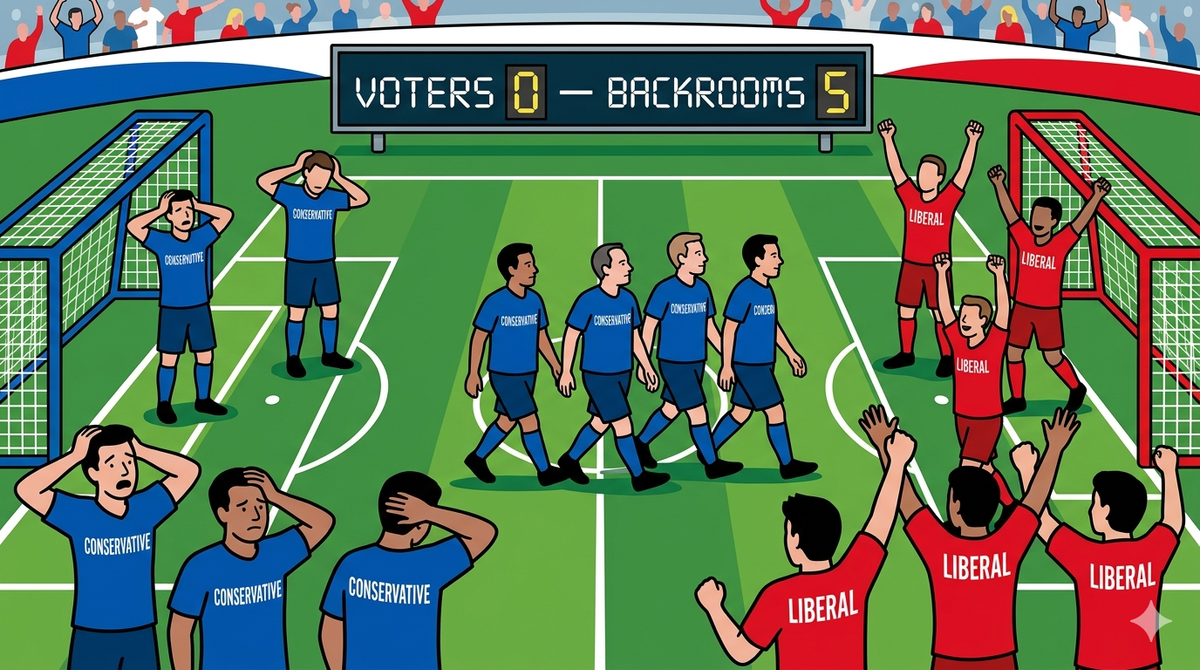
Five MPs crossed the floor to hand Carney a stealth majority. Is Canada's democracy being bought in backrooms?


Five MPs crossed the floor to hand Carney a stealth majority. Is Canada's democracy being bought in backrooms?
By Elke Porter | WBN News Vancouver | April 9, 2026
Subscription to WBN and being a Writer is FREE!
The Floor Beneath Your Vote: Canada's Floor-Crossing Crisis and What It Means for Democracy
In the spring of 2025, Canadians went to the polls and made a deliberate, consequential choice. They elected a Liberal minority government under Prime Minister Mark Carney — not a majority. The distinction matters. A minority government is a specific democratic signal: the country was divided, no single party earned dominant trust, and Parliament was meant to function as a check-and-balance institution.
In the months since, that signal has been systematically eroded — not through another election, but through the quiet parade of MPs crossing the floor.
Since November 2025, five Members of Parliament have left their elected parties to join the Liberal caucus. The four Conservative defectors are Nova Scotia MP Chris d'Entremont (November 4, 2025), Toronto-area MP Michael Ma (December 11, 2025), Edmonton MP Matt Jeneroux (February 18, 2026), and most recently, four-term Sarnia MP Marilyn Gladu (April 8, 2026). NDP MP Lori Idlout, who represents the vast riding of Nunavut, also crossed the floor to the Liberals on March 10, 2026. With Gladu's defection, the Liberals now sit at 171 seats — tantalizingly close to the 172 needed for a majority.
Let's be clear on one thing: floor crossing in Canada is entirely legal. There is no law, constitutional provision, or parliamentary rule that prevents an elected Member of Parliament from switching parties mid-term. An MP's seat, under Canadian parliamentary convention, belongs to the individual, not the party. This is a principle rooted in the Westminster tradition — the idea that an MP's first duty is to their constituents and their own conscience, not to the party machinery that got them elected.
But legality and legitimacy are two different things. And it is in that gap that a serious democratic conversation must take place.
When voters in Sarnia-Lambton-Bkejwanong cast their ballots for Marilyn Gladu in 2025, they did so knowing her as a four-term Conservative who had won her riding with 53 percent of the vote, compared to the Liberals' 38 percent. When voters in Markham-Unionville chose Michael Ma — a first-term MP — they elected him specifically to oppose Liberal spending policies. When voters in Nunavut chose Lori Idlout as their NDP representative, they chose a woman who had publicly declared she was "disgusted by the Carney government's response to Nunavut."
None of those voters chose the Liberal Party. And yet, that is now who represents them.
The public justifications offered by each floor-crosser have been polished and principled-sounding. D'Entremont said the budget "hits the priorities I have heard most in my riding." Ma cited "unity and decisive action." Jeneroux invoked a "national unity crisis." Idlout pointed to food insecurity and threats to northern sovereignty. Gladu said she needed "serious leadership."
But all of them, by their own admission, had private meetings with senior members of the Carney government before making their announcements. And the timing of certain events raises legitimate questions.
Consider: shortly after Idlout's floor-crossing, the federal government announced $277 million for water-treatment facilities in Nunavut and $250 million for 750 new homes in the territory. Was this coincidence, or the fruit of those "backroom conversations"? Michael Ma was given VIP treatment on official trade missions, accompanying Carney to China and Qatar. Matt Jeneroux was appointed Carney's unpaid special adviser on economic and security partnerships and joined the PM on trips to India, Australia, and Japan.
Conservative Leader Pierre Poilievre has called these arrangements "dirty backroom deals," accusing Carney of "seizing a costly Liberal majority that Canadians voted against." Critics at The Hub observed that all these floor-crossers "admitted to having backroom conversations with the Liberals, then deciding to cross the floor and dramatically changing their tune," pointedly asking: "What was promised to them?"
It is important to be precise here. No one has alleged criminal bribery or extortion under the Criminal Code. There have been no formal investigations, no charges laid, and no evidence produced of illegal inducements. What has occurred — the awarding of advisory roles, the high-profile travel invitations, the announcement of federal funding coinciding neatly with a defection — is the kind of political patronage that lives in a grey zone. It is the currency of Westminster politics everywhere: not a bribe in the legal sense, but an exchange of loyalty for access, influence, and resources.
Whether that constitutes corruption depends very much on your definition of the word.
This is perhaps the most pointed political observation anyone can make about the current wave of floor-crossings: every single one of them has gone in the same direction. From opposition to government. From Conservative or NDP to Liberal. Not one Liberal MP has crossed to the Conservatives.
This asymmetry is not accidental, and it is not merely a reflection of political ideology. It reflects the structural incentives built into a parliamentary system. Governing parties hold the keys to power: cabinet positions, advisory roles, government funding announcements, access to the Prime Minister, a seat at the table when major decisions are made. Opposition parties can offer solidarity, ideology, and the promise of future power — but nothing that competes with what the government can offer right now.
It is also worth noting a degree of historical irony. Pierre Poilievre has been vocal in denouncing these floor-crossings as undemocratic. But Poilievre himself, along with the vast majority of the Conservative caucus, voted against an NDP bill in 2012 that would have required floor-crossers to resign their seats and face a byelection. The Conservatives, it seems, have objected to floor-crossing primarily when it runs against their interests — just as the Liberals cheered the practice when, in 2007, Conservative MP Wajid Khan briefly served as Stephen Harper's adviser while still nominally a Liberal, before officially crossing the floor.
This is not to excuse what is happening now. It is to note that the problem is structural and bipartisan — and that the outrage tends to follow the direction of traffic.
The deepest issue here is not legal, and it is not even purely political. It is a question of what representative democracy actually means.
There are two competing theories of parliamentary representation. The first — call it the delegate model — holds that MPs are elected to carry out the wishes of their constituents, including the party platform those constituents voted for. Under this view, switching parties mid-term is a betrayal of the voters' trust. Only about a quarter of Canadians, according to Angus Reid polling, believe floor-crossers should be allowed to finish their term without facing voters again.
The second theory — call it the trustee model — holds that MPs are elected as individuals to exercise their judgment on behalf of their constituents. Under this view, an MP who genuinely believes their constituents' interests are better served under a different government is doing their job, even if uncomfortably. This is the constitutional tradition Canada has inherited.
Both theories have merit. Both are incomplete on their own. And the current wave of defections has forced Canadians to confront which model they actually believe in — and whether the system as designed still reflects their values.
One clear reform with broad support: mandatory by-elections. If an MP crosses the floor to a different party, their seat should immediately be vacated and a by-election called in that riding. This would preserve the MP's right to follow their conscience while also restoring the voters' right to weigh in. It would also introduce a meaningful cost to floor-crossing: the possibility that constituents will simply reject the move at the ballot box. History suggests many would. Research shows that the majority of floor-crossers throughout Canadian history have not survived the next election.
Woven into this political drama is the passage of Bill C-9, the so-called Combatting Hate Act, which cleared third reading in the House of Commons on March 25, 2026, with the support of the Bloc Québécois. Conservatives and the NDP both voted against it.
Bill C-9 amends the Criminal Code to create three new offences: wilfully promoting hatred against an identifiable group, a hate crime offence, and an intimidation offence targeting those who restrict access to religious or cultural spaces. Supporters argue it is a necessary modernization of hate speech law, particularly to address the rise of extremist symbols and targeted harassment.
Critics — ranging from the Canadian Civil Liberties Association to the Canadian Labour Congress to numerous religious organizations — argue the bill was rushed through Parliament without adequate study, and that it threatens fundamental freedoms in ways that have not been sufficiently examined. A key flashpoint has been the removal of the "good-faith religious defence" from the Criminal Code, which previously protected individuals who expressed views rooted in religious belief in good faith. Critics argue this change could expose faith communities to criminal prosecution for sincere religious expression.
The Canadian Civil Liberties Association stated the bill "threatens the rights of every Canadian" and was pushed through Parliament too quickly, cutting short the normal process of parliamentary scrutiny. The government used a procedural motion in March 2026 to end debate in committee and fast-track the bill to third reading.
Here is where the floor-crossing story and the Bill C-9 story intersect in a way that deserves scrutiny. The Liberals' ability to pass Bill C-9 — and to do so with the confidence of governing through a de facto near-majority — was enabled in part by the steady accumulation of floor-crossers. A weaker government, one truly constrained by its minority status, would have had to negotiate more broadly and compromise more deeply on contentious legislation. Instead, the progressive consolidation of seats through floor-crossing has given the Carney government a degree of legislative confidence it was not granted at the ballot box.
Whether one supports or opposes Bill C-9 on its merits, the manner in which it passed — rushed through committee, opposed by Conservatives, the NDP, multiple civil liberties groups, and dozens of religious organizations, passed with the support of the Bloc in a legislature whose balance of power was itself altered by politically motivated floor-crossings — raises serious questions about the health of Canadian democratic institutions.
Canadian democracy is not in crisis — but it is under strain, and the strain is self-inflicted. The following reforms deserve serious public debate:
Mandatory by elections for floor-crossers. If an MP leaves the party under whose banner they were elected to join another party, a byelection should be triggered. Let the voters decide whether to endorse the switch. This is the most direct way to reconnect the act of floor-crossing to democratic accountability.
Disclosure of backroom meetings and inducements. When an opposition MP meets privately with the Prime Minister's Office before crossing the floor, and government funding announcements follow shortly after, the public deserves full transparency. A formal disclosure requirement — similar to conflict-of-interest rules — would be a reasonable check on the most troubling aspects of politically motivated floor-crossing.
Parliamentary reform to protect minority mandates. A minority government is a democratic outcome, not an inconvenient obstacle. The system should be structured so that minority governments cannot effectively transform themselves into majority governments through the back door.
Serious parliamentary scrutiny of legislation. The manner in which Bill C-9 was fast-tracked through committee — with procedural motions used to silence debate and override normal review timelines — is a failure of Parliament's most basic function. A healthy Parliament, regardless of the government's seat count, should resist the impulse to rush fundamental changes to the Criminal Code without the careful, thorough study that Canadians deserve.
When you voted in the 2025 federal election, you were not just marking a box. You were making a statement about how you want your country governed, by whom, and under what values. The wave of floor-crossings currently reshaping the House of Commons — entirely legal, arguably unethical, and deeply consequential — is a reminder that in parliamentary democracy, the rules don't always protect the intent.
Five MPs have now walked across an aisle they were elected to stand on one side of. A minority government is quietly becoming something voters never sanctioned. And a significant piece of legislation affecting every Canadian's right to free expression has been passed through a Parliament whose composition no longer reflects the election that created it.
These are not abstract democratic concerns. They are live, urgent questions about who holds power in Canada, how they got it, and whether the people who put them there still have any say in the matter.
The floor, it turns out, was never as solid as it looked.
Sources: CBC News, CTV News, Global News, Radio-Canada, The Hub, Policy Magazine, iCONNECT Blog, Canadian Civil Liberties Association, Canadian Labour Congress, Open Parliament, Parliament of Canada (LEGISinfo), Wikipedia (List of Canadian politicians who have crossed the floor), Angus Reid Institute.
Elke Porter at:
Westcoast German Media
LinkedIn: Elke Porter or
WhatsApp: +1 604 828 8788.
Public Relations. Communications. Education
Let’s bring your story to life — contact me for books, articles, blogs, and bold public relations ideas that make an impact.
TAGS: #FloorCrossing #CanadianPolitics #DemocracyAtRisk #BillC9 #CarneyMajority #VoterBetrayal