📰 Is The Future Arriving Faster Than We’re Ready For?
By George Moen | WBN News | March 20, 2026
There are moments when the future stops feeling distant and starts becoming directional. What was once theoretical begins to take shape through real infrastructure, real investment, and real timelines.
The vision emerging now is not just about faster computers or smarter software—it’s about scale. A scale that forces us to rethink what limits actually exist.
Today, human civilization operates within a narrow band of energy and computation. Despite all our progress, we are still capturing only a fraction of the sun’s available energy. That limitation defines everything—from how fast AI can grow to how much economic output we can generate.
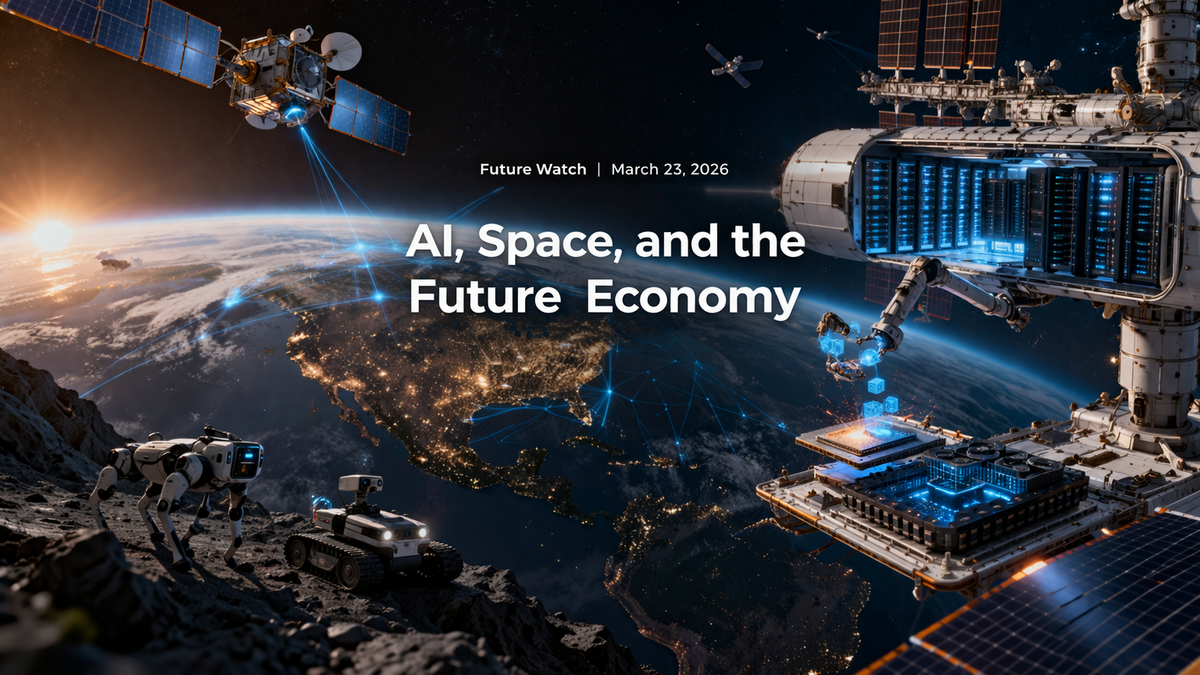
The next step being proposed is simple in concept but has massive implications: move beyond Earth as the primary platform.
Space changes the equation. Energy becomes constant. Solar power is uninterrupted. Constraints that exist on the ground—land, infrastructure, resistance—begin to fall away. In that environment, computing can scale at levels that are almost impossible to replicate on Earth.
This is where the conversation becomes exponential.
Instead of incremental chip improvements, the focus shifts to rapid iteration—factories that can design, test, and rebuild chips in continuous cycles. Instead of automation supporting humans, the expectation shifts toward large-scale deployment of humanoid robots, potentially outnumbering traditional production systems many times over.
And behind all of this is a single idea: abundance.
If AI and robotics can produce at near-zero marginal cost, the traditional model of scarcity begins to break down. Goods, services, and even experiences could become dramatically more accessible. The concept of “cost” itself starts to shift.
It’s a vision that sounds like science fiction—but it’s being approached with engineering discipline, not imagination.
Which leads to a more grounded question:
If the infrastructure for this future is being built now, how quickly does the surrounding world change?
Why It Matters
For small business owners, entrepreneurs, and professionals, this isn’t abstract—it’s strategic.
We are moving toward a world where compute and energy define competitive advantage. Those who can access and apply AI effectively will operate at a completely different level of speed and efficiency.
At the same time, automation is evolving from assistance to replacement. Tasks, roles, and even entire business models may be redefined faster than traditional systems can adapt.
But there is also a counterbalance.
As systems become more automated, human elements increase in value—trust, relationships, creativity, judgment, and leadership. The businesses that thrive will not just adopt AI—they will position themselves where AI cannot fully replace them.
And perhaps most importantly, the idea of abundance changes how we think about opportunity.
If production becomes easier, faster, and cheaper, the barrier to entry drops. New businesses can be created with fewer resources. Innovation cycles accelerate. Entire industries can emerge in compressed timeframes.
The challenge is not whether this shift will happen.
It’s whether you see it early enough to move with it.
George Moen
Publisher | WBN News
📧 gmoen@wbnn.news
🏷️ TAGS: #Future Watch #Elon Musk #Artificial Intelligence #Automation #Space Economy #Business Strategy #WBN News