By Elke Porter | WBN News Global | January 19, 2026
Subscription to WBN and being a Writer is FREE!

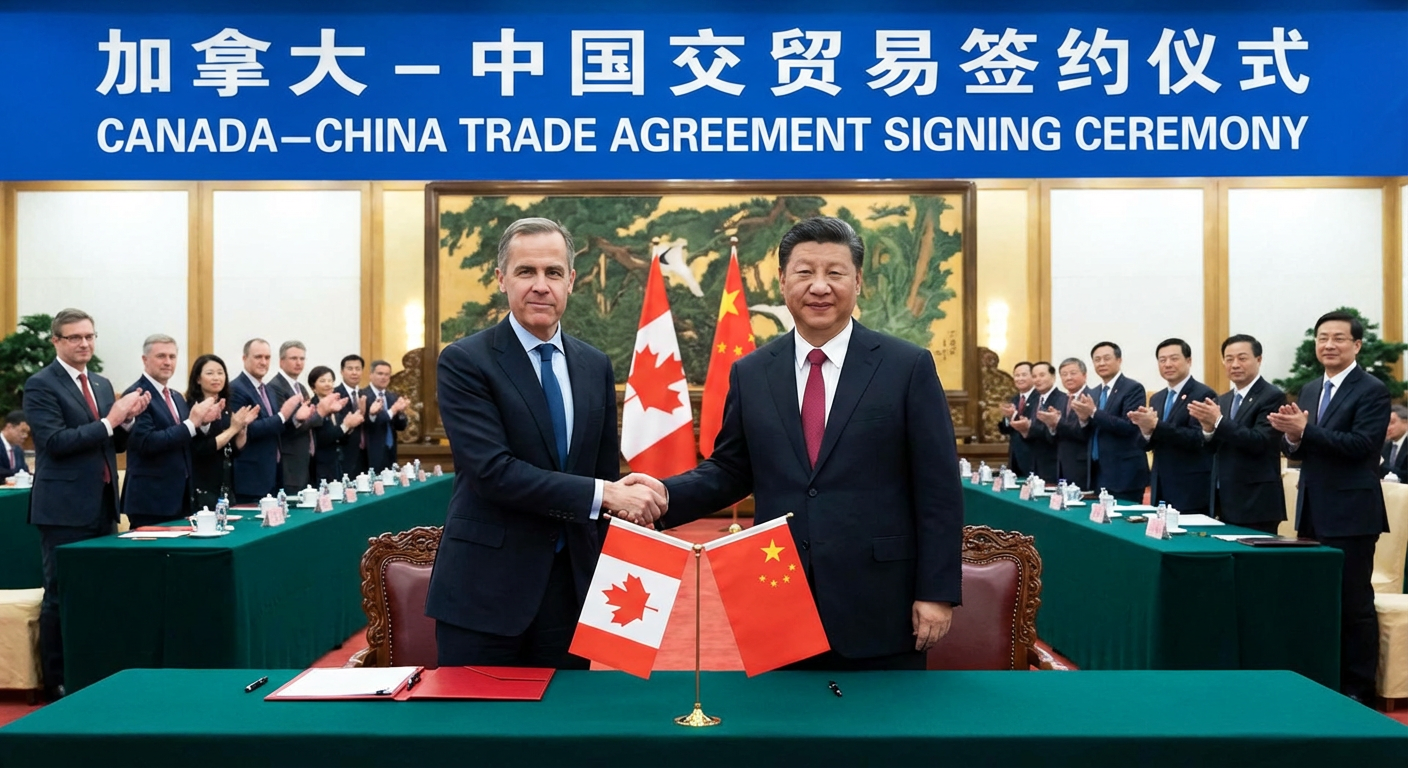
Canada has formally embarked on a major recalibration of its relationship with China, marking the most significant shift in bilateral ties in nearly a decade. Prime Minister Mark Carney’s visit to Beijing this week—the first by a Canadian prime minister since 2017—culminated in a joint statement with President Xi Jinping that sets out the pillars of a new Canada‑China strategic partnership focused on trade, investment, energy, and climate competitiveness.

The visit reflects the Carney government’s broader strategy to build a more resilient and diversified Canadian economy in an increasingly fragmented global landscape. With the United States growing more unpredictable and global supply chains under strain, Ottawa is seeking to rebalance its economic relationships—while maintaining security guardrails—by deepening engagement with the world’s second‑largest economy.


The Core of the Agreement

At the heart of the renewed partnership is a preliminary agreement‑in‑principle to reduce trade barriers and catalyse new two‑way investment, particularly in clean energy, manufacturing, and agri‑food.

Trade and Market Access

China has committed to a significant reduction in tariffs on Canadian agricultural exports:

  • Canola seed tariffs are expected to fall to a combined rate of approximately 15% by March 1, 2026, down from current levels of roughly 85%. China is a $4 billion annual market for Canadian canola producers.
  • Canola meal, lobsters, crabs, and peas are expected to be exempt from relevant retaliatory tariffs from March 1, 2026, through at least the end of the year.

Together, these measures are projected to unlock nearly $3 billion in new export orders, delivering immediate relief to Canadian farmers, fishers, and food processors.

China remains Canada’s second‑largest single‑country trading partner, with $118.9 billion in two‑way merchandise trade in 2024, including $30 billion in Canadian exports.

Trade Diversification

To build on this progress, Canada has set an ambitious new goal to increase our exports to China by 50% by 2030.


Electric Vehicles and Industrial Strategy

One of the most closely scrutinized elements of the agreement is Canada’s decision to allow up to 49,000 Chinese‑made electric vehicles annually into the Canadian market at the most‑favoured‑nation tariff rate of 6.1%.

According to the government, this volume reflects pre‑friction import levels from 2023–2024 and represents less than 3% of Canada’s annual new‑vehicle market.

The Carney government argues this policy serves three objectives:

  1. Consumer affordability, with an expectation that within five years more than 50% of imported vehicles will be priced under $35,000.
  2. Supply‑chain resilience, supporting the development of Canada’s EV ecosystem.
  3. Domestic investment, with expectations that Chinese manufacturers will pursue joint‑venture production in Canada with trusted partners within three years.

The government has emphasized that this approach is designed to protect and create Canadian auto manufacturing jobs, not displace them.


Winners, Concerns, and Regional Impacts

Agriculture and Western Canada

The agricultural sector stands to gain immediately. Saskatchewan Premier Scott Moe, whose government has long pressed for restored access to the Chinese market, participated in earlier trade delegations that helped lay the groundwork for the agreement.

China is Canada’s second‑largest customer for agriculture, forestry, and seafood products, with exports totalling $13.4 billion in 2024. The canola tariff reduction alone could save producers hundreds of millions of dollars annually.

Manufacturing and the Auto Sector

While the federal government insists the EV cap is modest, concerns remain within Canada’s manufacturing sector about long‑term competitive pressures and implications for Canada‑U.S. trade relations. Ottawa maintains that the limited volume and emphasis on domestic joint ventures mitigate the risk of market disruption.


Energy, Climate, and Investment Cooperation

Energy and clean technology form a central pillar of the new partnership. Canada and China committed to expanding cooperation in:

  • Batteries and energy storage
  • Solar and wind power
  • Clean fuels and emissions reduction technologies

During the visit, Prime Minister Carney met with Chinese business leaders to identify opportunities for accelerated investment in Canada, particularly projects that support the global transition to a low‑carbon economy and create high‑paying Canadian jobs.

Multiple memorandums of understanding were signed to reinforce cooperation on energy, food safety, wood products, climate action, and the fight against transnational crime.


Mobility, Tourism, and People‑to‑People Ties

President Xi committed to introducing visa‑free access for Canadians travelling to China, a move welcomed by the Canadian government as a step toward rebuilding people‑to‑people ties.

The two countries also agreed to expand cultural exchanges and tourism cooperation. Prime Minister Carney welcomed a new agreement between Destination Canada and China Media Group, aimed at increasing outbound tourism to Canada ahead of the FIFA World Cup 26™, which Canada will co‑host.


Security Engagement and Guardrails

Despite the expanded partnership, the Carney government emphasized that engagement with China will remain pragmatic and bounded.

Canada and China agreed to increase cooperation between law enforcement agencies to combat:

  • Narcotics trafficking
  • Cybercrime
  • Synthetic drugs
  • Money laundering

At the same time, the government has reiterated that cooperation will remain limited in sensitive areas such as defence, critical minerals, and advanced military technologies.


A Strategic Reframing

The language used by the Prime Minister signals a deliberate shift in how Ottawa views its role in a changing global order.

“By leveraging our strengths and focusing on trade, energy, agri‑food, and areas where we can make huge gains, we are forging a new strategic partnership that builds on the best of our past and reflects the world as it is today,” Carney said following his meeting with President Xi.

Canada has set an ambitious target to increase exports to China by 50% by 2030, positioning diversification as a central pillar of its economic strategy.


Conclusion: Pragmatism in a Fragmented World

The Beijing visit marks a turning point in Canada‑China relations. Rather than a wholesale realignment, the Carney government is betting that selective engagement—anchored in economic necessity and guarded by security limits—can deliver tangible benefits for Canadian workers and businesses.

Whether this approach succeeds will depend on implementation, enforcement of guardrails, and Canada’s ability to balance its expanding relationship with China against its longstanding alliances. What is clear is that Canada has chosen engagement over isolation at a moment when the global economic order is rapidly fragmenting.

The next phase of this partnership will unfold as tariff reductions take effect, investment decisions are made, and Canada tests whether economic diversification can coexist with strategic caution in an era of heightened great‑power competition.

Elke Porter at:
Westcoast German Media
LinkedIn: Elke Porter or
WhatsApp:  +1 604 828 8788.
Public Relations. Communications. Education

Let’s bring your story to life — contact me for books, articles, blogs, and bold public relations ideas that make an impact.

TAGS:

#Canada China
#Global Trade
#Economic Diversification
#Clean Energy
#Agri Food Exports
#Geopolitics
#WBN News Canada
#WBN News Global
#Elke Porter

Share this article
The link has been copied!