By George Moen | WBN News Subscribe For Free Click Here| June 19, 2026
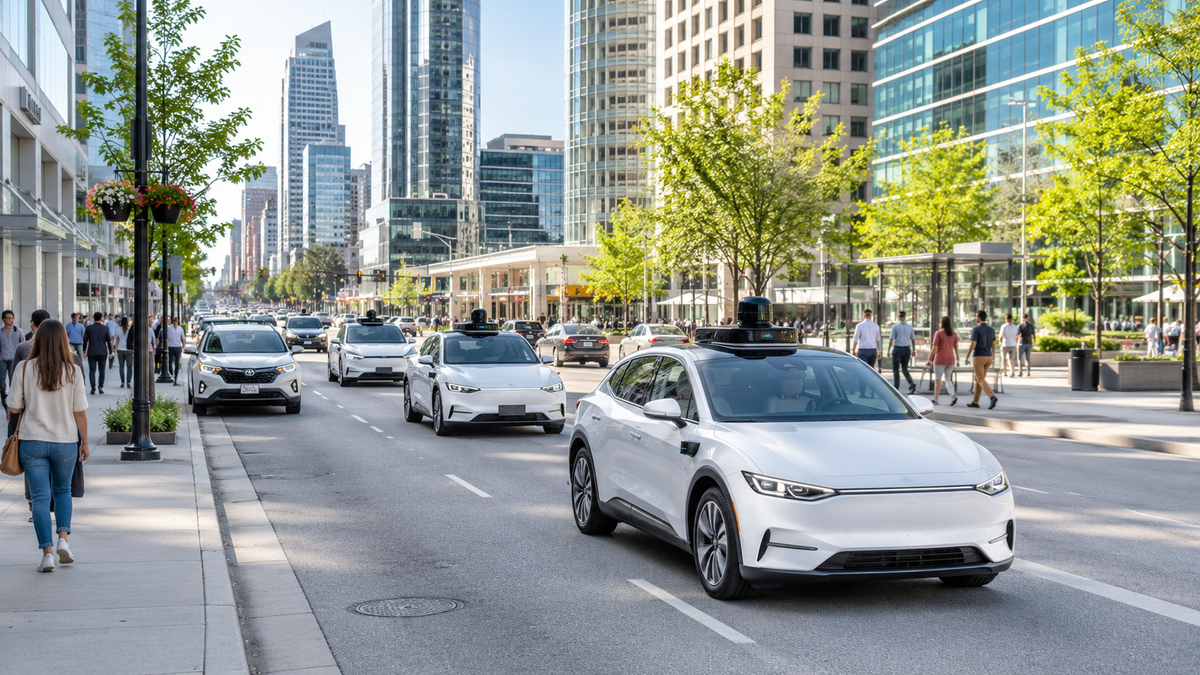
Driverless taxi services are rapidly moving from pilot projects to commercial operations across North America. While the technology promises lower transportation costs and improved safety, it could also reshape millions of driving-related jobs over the next two decades.
The driverless taxi industry has entered a new phase.
What was once considered a futuristic experiment is now operating at commercial scale in multiple U.S. cities. Companies including Waymo, Tesla, Zoox, Mobileye, and others are investing billions of dollars in autonomous vehicle technology, with expansion accelerating throughout 2026.
For business leaders, investors, policymakers, and workers, the key question is no longer whether robotaxis will arrive. The question is how quickly they will scale and what impact they will have on transportation-related employment.
Waymo, currently the clear leader in the North American robotaxi market, is now providing hundreds of thousands of paid rides each week across multiple U.S. cities. The company continues expanding operations while competitors prepare their own commercial launches. Recent announcements indicate that Mobileye plans to launch a U.S. robotaxi service in 2027, while several other operators are expanding testing and deployment efforts.
Industry analysts project explosive growth over the next decade as autonomous driving systems become more capable and vehicle costs continue to decline. Market forecasts suggest the global robotaxi sector could grow from approximately $1.3 billion in 2026 to more than $96 billion by 2034.
Why Adoption Is Accelerating
Several factors are driving adoption:
Lower Operating Costs
Human drivers represent one of the highest costs in ride-hailing services. Eliminating driver expenses creates the potential for lower fares and improved margins.
Improved Technology
Artificial intelligence, sensors, cameras, lidar systems, and mapping technologies have improved significantly over the past decade.
Safety Advantages
Several studies suggest advanced autonomous systems may eventually reduce accident rates compared with human drivers. Waymo has reported significantly lower injury-related crash rates than comparable human-driven transportation services.
Fleet Scalability
Robotaxis can operate for longer periods each day than human drivers, increasing vehicle utilization and revenue potential.
By The Numbers
- Waymo is now operating thousands of robotaxis in North America.
- The company is reportedly providing roughly 500,000 paid rides per week.
- The global robotaxi market is projected to reach more than $96 billion by 2034.
- Some market forecasts place the industry above $147 billion by 2033.
- North America currently represents the largest robotaxi market globally.
The Employment Question
The most significant long-term issue may not be technology.
It may be jobs.
North America currently has hundreds of thousands of workers employed as taxi drivers, ride-share drivers, delivery drivers, shuttle operators, and commercial transportation workers.
No credible forecast suggests these jobs will disappear overnight. Regulatory hurdles, geographic limitations, weather conditions, infrastructure challenges, and public acceptance will slow adoption in many regions.
However, the long-term trend appears increasingly clear.
As autonomous vehicles become cheaper and more reliable, a growing percentage of urban transportation could shift away from human drivers. Some industry observers estimate that 50% to 60% of taxi and ride-hailing driving functions could be automated by 2040, although actual outcomes remain uncertain.
The impact could be particularly significant in major metropolitan areas where robotaxis can achieve scale first.
New Jobs May Also Emerge
History suggests technological disruption rarely eliminates work entirely.
Instead, it changes the type of work being performed.
Autonomous vehicle fleets will require:
- Fleet technicians
- Remote vehicle operators
- AI system trainers
- Maintenance specialists
- Mapping professionals
- Infrastructure managers
- Safety auditors
- Software engineers
Industry leaders argue that while some driving jobs may decline, new technology-focused employment categories will emerge.
Looking Ahead
The next five years will likely determine whether robotaxis remain a niche transportation service or become a mainstream mobility platform.
Expansion into additional U.S. cities is already underway. Canadian markets are also beginning to evaluate how autonomous transportation could fit into urban planning and public transit systems.
The biggest barriers remain regulation, public trust, weather performance, and proving long-term economics at scale.
Yet the direction of travel appears increasingly difficult to ignore.
Why It Matters
The driverless taxi industry may represent one of the most significant labor and transportation shifts since the arrival of ride-sharing platforms more than a decade ago.
Most discussions focus on the technology itself.
The larger signal may be economic.
If autonomous transportation reaches widespread adoption, the effects will extend far beyond taxi companies. Insurance, logistics, urban planning, vehicle ownership, public transit, real estate, and employment markets could all be affected.
The winners may not simply be the companies building robotaxis.
The winners may be the organizations that adapt early to a transportation system increasingly powered by artificial intelligence.
George Moen
WBN News – Real-Time Intelligence For Business
Subscribe Here
Contact: gmoen@wbnn.news
LinkedIn: Here
Tags: #Driverless Taxis #Robotaxi Industry #Autonomous Vehicles #Artificial Intelligence #Transportation Technology #Future Of Work #Ride Sharing #Mobility Innovation #Labor Markets #Business Trends
Tags: Driverless Taxis, Robotaxi Industry, Autonomous Vehicles, Artificial Intelligence, Transportation Technology, Future Of Work, Ride Sharing, Mobility Innovation, Labor Markets, Business Trends
Any updates to the prompt?