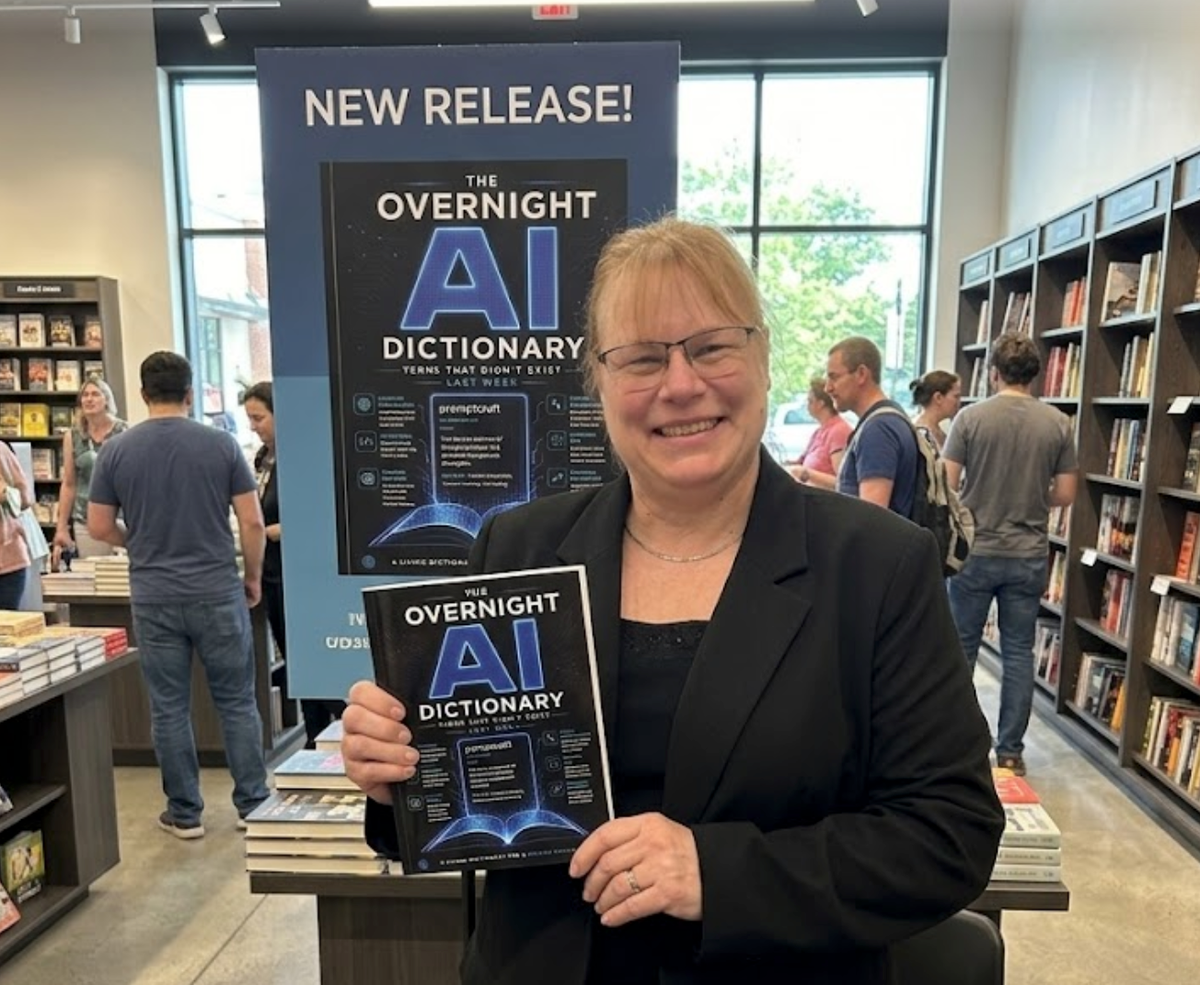
By Elke Porter | WBN Ai | July 10, 2026
Subscription to WBN and being a Writer is FREE!

A new humour-meets-reference book helps everyday readers decode the language reshaping the global economy — one hilarious definition at a time...

VANCOUVER, BC — There is a quiet crisis happening in living rooms, boardrooms, and family dinners across the world, and it has nothing to do with the technology itself. It has to do with the words.

Artificial intelligence is no longer a concept confined to research laboratories and science fiction. It is reshaping economies, rewriting job descriptions, and restructuring entire industries at a pace that has left most of the world's population doing what humans have always done when confronted with something they don't fully understand — nodding politely and hoping nobody asks a follow-up question.

Vancouver-based journalist and communicator Elke Porter decided to do something about that.

Her new book, The Overnight AI Dictionary: Terms That Didn't Exist Last Week, is now available on Amazon — a slim, sharp, genuinely funny A to Z guide to the vocabulary of artificial intelligence, written not for engineers or researchers but for everyone else. The curious. The confused. The professionally obligated to understand this stuff before Tuesday's presentation.


Why Vocabulary Matters More Than You Think

The economic stakes of AI literacy have never been higher. According to recent forecasts, AI is expected to contribute trillions of dollars to the global economy over the next decade, reshaping everything from manufacturing and healthcare to finance, media, and education. Companies are restructuring around it. Governments are legislating around it. Investors are betting enormous sums on it.

And most people cannot define the basic terms being used to justify those decisions.

"If you can't understand a language, it is harder to communicate," says Porter. "AI has created an entirely new world where familiar words have taken on completely different meanings. Inference, hallucination, alignment, embedding — these are ordinary English words that now carry specific technical meanings that shape billion-dollar conversations. You don't need to be an engineer to participate in those conversations. But you do need the vocabulary."

The stakes are not abstract. When a government debates AI regulation, when a company announces an AI strategy, when a job posting lists AI literacy as a requirement — the words being used carry real weight. Understanding them is no longer optional for informed citizenship, let alone professional relevance.


A Dictionary Unlike Any Other

What makes The Overnight AI Dictionary different from the dozens of technical glossaries already available is its deliberate, unapologetic commitment to being readable by actual human beings.

Every definition was written as original creative work — not copied from documentation, not summarised from Wikipedia, but crafted with real world metaphors, everyday comparisons, and the kind of examples that make a concept click rather than swim. The result is a book that explains catastrophic forgetting by comparing it to someone who took an intensive Spanish course and emerged unable to remember a single word of French, and describes the vanishing gradient problem as an urgent message being whispered down such a long line of people that it arrives as barely a breath.

The book covers everything from the basics — neural networks, supervised learning, natural language processing — to the more unusual corners of the field, including mesa-optimisation, deceptive alignment, and the lottery ticket hypothesis, all explained with the same accessible, irreverent energy that makes the technical feel approachable without making it feel dumbed down.

"Language is always the first thing to change," Porter writes in the foreword. "Before the infrastructure scales, before the regulations catch up, before anyone has agreed on what any of it means — the words arrive."

The computer added an estimated fifty thousand words to the English language. Then came the internet. Then AI. Then quantum computing. Each wave arriving before the previous one was fully absorbed, each generating its own avalanche of terminology spreading faster than anyone can learn it.


The Perfect Gift for the Curious, the Confused, and the Chronologically Challenged

The Overnight AI Dictionary is already on Amazon and makes an ideal gift for anyone trying to bridge the gap between generations increasingly divided by technological vocabulary. Find it here: https://amzn.to/4f9fiOG

"Buy this for your family, your friends, and especially your older relatives who want to understand what the younger generation is talking about," says Porter. "Put it on your Back-to-School or Thanksgiving wish list now. Understanding AI is not just a professional advantage anymore — it is a basic literacy for the world we are all living in whether we opted in or not."

The book is the first in what may become a series. Porter is already considering companion volumes on the vocabulary of quantum computing and virtual reality — two fields generating their own avalanche of new terminology that most people encounter daily and understand rarely.

For now, The Overnight AI Dictionary is available on Amazon in paperback form. It is small enough to read in an afternoon, useful enough to keep on your desk, and funny enough to leave on your coffee table where guests will pick it up and not put it down.

Which, in the age of infinite digital distraction, is the highest possible compliment a book can receive.


Of course, The Overnight AI Dictionary makes no claim to be comprehensive — and how could it be, when the language itself is being rewritten in real time, right before our eyes, faster than any single book could hope to capture? New terms are coined in research papers published this morning. New phenomena are named in Slack threads happening right now. By the time you read this sentence, someone somewhere has almost certainly invented a word that doesn't appear in these pages and probably should.

Think of this book not as the final word, but as the first one. The ABCs, the 123s, the confident first step into a vocabulary that will keep growing long after the last page is turned. A foundation to build on rather than a ceiling to bump against.

And when you finish it — when you close the back cover and feel that small, satisfying click of having named things that were previously floating unnamed in your understanding — keep going. Notice the words you encounter that you didn't know last week. Write them down. Share them. Ask what they mean and then ask what they really mean, because in this field those are frequently two very different questions.

This book exists because one person believed that making even a single concept clearer, making even a single reader feel less lost in a conversation that increasingly shapes all of our lives, was worth the work. If it helps even one person feel more confident, more curious, more equipped to participate in the world being built around all of us — then every definition was worth writing, every metaphor worth stretching, and every grandmother worth explaining gradient descent to.

Thank you for reading. Thank you for being curious. And thank you for keeping the conversation going — because that, in the end, is what language has always been for.


The Overnight AI Dictionary: Terms That Didn't Exist Last Week is available now on Amazon. Search for the title or visit Amazon.ca to order your copy here: https://amzn.to/4f9fiOG

About the Author
Elke Porter is a Vancouver-based journalist, communicator, and recovering AI sceptic who covers emerging technology, business, and community affairs for Westcoast German News. She wrote this book because she kept encountering words that didn't exist last week and suspected she wasn't alone. She was right.

Elke Porter at:
Westcoast German Media
LinkedIn: Elke Porter or
WhatsApp:  +1 604 828 8788.
Public Relations. Communications. Education

Let’s bring your story to life — contact me for books, articles, blogs, and bold public relations ideas that make an impact.

TAGS: #OvernightAIDictionary #AIForEveryone #ArtificialIntelligence #TechLiteracy #VancouverAuthor #AIVocabulary

Share this article
The link has been copied!