By Elke Porter | WBN News Vancouver | October 7, 2026
Subscription to WBN and being a Writer is FREE!
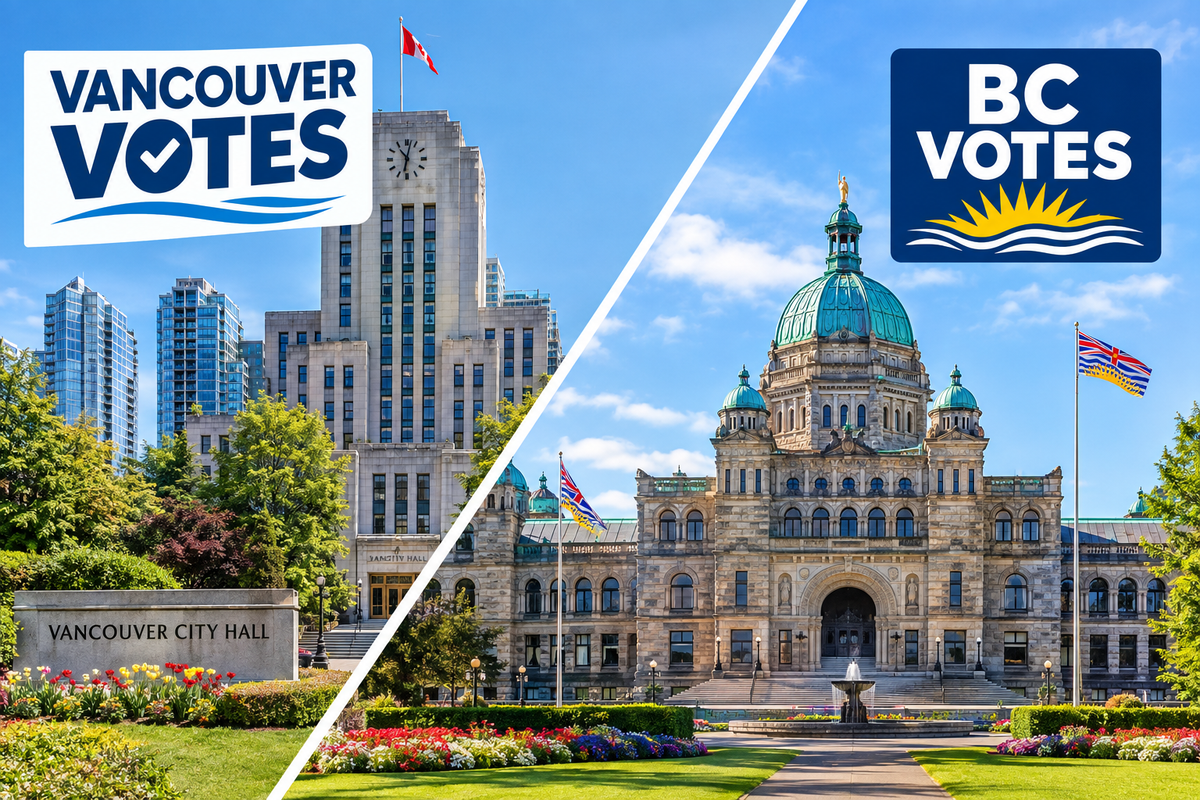
Here's a playful look at Vancouver's possible futures, with five mayoral outcomes paired with each premier.
Thoughts Before the Ballots
What follows is pure speculation over a cup of Earl Grey tea, not prediction, endorsement or political analysis to be taken to the bank. With Vancouver's civic election and B.C.'s snap provincial election landing just a week apart this October, residents are facing a double-decker ballot season. That invites the fun question of what City Hall and Victoria might look like together. Each scenario is based on what candidates and parties have broadly said they stand for, stretched only slightly for a smile. Whatever happens, it will still rain, the SkyTrain will still be packed at 8:15 a.m., and someone will still be complaining about a bike lane.
Part One: Premier David Eby Stays
In this scenario, David Eby remains premier—the political equivalent of surviving a house renovation only to discover the contractors have simply rearranged the furniture.
1. Ken Sim and David Eby: The Sequel Nobody Has to Re-learn
In this scenario, Ken Sim keeps City Hall and David Eby keeps Victoria—leaving British Columbians to wonder whether they have just endured two elections to approve the status quo. City Hall keeps its focus on public safety, tax discipline and "getting things done," while Victoria keeps pushing density near transit, so the cranes stay exactly where they are. The two leaders already know each other's phone numbers, which means fewer surprises and a few familiar disagreements over who pays for what.
The typical resident's life is much like today's: a new tower going up down the block, a slightly bigger police presence downtown, and the same debate at dinner about whether any of it is making rent cheaper. In the meantime, the two most expensive trips will be the ones to the grocery store and the gas station.
2. Kareem Allam and David Eby: The Spreadsheet Era
Allam, who pitches himself as a numbers-driven fixer, would likely spend his first months auditing everything from permit timelines to the city's budget lines, with charts to match. Eby's province would probably welcome a mayor eager to speed up housing approvals, though the two might quibble over whose data is better. Residents might notice permits moving faster and city announcements coming with more graphs, along with an adjustment period while a new team learns where the light switches are.
3. Pete Fry and David Eby: Green Lights and Bike Lanes
A Green mayor and an NDP premier would likely find common ground on transit, climate action and non-market housing, with some friendly tension over how fast neighbourhoods should change. Expect more talk of greenways, tree canopy, community amenities and sustainable building standards. The typical resident might pedal to work on an expanded bike network, shop at a farmers' market that suddenly has city funding, and grumble a little about losing a parking spot or two.
4. Colleen Hardwick and David Eby: The Zoning Tug-of-War
If elected, Colleen Hardwick could become a fixture at the Auditor General’s office, which she helped set up, which conducts financial, compliance, and performance audits across every City department—including the offices of the Mayor and Council, boards, and City-controlled corporations.
Hardwick's emphasis on neighbourhood planning and caution about rapid density would run straight into Eby's provincial housing mandates, making this the most interesting pairing to watch from the sidelines. Council meetings might start to feel like a spirited family dinner where everyone loves the house but disagrees about the renovation. Residents could see more heritage protection and community consultation, more headlines about city-province friction, and more evenings spent at public hearings.
5. Rebecca Bligh and David Eby: Pragmatic Middle Ground
Bligh, a sitting councillor with experience on housing files, would arrive knowing City Hall's hallways and could work fairly smoothly with the province on supply and supportive housing. Without a big party machine behind her, she might have to build coalitions vote by vote, which could make for collaborative or very long council meetings. The typical resident would likely see steady continuity on housing with a fresh face at the podium, and might wonder whether "independent-minded" means more compromise or more gridlock.
Part Two: Interim Leader Lorne Doerkson Leads the BC Conservatives to Victoria
In this scenario, Doerkson goes from interim leader to premier in the space of one campaign, which may be the fastest promotion in B.C. politics since a substitute teacher was suddenly handed the principal’s office and the keys to the district.
6. Ken Sim and Lorne Doerkson: Common Ground on Safety
A tax-conscious mayor and a Conservative premier might find quick agreement on public safety, addiction treatment and keeping costs down. Some provincial housing mandates could loosen, handing more zoning control back to the city, which Vancouver may enjoy or find to be a heavier lift than expected. Residents might see more emphasis on enforcement and treatment-first approaches, fewer provincial housing rules, and an ongoing discussion about whether building will speed up or slow down.
7. Kareem Allam and Lorne Doerkson: The Efficiency Experts
Two leaders who both like talking about waste, red tape and value for money could make government streamlining fashionable, at least for a while. The challenge would be a brand-new mayor learning to work with a brand-new provincial government, with plenty of first meetings. Residents might notice faster service at City Hall, quieter ribbon-cuttings, and a lively online debate about which programs count as "waste."
8. Pete Fry and Lorne Doerkson: The Odd Couple
A Green mayor and a Conservative premier would likely disagree on climate policy, transit funding and drug policy, which makes this the pairing most likely to generate dramatic headlines. Still, odd couples sometimes surprise everyone, and both might find common cause in local decision-making and practical infrastructure. Residents could see bold city climate initiatives running into provincial funding questions, while enjoying some highly quotable press conferences.
9. Colleen Hardwick and Lorne Doerkson: Neighbourhoods First
If the Conservatives return zoning power to municipalities, Hardwick would gain the local control she has long argued for, which would make this the most philosophically aligned pairing on planning. Supporters would celebrate the return of community-led decisions, while housing advocates would worry about how quickly new homes get built. The typical resident might find their street changing more slowly and community meetings packed, with a fresh round of debate about where the next generation will live.
10. Rebecca Bligh and Lorne Doerkson: Learning to Dance
Bligh would bring council experience while the province shifts direction, so much of her term might be spent translating between Vancouver's needs and Victoria's new priorities. Her coalition-building skills would be tested both on council and across the provincial table. Residents could see a mayor working hard to keep housing projects moving under changing rules, and might be thankful for anyone who can explain exactly what changed and when.
Summary
However the ballots fall, Vancouver residents will be living with a partnership between City Hall and Victoria, and the real story is how well those two levels of government work together. Pairings that share priorities tend to move faster but invite fewer checks. Pairings that clash generate more friction but also more debate, and debate isn't always a bad thing in a democracy.
The biggest variable in most scenarios is housing: who decides where homes go, how fast they're built, and who pays for the services around them. So before October 17 and October 24, it's worth reading the platforms, asking the tough questions, and voting twice: once for the city, and once for the province. As for the weather, it will keep raining in Vancouver regardless of who wins.
Disclaimer: This article is a light-hearted thought experiment, not an endorsement of any candidate or party. The pairings and scenarios are speculative, based loosely on candidates' publicly stated priorities and imagined for entertainment. We encourage readers to review the platforms, attend debates, and make their own informed choices at the ballot box on October 17 and October 24.
Elke Porter at:
Westcoast German Media
LinkedIn: Elke Porter or
WhatsApp: +1 604 828 8788.
Public Relations. Communications. Education
Let’s bring your story to life — contact me for books, articles, blogs, and bold public relations ideas that make an impact.
TAGS: #VanPoli #BCPoli #VanElxn2026 #BCElection2026 #VancouverVotes #CityHallMeetsVictoria