By Elke Porter | WBN News Vancouver | August 14, 2026
Subscription to WBN and being a Writer is FREE!
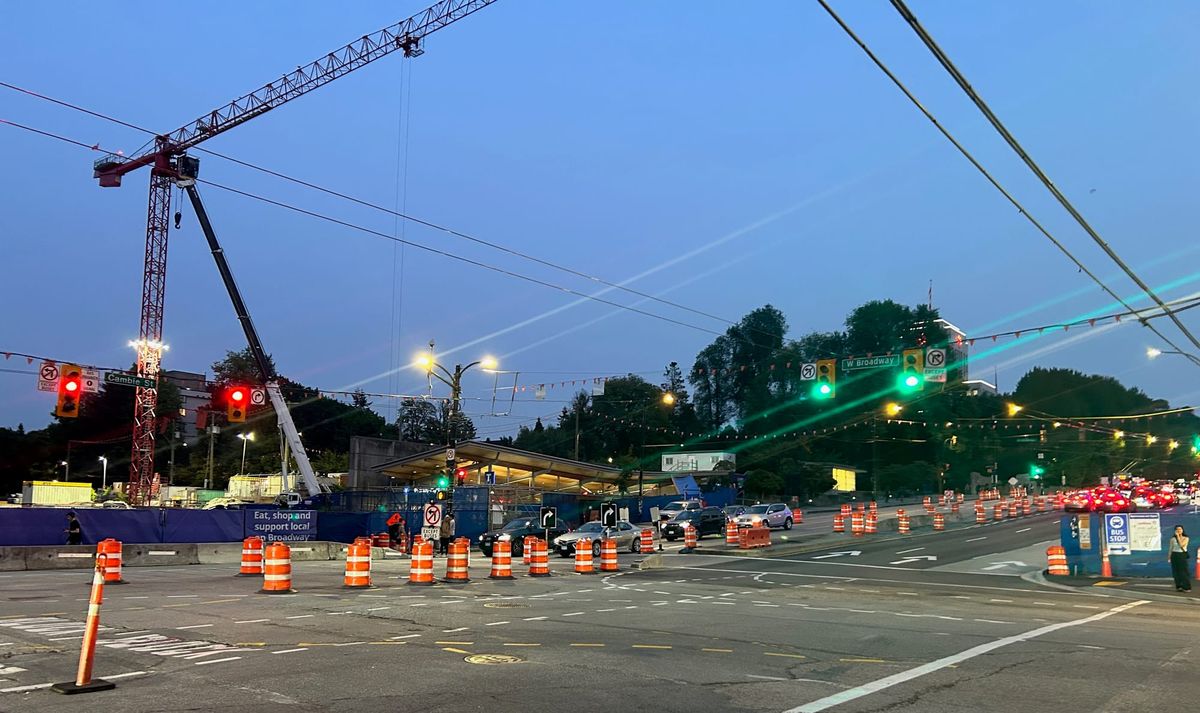
If you've tried to cross Vancouver this summer, you already know the punchline before we tell the joke: there isn't a straight line left in the city. Broadway is closed at Cambie. West 12th is torn up by Kitsilano Community Centre. Fourth Avenue, which quietly becomes 6th and then 2nd, is squeezed by work at the Granville Bridge approaches. Buses are rerouted, sidewalks are fenced off, and drivers are white-knuckling their way through detours that seem to multiply by the week.
The City says it's all necessary — crumbling infrastructure, tight budgets, urgent housing targets. All true. But with a civic election landing this October, Vancouverites stuck in traffic have more than idle curiosity about who's in charge of the cones — they will have something to say at the ballot box.
The Big Picture: It's Not Three Projects, It's Dozens
Ask around and people will tell you about "that one closure near their house." The reality is bigger than any single detour. The City of Vancouver's own active-projects list runs to nearly twenty concurrent construction efforts stretching from Marpole to Hastings-Sunrise, touching bridges, sewers, water mains, bike lanes, and public plazas all at the same time.
Among them: seismic upgrades on the Cambie Street Bridge, joint replacements on the Georgia Viaduct starting this September, sewer main work on Terminal Avenue, water main upgrades near Renfrew Community Park, and infrastructure renewal in Shaughnessy, Marpole, and along Kamloops Street. Add in newer amenity projects — permanent plazas going in at Cambie and 18th, Granville and 14th, Main and 14th, and Kamloops and Hastings — and the picture becomes clear: this isn't a couple of unlucky corridors. It's nearly the whole map.
Kitsilano: A Community Centre Caught in the Crossfire
The Kitsilano War Memorial Community Centre itself is running its programs as usual — swimming, skating, and fitness classes haven't skipped a beat. The chaos is all around it. A transit-oriented development is rising directly on top of the new Arbutus SkyTrain station, bringing higher density, below-market rental housing, and a new Jewish community facility to the area. A few blocks away, council has approved a 21-storey mixed-use social housing tower from Brightside Community Homes Foundation at West 5th and Arbutus. Layer in the ordinary churn of infill housing along Larch, Arbutus, and Broadway, and West 12th has become a case study in what happens when a neighbourhood's growth spurt and its road maintenance schedule hit at the exact same moment.
Granville Island's Bridge Problem
Down at the south end of the Granville Bridge, the story is less about new housing and more about old concrete. Built in 1954, the bridge's south approach ramps are undergoing structural rehabilitation — concrete, joint, and bearing repairs on infrastructure that has quite literally been holding up traffic for seventy years.
At the same time, a separate structural repairs and recoating program is renewing the steel of the bridge itself. Neither project is optional; both are the unglamorous kind of maintenance that keeps a bridge from becoming a headline for the wrong reasons. But paired together, they've turned the approach to one of Vancouver's most-visited destinations into a slow crawl of lane closures and pedestrian detours — an inconvenient welcome mat for a summer tourist season that was supposed to be the city's showcase.
Why Everything, All At Once?
City officials would point out — fairly — that much of this work is driven by decades of deferred maintenance, a genuine housing crisis, and provincial and federal deadlines that don't always align with each other, let alone with tourist season augmented by the World Cup 2026. Bridges built in the 1950s don't wait for a convenient year to need repairs. Housing targets don't pause for August. But there's a difference between individually justifiable projects and a coordinated citywide construction calendar, and this summer has made that difference impossible to ignore.
Businesses along blocked corridors report vanishing foot traffic. Commuters are adding twenty, thirty, forty minutes to trips that used to take ten. Bus riders are rerouted onto routes that no longer resemble the ones they memorized. Coordination — or the visible lack of it — has become the story as much as the construction itself.
The Ballot Box Is Coming
Vancouver heads to the polls this October, and this summer of cones and detours isn't going to be forgotten by voting day. Growth, transit reliability, infrastructure renewal, and housing delivery are exactly the issues mayoral and council candidates will be pressed on — and residents who've spent the summer rerouted, delayed, and detoured will be listening with unusually sharp ears.
It's one thing for a candidate to promise "more housing" and "better infrastructure" in the abstract. It's another to explain, credibly, how the next term will avoid turning every major corridor into a construction site in the same three months. For a lot of Vancouverites, the candidate who can answer that question — with an actual plan for sequencing and coordination — may have an edge that has nothing to do with slogans and everything to do with getting people home on time.
By October, the pipes may be replaced, the bridge may be recoated, and a few of those plazas may even be open for a coffee. Whether the political fallout clears up as quickly as the orange cones is a different question entirely — and it's one Vancouver voters will be answering themselves, one ballot at a time.
Elke Porter at:
Westcoast German Media
LinkedIn: Elke Porter or
WhatsApp: +1 604 828 8788.
Public Relations. Communications. Education
Let’s bring your story to life — contact me for books, articles, blogs, and bold public relations ideas that make an impact.
TAGS: #VanTraffic #VancouverConstruction #VanPoli #YVR2026Election #GranvilleBridge #KitsilanoConstruction