By Elke Porter | WBN News Canada| August 16, 2026
Subscription to WBN and being a Writer is FREE!

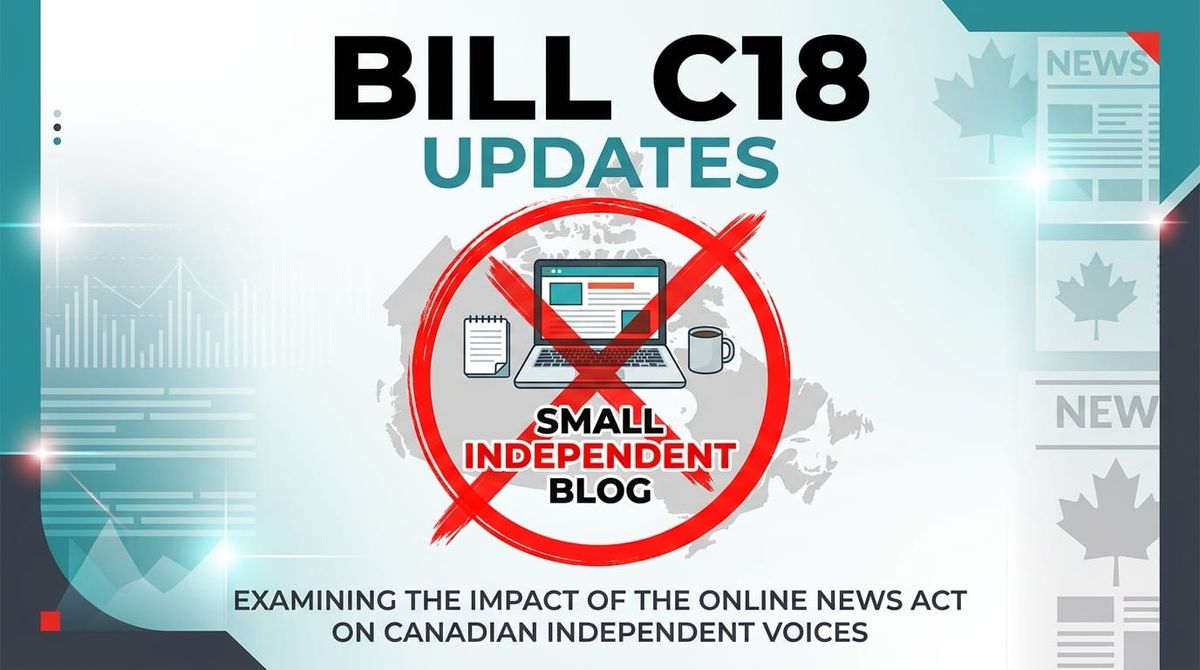
Canada set out to save journalism. Instead, thousands of small, independently owned publishers may have been left standing outside the door.

The story begins with Bill C-18, the Online News Act, introduced under the Trudeau government and receiving Royal Assent on June 22, 2023. The legislation was intended to address the growing power imbalance between Canadian news organizations and enormous digital platforms such as Google and Meta. Its stated purpose included supporting the sustainability of Canadian news businesses—including independent local ones.

On paper, that sounds like exactly what independent publishers needed.

In practice, the results have been much more complicated.

Meta chose not to participate in the system. In August 2023, Facebook and Instagram began blocking Canadian news content and links from being viewed by people in Canada. Meta said it was complying with the legislation and announced that the change would be permanent.

For a major newspaper, losing Facebook traffic is a serious problem.

For a one-person publication, it can be devastating.

Independent bloggers often do everything themselves: reporting, interviewing, photography, writing, editing, website management, social media, advertising, accounting and promotion. Facebook and Instagram were not merely places to post links. They were distribution channels that allowed a small publisher to reach readers who might never have discovered the website otherwise.

Then came the other side of C-18.

Google agreed to contribute $100 million annually, indexed to inflation, to Canadian news organizations through the Canadian Journalism Collective (CJC). In October 2024, the CRTC approved Google's exemption from the bargaining provisions of the Act based on that agreement.

The CJC is now distributing that money. By December 2025, it had distributed more than $96 million to 459 eligible news businesses.

But eligibility matters.

Under Section 27 of the Online News Act, one route to eligibility for an independent digital news business requires it to regularly employ at least two journalists in Canada, among other requirements. The organization must also produce news of public interest, operate in Canada, meet requirements concerning the scope of its coverage and follow recognized journalistic standards or its own qualifying code of ethics.

That creates a fundamental problem for the solo publisher.

A journalist who has spent years building an independent publication may be producing original Canadian journalism every week. But if that publication is operated by one person, it may not meet the statutory threshold.

And there is another irony: when the money is distributed, the regulations link compensation to the number of full-time-equivalent employees producing original news content.

So the smallest publishers face a double squeeze.

Meta took away an important distribution channel. The government's replacement system created eligibility rules that can exclude the very smallest operators.

This isn't an argument against supporting journalism. Quite the opposite.

Canada absolutely needs strong newspapers, broadcasters, Indigenous media, community publications and professional newsrooms. But journalism is not only produced inside large organizations. Some of Canada's most passionate local, cultural, community and niche reporting comes from people who built publications themselves, often without investors, corporate backing or government assistance.

The lesson from C-18 should therefore be bigger than the debate over Google versus Meta.

If Canada wants a diverse journalism ecosystem, it has to include the person working alone at the kitchen table.

Otherwise, we risk building a system designed to save Canadian journalism while unintentionally making it harder for the next generation of independent Canadian publishers to survive.

And that is a problem worth talking about.

Elke Porter at:
Westcoast German Media
LinkedIn: Elke Porter or
WhatsApp:  +1 604 828 8788.
Public Relations. Communications. Education

Let’s bring your story to life — contact me for books, articles, blogs, and bold public relations ideas that make an impact.

TAGS: #CanadianJournalism
#IndependentJournalism
#OnlineNewsAct
#BillC18
#CanadianMedia
#IndependentPublishers

Share this article
The link has been copied!