By Elke Porter | WBN AI | September 21, 2026
Subscription to WBN and being a Writer is FREE!
Picture this: it's 1985, you're wearing acid-wash jeans, your hair could survive a hurricane thanks to sheer chemical willpower, and you're watching a movie about time travel in a car that runs on plutonium. Nobody in that theatre walked out thinking "you know what's actually going to happen? I'll carry a device in my pocket smarter than every computer NASA owned combined, and I'll use it mostly to watch a raccoon eat a tiny burrito." And yet here we are. So the real question isn't whether science fiction predicted the future — it's how it got so much eerily right while completely whiffing on the stuff that actually changed our lives.
Start with the obvious ones. Star Trek's communicator — that flip-open device Kirk barked "beam me up" into — is basically a flip phone with better dialogue. The show's tablet computers, the PADDs, look uncomfortably like an iPad Nichelle Nichols could've reviewed on a keynote stage. The ship's voice-activated computer, the one that just answers questions out loud when you ask it nicely? That's Siri, Alexa, and Google Assistant, thirty years early and with better manners. Even the translator earpiece — instant language conversion — is basically what Google Translate's conversation mode does now, just without the beeping.
Star Wars gets credit for holograms (Leia's "help me, Obi-Wan" message isn't that far off from volumetric video calls being demoed today), for tablets and touchscreens everywhere, and for a galaxy full of autonomous drones doing surveillance and combat work — which, unfortunately, is now just Tuesday for modern militaries. 2001: A Space Odyssey gave us a tablet-reading, video-calling future in 1968, along with HAL, a conversational AI that manages a spacecraft and occasionally has opinions about your plans — which is either uncannily accurate or a little too on the nose given where AI assistants are headed.
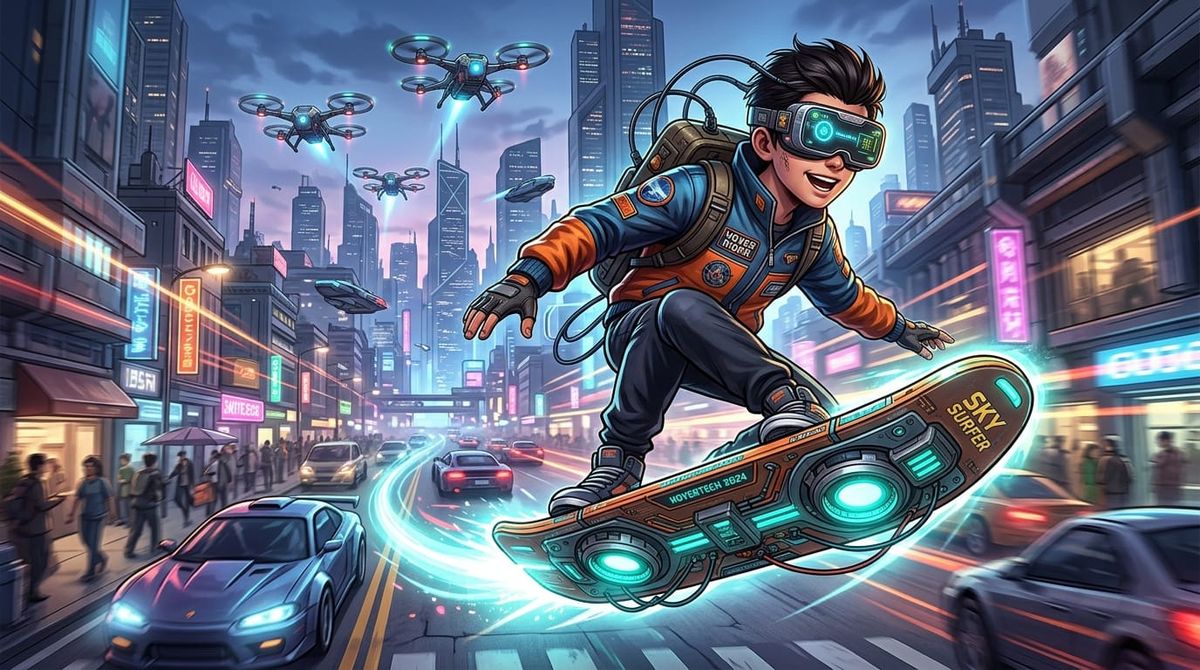
Then there's Back to the Future Part II, the movie that dared to promise us hoverboards by 2015 and delivered, instead, a hoverboard-shaped disappointment that still just rolls on wheels. But before we drag it too hard, give it its due: it nailed video calling as a casual, multi-person household activity, decades before Zoom made "you're on mute" the most spoken sentence of 2020. It predicted wearable tech and hands-free devices, tablet-like screens, and even flat-screen televisions mounted on walls, back when most living rooms still had a TV the size and weight of a washing machine. It also, charmingly, predicted fax machines taking over every surface of daily life, which is the kind of miss that ages like milk — proof that even a film with genuinely good instincts can bet on the wrong horse.
Now, the "predictive programming" theory — that filmmakers were quietly fed real military tech and told to drip it into scripts to soften the public up for what's coming — is a fun conspiracy to entertain over drinks, but the real story is less cloak-and-dagger and more collaborative. The military and intelligence world absolutely has consulted with Hollywood, openly: the Pentagon has long lent equipment and technical advisors to films in exchange for script approval, and DARPA and various futurists have sat down with directors — Steven Spielberg famously gathered technologists and futurists to brainstorm the surveillance and gesture-interface tech in Minority Report, some of which genuinely echoed research already underway in labs. So it's less "secret puppet masters priming your subconscious" and more "sci-fi writers are curious people who ask actual scientists what's coming, then jazz it up with laser swords."
And you're right that the misses are just as telling as the hits. 1980s futurism gave us neon spandex, shoulder pads, and computers with 64kb of memory playing Donkey Kong — nobody in that big-hair era was picturing a pocket device with more computing power than the moon landing, mostly used to argue with strangers online. We imagined bigger, chunkier versions of what we already had — flying cars, robot butlers, fax machines everywhere — rather than the invisible, miniaturized, networked world we actually got.
So what's next that we're not seeing yet? Probably not what today's sci-fi is loudly promising us — teleportation, AI Agents taking over everything, then going on strike, sentient robots battling an existential crises. It's more likely to be the unglamorous stuff: quantum computing quietly breaking encryption before most people know what a qubit is, brain-computer interfaces going from "medical device" to "convenience," and AI systems embedding themselves so deeply into daily infrastructure that, much like electricity, we stop noticing them at all.
Which is the real lesson buried in all this neon-and-laser nostalgia: the future rarely arrives the way fiction imagines it. It's quieter, weirder, and far less interested in giving us the hoverboards we were promised. But every so often, a screenwriter and a scientist have coffee, and thirty years later we're all walking around with a communicator in our pocket, wondering why nobody warned us about the burrito-eating raccoon videos.
Elke Porter at:
Westcoast German Media
LinkedIn: Elke Porter or
WhatsApp: +1 604 828 8788.
Public Relations. Communications. Education
Let’s bring your story to life — contact me for books, articles, blogs, and bold public relations ideas that make an impact.
TAGS: #PredictivePogramming #SciFiPredictions #StarTrek #BackToTheFuture #FutureOfTech #RetroFuturism