By Elke Porter | WBN AI | November 9, 2026
Subscription to WBN and being a Writer is FREE!
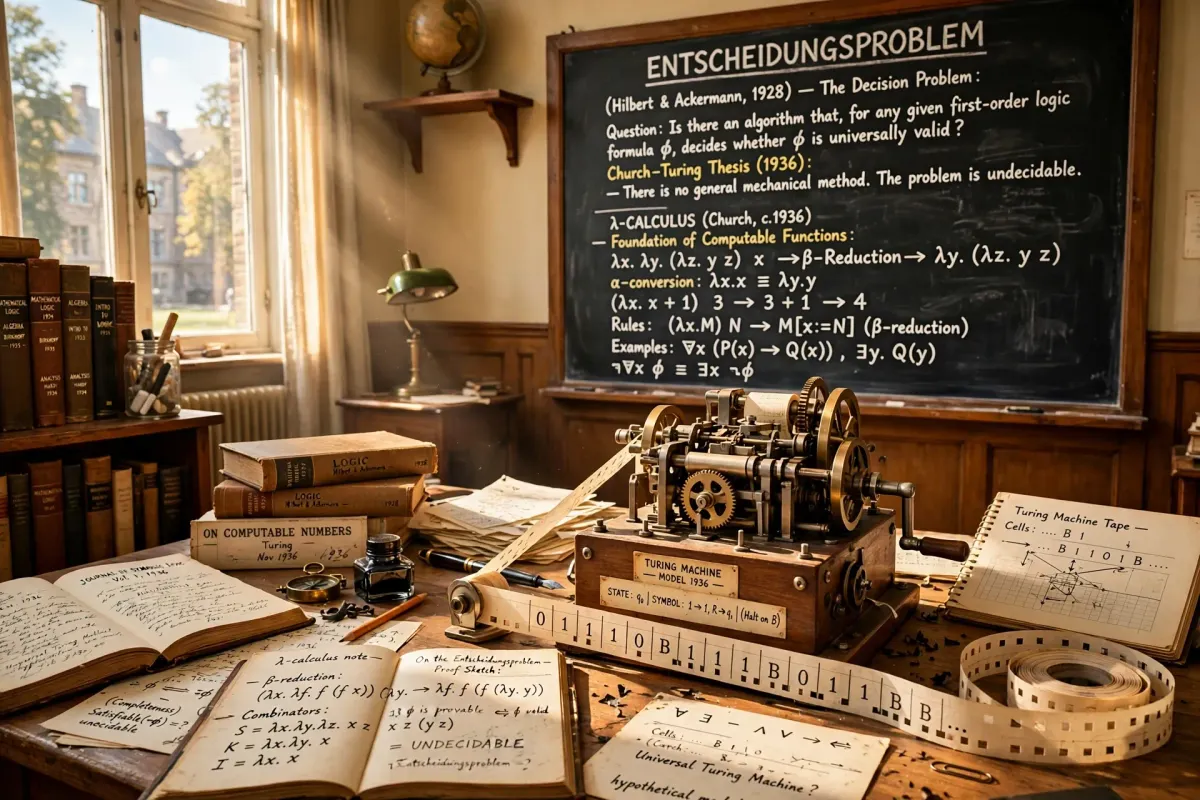
The German mathematician David Hilbert believed mathematics could be made complete and certain. In 1928, with Wilhelm Ackermann, he posed the sharpest question: the Entscheidungsproblem, the decision problem. Could a mechanical procedure decide, for any mathematical statement, whether it was true or false? Hilbert believed the answer would be yes.
The first crack came from an Austrian. Kurt Gödel, a young logician from Vienna, showed in 1931 that no system strong enough for arithmetic can prove every true statement inside it. He built a sentence saying, in effect, “this statement cannot be proved in this system.” If the system proved it, it would be inconsistent; if it did not, the sentence was true and unprovable.
The second answer came from a Brit. Alan Turing, 23 at Cambridge, asked in 1935 what a “mechanical procedure” actually was. His answer: a machine with a long paper tape, a head that reads and writes one symbol at a time, and a short table of rules — the Turing machine. Then he imagined a universal machine that could read the description of any other machine and imitate it — the stored-program computer in embryo. He proved in 1936 that no procedure can decide in advance whether a machine will stop or run forever. If that halting question has no answer, neither does Hilbert’s problem.
The third answer came from an American, at almost the same moment, by a different road. Alonzo Church, a logician at Princeton, had invented the lambda calculus, in which everything is a function and computation is function application. In April 1936 he proved there is no algorithm to decide whether two lambda expressions are equivalent — and from that, that the Entscheidungsproblem has no solution. Turing’s machines and Church’s functions defined exactly the same computable things: the Church–Turing thesis.
So AI did not begin with a computer. It began with a question, a limit, and two definitions of computation. Hilbert asked whether thinking could be mechanised. Gödel showed that even mathematics has limits. Turing gave us the machine that could do anything computable, and Church gave us the language to write its programs. Every computer, and every AI built on one, still lives inside those boundaries.
Elke Porter at:
Westcoast German Media
LinkedIn: Elke Porter or
WhatsApp: +1 604 828 8788.
Public Relations. Communications. Education
Let’s bring your story to life — contact me for books, articles, blogs, and bold public relations ideas that make an impact.
TAGS: #ArtificialIntelligence #AIHistory #AlanTuring #AlonzoChurch #KurtGoedel #DavidHilbert #TuringMachine #Entscheidungsproblem