
Crystal Mirkazemi | WBN News – Vancouver | September 29th, 2026

For decades, one of the most familiar principles in investing has been diversification: own equities for growth, bonds for stability, and allow the two to balance one another through different market environments.

But what happens when bonds no longer provide the same protection they once did?

That question is becoming increasingly important as investors navigate higher interest rates, persistent inflation, rising government debt and a global investment landscape that looks considerably different from the one that shaped traditional portfolio construction.

The answer may not be abandoning traditional assets. Instead, it may be about broadening what diversification means.

Real Returns Matter More Than Nominal Returns

One of the most important concepts for investors today is the distinction between a nominal return and a real return.

A bond may offer an attractive stated yield, but the investor's true purchasing-power return depends on inflation.

Consider a simplified example.

If a five-year Treasury bond yields 5% and inflation averages 2.5% over that period, the approximate real return would be 2.5%.

Inflation-protected securities, such as U.S. Treasury Inflation-Protected Securities—or TIPS—approach the equation differently. Their principal value adjusts with inflation, allowing investors to focus more directly on the real yield they are receiving.

This creates an important concept known as the inflation breakeven rate.

If inflation over the investment period ultimately comes in above the market's breakeven expectation, inflation-protected securities can become relatively more attractive. If inflation comes in below that level, traditional nominal bonds may perform better relative to them.

In other words, investors are not simply asking:

"Where will interest rates go?"

They are increasingly asking:

"What will inflation look like over the next several years?"

That distinction matters.

Why the Bond Market Is Receiving So Much Attention

Bond yields also have implications far beyond investment portfolios.

They affect mortgages, corporate borrowing, government financing costs and ultimately the broader economy.

One framework for thinking about government debt sustainability is relatively straightforward: over long periods, an economy ideally needs to grow fast enough relative to the cost of servicing its debt.

If borrowing costs rise substantially faster than economic growth, the mathematics become more difficult. That does not mean a particular level of government debt automatically becomes unsustainable. Debt sustainability depends on numerous factors, including economic growth, inflation, government revenues, fiscal policy, maturity structure and financing costs.

But rising real yields increase the importance of the conversation.

The challenge becomes particularly interesting when long-term Treasury yields rise even when central banks are not actively increasing short-term policy rates.

The bond market can effectively impose tighter financial conditions on its own.

Can Governments Influence Long-Term Rates?

Governments and central banks do have tools that can influence different parts of the bond market.

For example, a Treasury could adjust the types of securities it issues or repurchases, while a central bank can alter its balance sheet or reserve-management policies.

The discussion referenced a strategy similar to Operation Twist, in which policymakers influence the maturity composition of government debt by buying longer-term bonds while selling or allowing shorter-term securities to mature.

The objective is not necessarily to change the total amount of government debt, but rather to influence financing conditions across different maturities.

However, markets are enormous.

Small interventions may have limited impact when compared with the size and liquidity of the global Treasury market. Ultimately, investors continuously reassess the compensation they require for inflation risk, duration risk and fiscal uncertainty.

That is why the bond market can remain such an influential force.

The Problem With Assuming Bonds Will Always Protect Stocks

Traditional balanced portfolios were often constructed around an assumption that bonds could cushion equity-market declines.

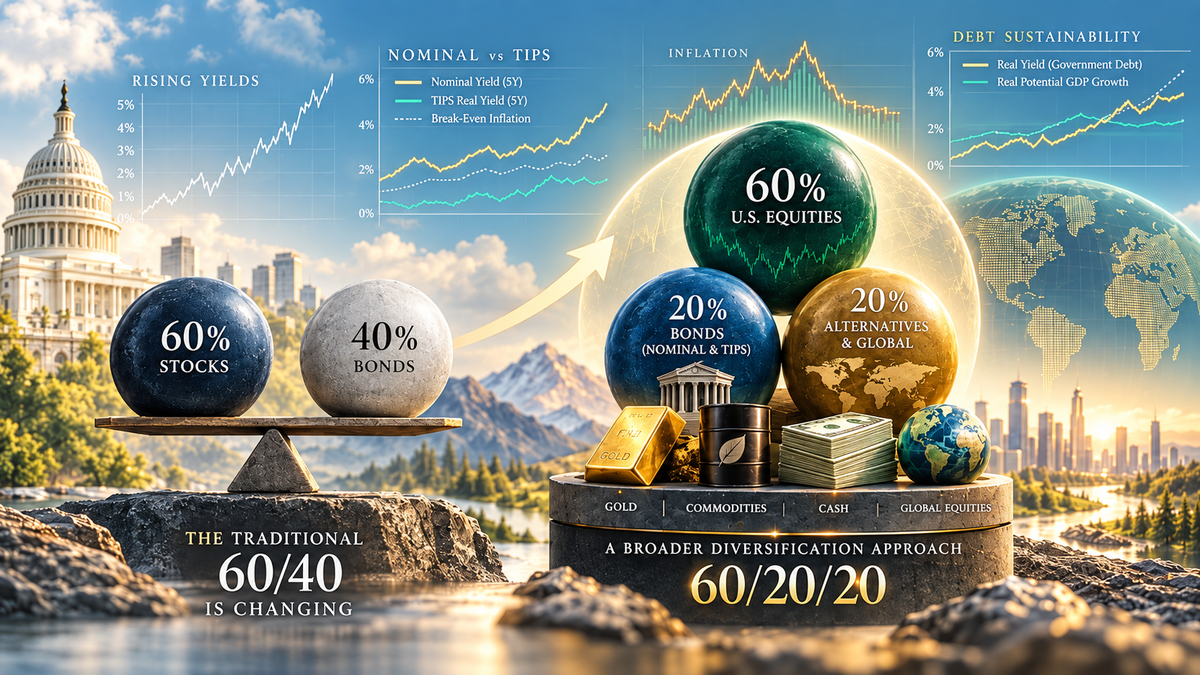
The classic example is the 60/40 portfolio: roughly 60% equities and 40% bonds.

That relationship is not guaranteed.

In 2022, investors experienced a particularly uncomfortable environment in which both stocks and bonds declined significantly at the same time. When inflation becomes one of the dominant economic risks, interest rates may rise while equity valuations simultaneously come under pressure.

In that environment, the asset traditionally expected to protect the equity portion of a portfolio can instead contribute to its volatility. That is one reason investors are increasingly discussing portfolios that go beyond a simple stock-and-bond allocation.

From 60/40 to 60/20/20

One framework discussed was a hypothetical 60/20/20 allocation.

Rather than holding approximately 60% equities and 40% conventional bonds, the portfolio could retain an equity allocation while reducing traditional fixed income and introducing an additional diversification sleeve.

That additional allocation might include exposures such as:

  • inflation-protected securities;
  • commodities;
  • gold;
  • cash or short-duration securities;
  • high-yield or floating-rate debt;
  • international equities;
  • emerging markets; and
  • other real or diversifying assets.

This is not a universal portfolio recommendation. The appropriate allocation depends on the investor's objectives, risk tolerance, time horizon, liquidity requirements and circumstances.

The broader principle is what matters: Diversification is not simply owning more investments. It is owning assets that respond differently to different economic environments.

International Markets May Matter More

Another important theme is the changing opportunity set outside the United States.

For many years, U.S. equities—particularly large technology companies—dominated global market performance.

More recently, international equities, commodities and other areas of the market have periodically become more competitive.

That raises an important portfolio-construction question. If leadership rotates between countries, industries and asset classes, investors who are excessively concentrated in what performed best during the previous cycle may be less prepared for the next one.

Diversification therefore becomes less about predicting the next winning market and more about maintaining exposure to several possible sources of return.

Measuring Diversification Through Risk-Adjusted Returns

One way investment professionals evaluate an asset is through its Sharpe ratio, a measure that compares return with the amount of volatility taken to achieve it.

Different investments can produce dramatically different Sharpe ratios across different market environments. A portfolio combining assets with imperfect correlations may therefore produce a more attractive risk-adjusted outcome than simply concentrating in whichever asset currently has the highest return.

The important word is combining.

The goal is not necessarily to find one perfect investment. It is to construct a portfolio in which different components have different jobs.

Some may provide growth. Some may generate income. Some may respond positively to inflation. Others may provide liquidity or potentially reduce portfolio volatility.

Real Assets and the Role of Optionality

Assets such as gold, commodities and—in some portfolio discussions—Bitcoin are also increasingly considered within the broader debate around monetary policy and real assets.

These assets behave very differently and carry very different risks, so they should not automatically be grouped together.

However, the common argument behind including certain real or scarce assets is optionality.

If the financial system eventually returns to an environment in which real interest rates are suppressed or inflation becomes more persistent, assets outside traditional stocks and nominal bonds may behave differently.

That potential diversification benefit is what investors are examining.

The Bigger Lesson: Diversification Must Evolve

Perhaps the most important message is that portfolio construction cannot remain static while the economic environment changes.

The relationships between inflation, interest rates, equities, bonds, currencies and commodities evolve over time.

A strategy that worked exceptionally well during decades of declining inflation and falling interest rates may behave differently during a period characterized by larger fiscal deficits, higher real yields and changing global capital flows.

That does not mean abandoning stocks or bonds.

It means understanding why each investment is in the portfolio. A thoughtful portfolio should not depend entirely on one economic outcome. Instead, it should be positioned so that different assets can contribute under different conditions. Ultimately, diversification is not about predicting exactly what happens next. It is about being positioned for more than one possibility.

This article is for educational purposes only and is not intended as investment advice. Investment strategies should be considered in relation to an individual's objectives, risk tolerance, time horizon and financial circumstances.

Article #047

Crystal Mirkazemi | WBN News – Vancouver

My mission is to empower you to think big and build solutions for your family and business. Every milestone of life's journey is a chance to appreciate a financial plan. As I always say: Your most significant asset to be independent lies in your attitude towards money.

LinkedIn: https://www.linkedin.com/in/crystalmirkazemi/

Contact me here: wbn.cwc@gmail.com

Tags: #WBN News Vancouver #Crystal Mirkazemi #Disciplined Thinking #Build With Purpose #Financial Clarity #Timeless Principles #Intentional Living #Strategic Thinking

Share this article
The link has been copied!