By Elke Porter | WBN News Vancouver | August 17, 2026
Subscription to WBN and being a Writer is FREE!

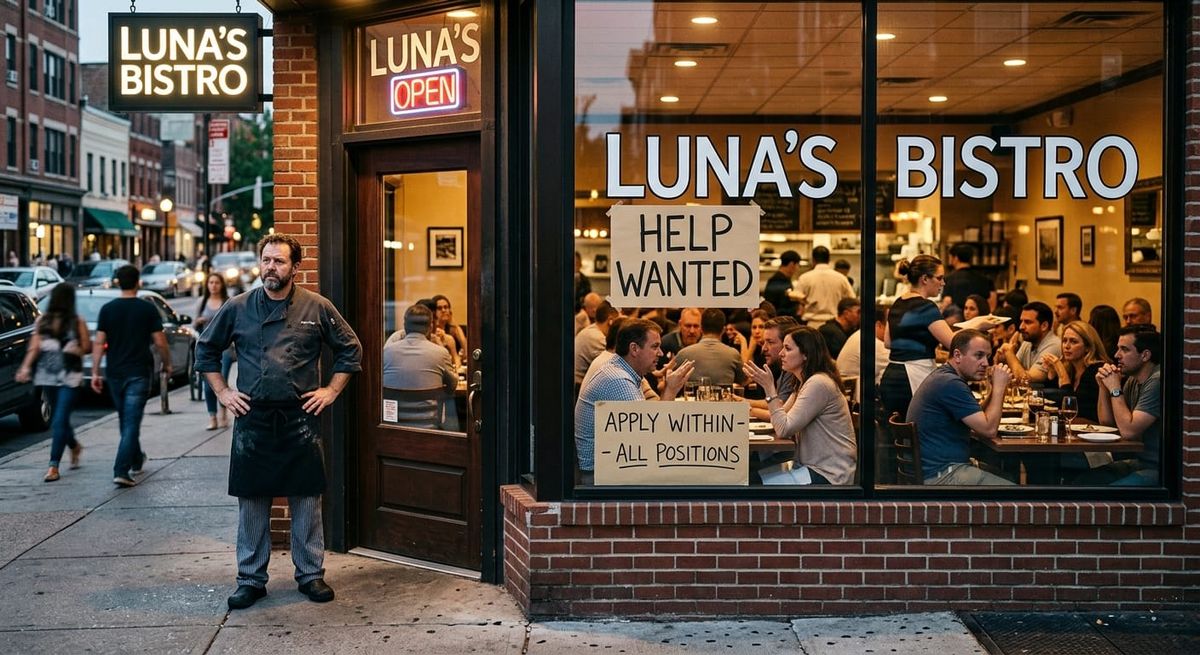
Every restaurant owner has said it at least once this year: "We can't find good staff." Help-wanted signs sit in windows for months. Shifts go unfilled. Menus get trimmed because there simply aren't enough hands in the kitchen or on the floor.

But talk to the people who've actually worked the floor, and the mystery disappears fast. It isn't that nobody wants to work — it's that the job, as it's currently structured, asks for more than most people are willing to give for what it pays back. A friend who has spent years serving tables agreed to walk me through what the job actually looks like from the inside. Here's what she told me.

1. The Schedule Never Lets You Rest

Split shifts are common: close the restaurant late one night, then be back to open it again the next morning. There's barely enough time to get home, sleep, and turn around — let alone have any kind of evening.

2. "We Need You to Stay" Isn't a Request

When a coworker calls in sick, there's often nobody to replace them. So the shift you were supposed to work turns into a double, worked back-to-back with no real say in the matter, because if you leave, the restaurant simply doesn't run.

3. New Management, New Chaos

Managers turn over more often than you'd expect, and each one takes time to learn how to actually run a floor. Until they do, servers get stuck with either too many tables to handle properly or too few to make any real money — and either way, it's the server who eats the consequences of a manager still finding their footing.

4. Time Off Is a Privilege You Have to Beg For

Officially, two weeks' notice gets you a day off. In practice, that request often comes back with a catch: find someone to cover your shift yourself, or you're not getting the day. That's how servers end up missing weddings, birthdays, family milestones — even events they already bought tickets for — because the system treats their personal life as optional.

5. No Breaks, Full Stop

No bathroom break. No time to eat. No moment to sit down. An entire shift on your feet, moving, with your body's basic needs treated as something to work around rather than something the job accounts for.

6. You Can't Even Eat the Mistake

If a kitchen error sends out a dish nobody ordered, servers often aren't allowed to eat it in the back — the logic being that letting them would create an incentive to "accidentally" order extra food. So a perfectly good plate gets thrown out while the person serving it goes hungry.

7. Your Tip Isn't Really "Their" Tip

Customers who leave 20% assuming it goes straight to their server are often only partly right. That tip frequently gets split — among the hostess, support staff, kitchen staff, and in some cases the restaurant owner. The generous tip a customer feels good about leaving may end up as a much smaller amount in the hands of the person who actually served them.

8. Blamed for the Kitchen, Charged for the Blame

If food comes out wrong or late because of a kitchen mistake, it's often the server who takes the hit in the form of a smaller tip — or no tip at all. And here's the part that surprises most people: even with no tip in hand, servers may still be required to "tip out" a share to the kitchen and support staff, effectively paying out of pocket for a shift that already didn't pay them fairly.

9. No Way to Plan a Life

Schedules typically come out only two weeks in advance, which makes it almost impossible to commit to anything further out — a trip, a class, a standing plan with friends. Life has to be built around a schedule that barely gives you time to build it.

10. Unpredictable Pay

Because so much of a server's income depends on tips, earnings swing wildly based on factors entirely outside their control. A generous crowd on a Friday night might mean a great shift; a slow Tuesday or a table of bad tippers can mean hours of hard work for very little pay. There's no floor to fall back on when the room isn't in a tipping mood.

11. Blamed for Things You Didn't Do

Servers are often the first — and sometimes only — target for customer frustration, even when the real cause is something entirely out of their hands: a slow kitchen, an item that's out of stock, or menu prices they didn't set. They're the face of the restaurant, which means they absorb the anger meant for the business as a whole.


Put all eleven of these together, and the labour shortage stops looking like a mystery. It's not that people don't want to work in restaurants — it's that the job, as currently built, demands round-the-clock availability, physical endurance, and a tolerance for financial unpredictability, all while offering very little control or stability in return. Fix enough of these, and the "nobody wants to work anymore" problem might just solve itself.

Then there's a harder edge to this story that's worth naming directly. The conditions described above — unpredictable hours, dependency on management's goodwill for time off, workers who can't easily walk away — sit on a spectrum, and at the far end of that spectrum is labour trafficking.

Restaurants and other service industries are among the settings where labour trafficking has been documented in BC, and migrant workers are especially vulnerable — limited language skills, social isolation, immigration status tied to a single employer, and debt owed to recruiters can all make it harder for someone to leave a bad situation, even an abusive one.

The BC Restaurant and Foodservices Association took this seriously enough to offer its members trafficking-awareness training ahead of the FIFA World Cup 2026, in partnership with the Human Trafficking Prevention Network of BC, specifically to help hospitality staff recognize and respond to trafficking situations during the expected surge in visitors.

Most servers dealing with a bad schedule or a shorted tip-out aren't trafficking victims — that distinction matters, and conflating the two would do a disservice to people experiencing actual coercion. But the same industry conditions that make it hard to say no to a manager are exactly the conditions traffickers exploit when there's no floor left to fall through. An industry serious about fixing its staffing crisis has to be serious about that end of the spectrum too, not just the exhausting-but-legal end

Of course restaurants owners would say that this is the way it has to be or we can't run our restaurants.

So, what this means is that the business model is broken and something new has to take its place — a model where staffing a shift doesn't depend on guilt-tripping someone out of their sister's wedding, and where a paycheck doesn't rise or fall on a stranger's mood. Other countries run restaurants profitably with livable base wages and real breaks; the excuse that it "has to be this way" is really an admission that the industry has never been forced to try anything else. Until it is, the staffing crisis isn't a mystery restaurants are suffering through — it's a bill finally coming due.

Sources referenced for additional context: YouTube discussion on restaurant service work, Facebook post on serving experiences, Elite Daily: "Why Waiting Tables Is The Worst Possible Job For Generation Y"

TAGS: #RestaurantLife #ServerProblems #TipTheServer #RestaurantIndustry #HospitalityWorkers #StaffingCrisis

Share this article
The link has been copied!