By Elke Porter | WBN News Global | November 3, 2026
Subscription to WBN and being a Writer is FREE!
Governments across Europe have updated their civil-defence advice, urging households to keep food, water, medicine and other essentials on hand. Viral posts and videos claim that 16 countries, including Ireland, Germany and France, have been "told to prepare for war." Officials describe the guidance differently: as general resilience planning against armed conflict, cyberattacks, blackouts and natural disasters, not as a notice of imminent war. Citizens are asking, why is this suddenly appearing out of the blue?
The EU Sets a 72-Hour Benchmark
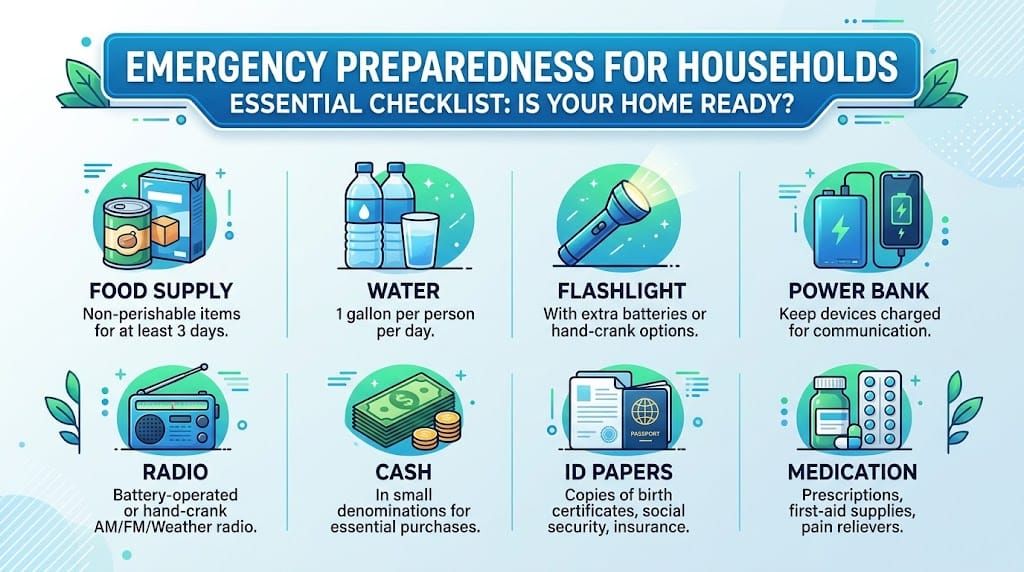
The European Commission launched its Preparedness Union Strategy in March 2025. The strategy recommends that the EU's roughly 450 million residents keep enough supplies to last at least 72 hours. It lists natural disasters, cyberattacks and geopolitical crises, including possible armed aggression against member states, among the risks. Commissioner Hadja Lahbib named food, water, a flashlight, a power bank, a radio, cash, ID papers and medication as key items. The plan also calls for preparedness lessons in schools and an EU-wide stockpiling strategy.
Individual Countries Go Further
Several national governments have issued their own guidance. Germany's crisis brochure advises households to hold supplies for up to 10 days, and Bloomberg has reported that the country is preparing hospitals for wartime needs. Sweden mailed five million pamphlets to residents in late 2024, covering scenarios up to a nuclear attack. France, Finland and Norway have also published updated guides. In Ireland, a militarily neutral country, the EU advice has renewed debate about national readiness. In Britain, Defence Secretary Wes Streeting warned in late October that adversaries could be in a position to attack by 2030, giving the country "a little over 1,000 days" to be ready to fight alongside its allies, a planning deadline rather than a forecast of war.
What About Canada and the United States?
North America has not seen a comparable wave of new announcements, and neither government has issued a war-specific advisory. Both countries, however, run long-standing preparedness programs. Public Safety Canada's "72 Hours: Is Your Family Prepared?" campaign, launched in 2006, asks Canadians to cope on their own for at least three days. In the United States, FEMA's Ready.gov, launched in 2003, recommends a kit with food, water and medicine for several days.
Local institutions report little change. When this reporter asked staff at a local bank branch about the European advisories, they said they had heard nothing about them.
The Digital Threat
Cyber risk features in every preparedness plan. Cybersecurity firm CrowdStrike's 2026 Global Threat Report describes an "evasive adversary" who uses AI to accelerate attacks and turns AI itself into a new attack surface. Its key findings:
- 27 seconds: fastest eCrime breakout time on record
- 89% increase in attacks by AI-enabled adversaries
- 42% increase in zero-day vulnerabilities exploited before public disclosure
- 40% of vulnerabilities exploited by China-nexus threat actors targeted edge devices
- 266% increase in cloud-conscious intrusions by state-nexus threat actors
The risk has already moved from screens to store shelves. Overnight on October 11 to 12, hackers took remote control of internet-connected refrigeration controllers at hundreds of supermarkets across France and forced fridges and freezers into extended defrost cycles at temperatures up to 50°C. Intermarché, E. Leclerc and Coopérative U confirmed the attack, which spoiled food worth millions of euros and sparked fires in some stores. The Paris prosecutor's office opened an investigation, and analysts at the security firm Sekoia warned that similar vulnerable controllers operate in Spain, Portugal, Poland, Germany and Belgium.
Banks face the same pressure. Attackers target financial institutions for their money and data, often through the suppliers they depend on. In April 2026, the Bank of Canada and the country's largest banks met to assess cyber risks raised by an advanced new AI model from Anthropic, and in October the Office of the Superintendent of Financial Institutions (OSFI) warned that frontier AI can amplify cyber and third-party risks for Canadian lenders. The European Central Bank ordered the 110 banks it supervises to file AI cyber-risk action plans by October 31. OSFI also stressed that Canada's financial system remains resilient, backed by strong capital and risk management. Even so, a successful attack could interrupt card payments or online banking, which is why preparedness lists recommend keeping some cash at home.
What It Means for Households
Emergency managers on both sides of the Atlantic give the same basic advice: know the local risks, make a household plan and keep enough supplies to manage on your own for at least three days. And keep some cash on hand!
Elke Porter at:
Westcoast German Media
LinkedIn: Elke Porter or
WhatsApp: +1 604 828 8788.
Public Relations. Communications. Education
Let’s bring your story to life — contact me for books, articles, blogs, and bold public relations ideas that make an impact.
TAGS: #EmergencyPreparedness #CivilDefence #Germany #Ireland #France #Canada #Cybersecurity #CrowdStrike #72Hours